
Forbes Africa – June-July 2026
Summary
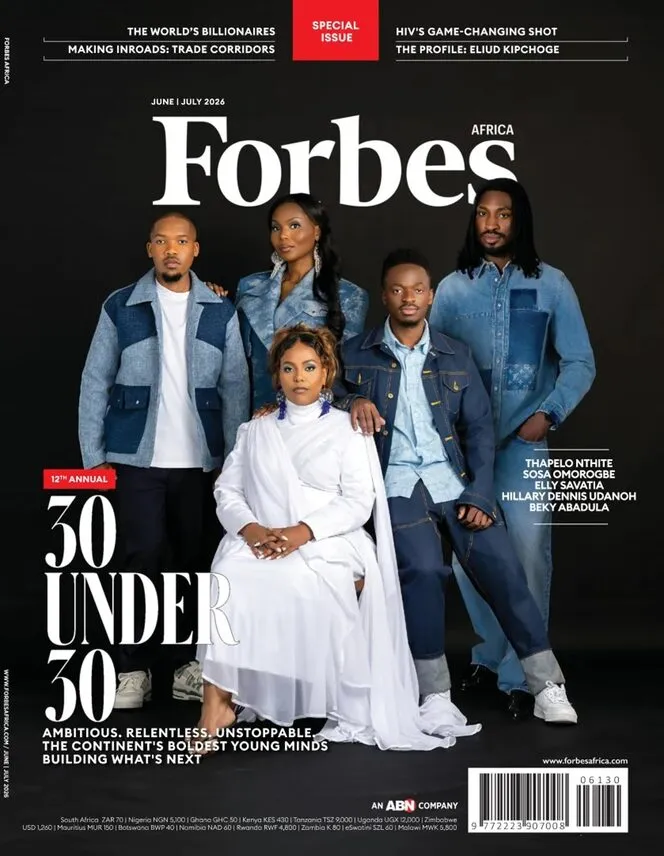
Forbes Africa names 50 rule-breakers under 50 in 2026 — ambitious young leaders reshaping the continent's business, music, and technology sectors against a backdrop of trade-corridor realignment.
June/July 2026 (volume 16, number 3) opens with the cover story "50 Under 50: The Rule-Breakers Of 2026" (p.30) by Chanel Retief. The profile "From Reading To Readiness" (p.56) follows Nicole Pillay into a literacy startup that has reached 120,000 children across South Africa. Upfront pieces cover "The Nairobi Narrative" (p.8) on Kenya's startup ecosystem and "Trade Corridors: The Long Road to Open Markets" (p.18) on the African Continental Free Trade Area implementation. "Taking A Shot" (p.24) asks whether Africa is closer to ending AIDS. Sports section "Chasing Greatness" (p.94) profiles Eliud Kipchoge's marathon legacy and his global running program. The New Billionaires list (p.68) tracks Africa's newest entrants to the three-comma club. CEO Strategies features an argument that Africans must dominate their own economic landscape (p.72). Forbes Life covers electric vehicle adoption in "Fuel For Change" (p.76).
Renuka Methil opens with an Editor's Note titled "AI Before ABC." The issue balances hard economic reporting with cultural and sports content that reflects Africa's diversified readership.
—————
Content Guide
▸ Cover Story
p.30 · 50 Under 50: The Rule-Breakers Of 2026
Chanel Retief profiles 50 Africans under 50 who are building businesses, shaping music, and leading technology ventures. The list spans fintech founders in Lagos, agri-processors in Nairobi, and amapiano producers in Johannesburg. Venture investors can use the sector-tagged profile for scout targets.
▸ Upfront / Policy
p.8 · The Nairobi Narrative
Paula Slier reports on Nairobi's startup ecosystem maturation. The article cites $1.2 billion in venture funding flowing to Kenyan startups in 2025, with fintech taking 55 percent of the total.
p.18 · Trade Corridors: The Long Road To Open Markets
Freddie Hiney tracks the AfCFTA implementation, flagging that only 12 of 55 member states have ratified the full protocol. Logistics operators can use the ratification table to prioritize customs-clearance investments.
p.24 · Taking A Shot: Is Africa Closer To Ending AIDS?
Oluwatomisin Amokeoja reports on long-acting injectable PrEP roll-out across sub-Saharan Africa. The article cites a 73 percent reduction in new infections in trial sites in South Africa and Uganda.
▸ The Profile
p.56 · From Reading To Readiness
Nicole Pillay profiles a literacy startup that has distributed 120,000 books to early-grade learners in underserved South African communities. The operating model uses retired teachers as reading coaches, keeping per-child cost under $15 annually.
▸ CEO Strategies
p.72 · Africans Must Dominate Their Own Economic Landscape
Oluwatomisin Amokeoja argues that African institutional capital should lead infrastructure and industrial funding rather than waiting for foreign direct investment. The piece cites the Africa Finance Corporation's $2.3 billion project pipeline as a model.
▸ Sports
p.94 · Chasing Greatness
Freddie Hiney profiles Eliud Kipchoge at 42, discussing his marathon career and his global running program that has started 500 community running clubs in 30 countries.
▸ Forbes Life
p.76 · Fuel For Change
Nafisa Akabor reviews electric vehicle adoption in South Africa. The article lists 12 EV models available locally and compares charging infrastructure across Johannesburg, Cape Town, and Durban.
—————
Editor's Take
This is a well-balanced issue that deserves credit for avoiding the usual "Africa rising" cliches. The 50 Under 50 list is genuinely diverse — not just tech founders but also musicians, farmers, and educators. The trade-corridors piece is the most useful article for business readers: it names which countries have ratified AfCFTA and which have not, making it a practical reference for logistics planning. The weakest content is "Fuel For Change," which reads like a sponsored section for EV brands. The Kipchoge profile, while inspiring, adds nothing to what has been written about him in a dozen other magazines. Still, for anyone tracking African business talent under 50, this issue delivers a scouting report worth the cover price.
Strengths
• Trade Corridors AfCFTA ratification table for logistics planning
• Literacy startup per-child cost model replicable across Africa
• 50 Under 50 list spans sectors beyond tech
Weaknesses
• Fuel For Change EV piece reads as sponsored brand content
• Kipchoge profile covers well-trodden ground with no new angles
Verdict: Recommended — The trade-corridor analysis and 50 Under 50 list make this a solid mid-year issue for Africa-focused investors.
