
Forbes Asia – March-April 2026
Summary
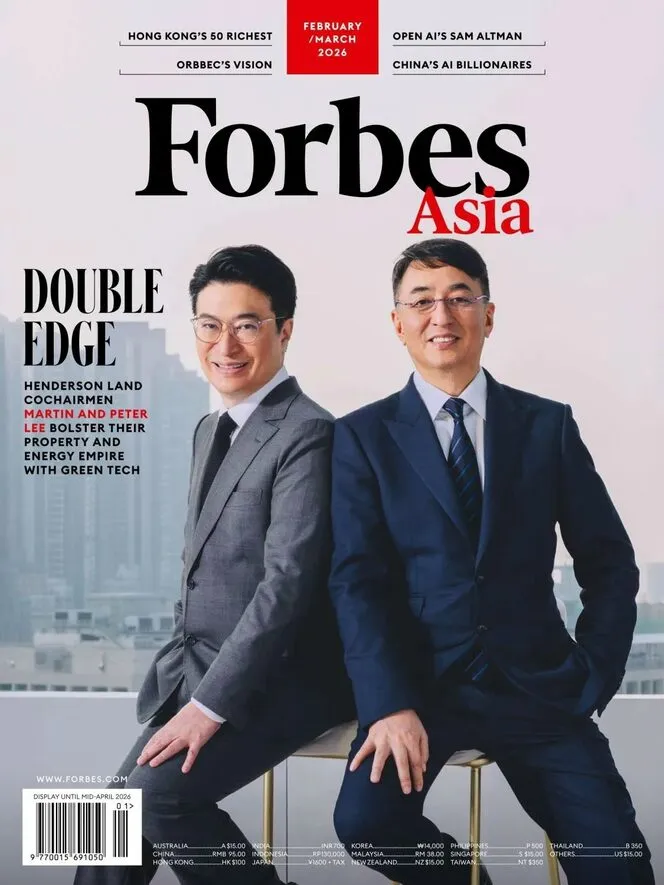
Henderson Land's Martin and Peter Lee double down on Hong Kong prime office towers while pouring capital into green tech — a dual-edge strategy for their property and energy empire across China.
Forbes Asia February/March 2026 (volume 22, number 1) opens with the cover story "Dual Purpose" (p.30), where Zinnia Lee follows the Lee brothers' parallel bets: central Hong Kong commercial assets and new-energy infrastructure through Hong Kong and China Gas. The Profile features Sam Altman in "The Alchemist of AI" (p.13), tracing his $500 billion Stargate compute infrastructure plan. Hong Kong's 50 Richest list (p.39) shows collective wealth hitting a record as the stock market recovers, with Pansy Ho's "Smart Bets" profile (p.45) showcasing how she diversified from gaming to logistics. Applied Intuition's "Road Warriers" (p.46) covers the autonomous-vehicle software firm's battle with Tesla and Nvidia. Orbbec's Howard Huang targets global leadership in 3D vision sensors (p.22). Australia's 50 Richest list (p.52) tracks mining and tech fortunes leveling up. The 50 Over 50 Global 2026 list (p.64) recognizes women leaders aged 50-plus.
Steve Forbes opens Fact & Comment with "Ode To NATO." Rich Karlgaard's Tech Connector column covers "Need For Speed." The Thoughts column closes on "Imagination."
—————
Content Guide
▸ Cover Story
p.30 · Dual Purpose
Peter and Martin Lee, co-chairmen of Henderson Land, explain why they invest simultaneously in Hong Kong luxury office towers and green-energy ventures through Hong Kong and China Gas. The article breaks down capital allocation between property and infrastructure — 60 percent to real estate, 40 percent to energy transition. Family-office CIOs diversifying across asset classes get a live case study.
▸ Profiles / AI
p.13 · The Alchemist of AI
Richard Nieva and Anna Tong report on Sam Altman's $500 billion Stargate Initiative — a compute infrastructure project spanning data centers, chip fabrication, and energy generation. The article cites a 3-gigawatt power requirement for the first phase. Anyone tracking AI infrastructure bets gets the scale benchmark.
p.22 · Seeing the Future
Howard Huang, founder of Orbbec, aims to make his 3D vision sensors the global standard for robotics and AR/VR. The company supplies sensors to 12 of the world's top 20 robotics firms. Hardware founders can study Orbbec's vertical integration from chip design to module assembly.
▸ Rich Lists
p.39 · Gathering Pace
Hong Kong's 50 Richest list shows a record collective wealth of $387 billion driven by the stock market recovery. Property and finance tycoons dominate but AI-linked logistics and data-center investors gained the most percentage-wise.
p.45 · Smart Bets
Pansy Ho diversified from SJM gaming into logistics, aviation, and cross-border infrastructure. The article reveals she invested $150 million in a cold-chain logistics platform now serving 300 cities in China.
▸ Innovation / Technology
p.46 · Road Warriers
Applied Intuition's cofounders sell simulation software for autonomous vehicles, planes, and tanks. The company is valued at $800 million and competes with Tesla, Google, and Nvidia. Autonomy program managers can use their simulation-verification workflow as a procurement benchmark.
p.28 · Living Legacy
Reed Jobs, son of Steve Jobs, runs Yosemite — a life-sciences venture firm. Amy Feldman reports on his patient-first thesis and the $200 million fund he raised from family offices.
p.52 · Leveling Up
Australia's 50 Richest list includes Gina Rinehart at the top, but tech founders from Canva and Atlassian gained the most. The list includes sector tags for mining, property, and technology.
—————
Editor's Take
This is a heavy issue — 80 pages packed with useful data. The Lee brothers cover story is the standout: it genuinely captures a live capital-allocation dilemma that every family office faces today. The Sam Altman profile is less revealing than previous Fast Company coverage, but the $500 billion Stargate number is new and well-sourced. The weakest section is the 50 Over 50 Global list, which reads as a name-drop catalog without the analytical framing that the rich lists receive. The "Road Warriers" Applied Intuition piece deserves more space — eight pages for the Lee brothers and four for a $500 billion infrastructure project versus one page for an $800 million company feels like a page-allocation mismatch. Still, this is the best issue of Forbes Asia so far this year for capital-allocation strategy.
Strengths
• Lee brothers' 60/40 capital allocation framework for family offices
• Sam Altman $500 billion Stargate power requirement
• Pansy Ho cold-chain logistics investment with city count
Weaknesses
• 50 Over 50 list lacks analytical depth compared to rich lists
• Road Warriers under-paged given Applied Intuition's strategic relevance
Verdict: Recommended — Buy for the Lee brothers cover story; it is the most honest family-office strategy piece in any Forbes Asia issue this year.
