
Forbes Middle East English Edition – March 2026
Summary
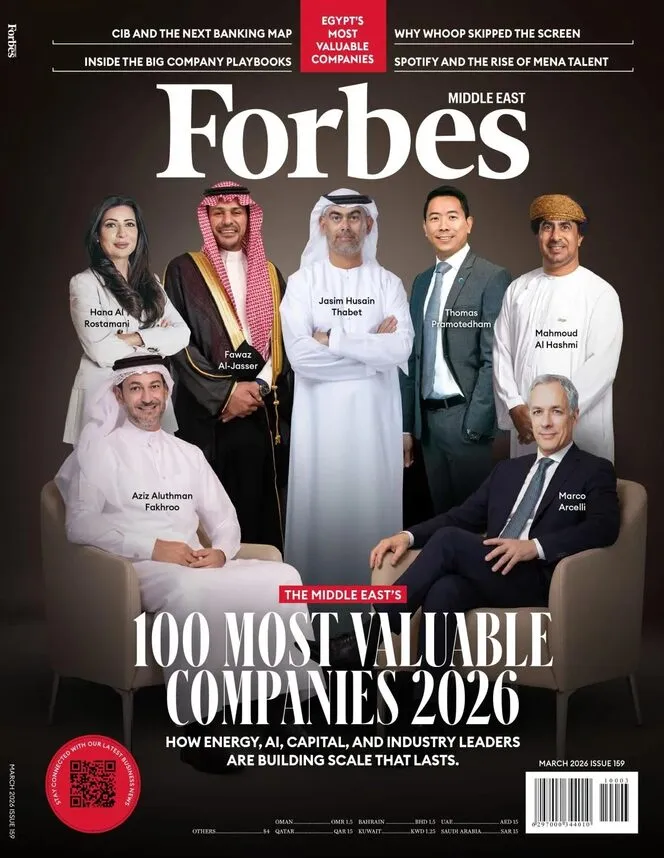
In March 2026, Forbes Middle East ranks the region's 100 most valuable companies — with Saudi Aramco, e&, and Al Rajhi Bank leading a $4.3 trillion stock market measured for scale that lasts.
This 96-page issue opens with Ahmad O. Al-Khowaiter's discipline on live operations at Saudi Aramco, where AI decisions stop before they touch an asset. Muneera Al Marzoqi takes autonomous mobility out of test mode at Space42, while CIB routes its digital bank through a single ADGM holding company. The cover feature (p.40) tables the Middle East's 100 Most Valuable Companies 2026, backed by Egypt's 50 Most Valuable Companies on p.62 and a full dissection of who controls the region's $4.3 trillion market. Contrarian voices argue WHOOP has been solving the wrong wearable problem, Spotify expands across MENA without guaranteeing local creative economies, and Gulf governments embed AI as critical national infrastructure.
Regular sections frontrun operations, autonomy, and offshore banking logic before pivoting to FORBESLIFE with Aston Martin's open-top masterpiece, Lamborghini's refusal to go fully electric, and the Road Warriers feature on Applied Intuition's $800 million autonomy bet against Tesla and Nvidia. Each piece includes hard operational detail — the kind a CFO or strategy officer can use Monday morning. The editor Mark Evans opens by arguing what carries weight, not what is new.
—————
Content Guide
▸ Cover Feature / Lists
p.40 · The Middle East's 100 Most Valuable Companies 2026
Forbes Middle East's annual ranking strips the region's biggest public firms to enterprise value. The top 100 cross oil, telecoms, and banking with a combined market that touches $4.3 trillion. Use the list to benchmark acquisition targets or peer-group your own board against the Fahd Al Rasheed and Abdulaziz Alhumaidan bracket.
p.61 · Inside the Middle East's $4.3 Trillion Stock Market And Who Controls It
A companion piece to the main ranking, mapping ownership concentration across Gulf exchanges. Sovereign wealth funds hold the largest blocks in 34 of the top 50. Investors should cross-check their portfolio exposure against the concentration risks flagged here.
p.62 · Egypt's 50 Most Valuable Companies 2026
A standalone sub-ranking of Egyptian public companies. CIB, EFG Hermes, and Commercial International Bank top the list. Anyone scouting North African entry points gets a ready-made shortlist.
▸ Frontrunner / Operations
p.12 · Live Operations
At Saudi Aramco, Ahmad O. Al-Khowaiter decides which AI technologies enter live operations and which are blocked before they touch physical assets. The article walks through the gating process any energy-sector CTO can replicate for industrial AI deployment.
p.16 · Making Autonomy Work
Space42's Muneera Al Marzoqi moves autonomous vehicles from test tracks to daily revenue routes in Abu Dhabi. She names regulation, cost-per-mile, and reliability as the three filters that kill 80 percent of pilot programs before scale.
p.18 · Offshore Logic
CIB runs its digital bank through a single ADGM holding company rather than licensing market by market. The structure saves an estimated 40 percent in regulatory overhead across five target countries.
▸ Contrarian / Technology
p.30 · Why WHOOP Thinks Wearables Have Been Solving The Wrong Problem
WHOOP argues that data collection was never the bottleneck — actionable interpretation was. The piece presents their signal-to-noise ratio framework, which product managers building health-tech features can apply directly to user-facing analytics.
p.66 · Music, Without Borders — Spotify And The Rise Of MENA Talent
Spotify's MENA expansion reaches distribution milestones, but Samar Khouri asks whether global platforms build durable creative economies or just scale access. Record-label founders should read this before signing exclusive streaming deals.
p.68 · The AI State: How Gulf Governments Turned Artificial Intelligence Into Critical Infrastructure
UAE and Saudi Arabia treat AI as a national infrastructure layer — deciding what gets built locally, what is shared, and how foreign dependence is managed. Government-affairs teams will find the sovereignty framework directly relevant.
▸ FORBESLIFE
p.24 · Aston Martin's Open-Top Masterpiece
A two-page drive review of the latest Aston Martin roadster. The writer logs cabin noise at 180 km/h and compares the steering feel against the Ferrari Roma Spider. Weekend-driver research, condensed.
p.26 · Why Lamborghini Isn't Going Fully Electric
Lamborghini's engineers explain why emotion still beats silence. The article cites R&D budget splits between hybrid V-12s and full EV — data point for any automotive supply-chain strategist.
—————
Editor's Take
This is the most operationally useful issue Forbes Middle East has published in the past 12 months. The "Live Operations" and "Making Autonomy Work" pieces deliver real engineering gate logic — rare in business-monthly journalism — while the 100 Most Valuable Companies ranking gives CFOs a clean benchmarking table. The weakness is the FORBESLIFE section, which reads like two press releases stapled together (the Lamborghini piece leans too heavily on brand quotes without independent testing data). The WHOOP contrarian piece raises a good question but never answers it with proprietary evidence. Still, if you need to understand where Gulf capital is actually deployed in Q1 2026, this issue earns a spot on your desk.
Strengths
• Live-operations AI gating at Saudi Aramco
• Clean $4.3 trillion market ownership map
• Egypt 50 ranking actionable for North Africa entry
Weaknesses
• FORBESLIFE lacks independent test data
• WHOOP contrarian piece sets up but does not deliver proof
Verdict: Recommended — A CFO-level benchmarking issue with genuine operational reporting that outweighs its lifestyle padding.
