
Wyoming Wildlife – June 2026
Summary
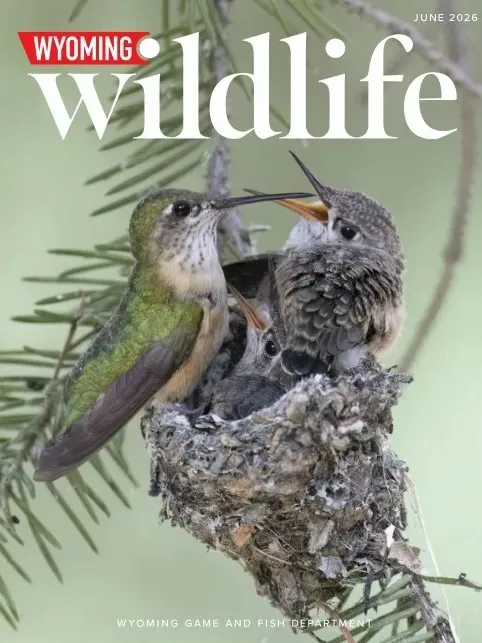
A female broad-tailed hummingbird tending two nearly grown chicks takes the cover of Wyoming Wildlife June 2026 (Volume 90, Number 6), photographed by Mark Gocke southwest of Wilson. He shot it in dense canopy at late day on a Canon EOS 7D Mark II with a Canon 100-400mm f/4.5-5.6 IS lens at 1/30 second, f/5 and ISO 2000; two days later the chicks had fledged.
Director Angi Bruce leads with wildlife crossings. Since 2017 Wyoming has invested more than $90 million in crossings, identified more than 240 hotspots statewide, fitted more than 1,500 GPS collars on big game, and won a $24 million federal pilot grant — the largest in the first funding period.
The features explain how horses do conservation work (p18), how bullsnakes and rattlesnakes coexist in Wyoming (p26), and the secret life of a trophy trout (p36). The back cover shows assistant state wildlife veterinarian Dr. Charlie Bahn sampling an elk for chronic wasting disease at Sybille.
—————
Content Guide
▸ Leading Off — Crossing the road (p2)
Angi Bruce, director
In late April the director spoke at two congressional briefings in Washington DC, one focused on wildlife crossings. She sets Wyoming's case on its wide intact landscapes, cold-water streams and wildlife that often outnumber people. Wyoming is a top pronghorn destination, holds the world's largest sage-grouse population, supports bighorn sheep and world-class trout fisheries, and sustains grizzly bears, pikas, wolves and golden eagles. Read her column before the features, since it frames the whole issue.
The numbers
Using collision and carcass data with local expertise, road summits identified more than 240 hotspots statewide. Since 2017 Wyoming has invested more than $90 million in wildlife crossings, from large pronghorn overpasses to fencing guiding deer to existing agricultural underpasses. More than 1,500 GPS collars are now on big game. A $24 million Federal Highway Administration pilot grant — the largest in the first funding period — went to the Kemmerer U.S. Highway 189 project. Private fundraising for the top bighorn sheep priority has reached $2.5 million, with the Game and Fish Commission and WYDOT committing millions more. Ask what your state has spent on crossings before assuming nothing is happening.
▸ A Couple Pennies — The dirt-road wave (p4)
Tracie Binkerd
The editor drives dirt roads in June to reach out-of-the-way fishing spots and describes the dirt-road wave: two fingers lifted from the wheel, sometimes just an index finger, maybe a small nod, meaning "I see you." She learned it riding traplines with her father. Rural greetings are the smallest social contract there is. Try the wave on the next dirt road you drive.
▸ Features
p.18 · Backcountry partners — How the Wyoming Game and Fish Department utilizes horses for wildlife conservation
This feature explains how the department uses horses for wildlife conservation work, matching the backcountry theme of the issue. Horses still do work vehicles cannot in rough country. Ask your own state agency whether it keeps a horse string.
p.26 · Amiable association — Bullsnakes and rattlesnakes can and do exist together in Wyoming
The feature reports that bullsnakes and rattlesnakes can and do live together in Wyoming. Two snake species sharing ground is more common than most people think. Learn the difference between a bullsnake and a rattlesnake before you next lift a rock.
p.36 · Air, land and hoof — The secret life of your trophy trout
The trout feature covers the secret life of a trophy fish. A trophy trout is the end of a long life most anglers never see. Check your waters' trout regulations before the next season opens.
▸ Departments
p.5 · Points and Pointers
Reader letters run here, including Carl Nollen of Runnells, Iowa praising the Mississippi Kite story from January 2026 and the new look, though he dislikes the white border on the cover. Another subscriber calls the 2026 photo issue the best. Letters pages tell you what a magazine's readers actually read. Enter the next photo issue with an image taken without bait.
p.10 · Lands
The Lands department returns each month on habitat and place. Place-based columns carry a state magazine. Read one Lands page before you visit public land.
p.12 · Species Spotlight
Species Spotlight profiles one species an issue. Single-species pages are the most teachable thing in a state magazine. Name one species you could not identify last year.
p.14 · On the Job / p.16 · In the Field
On the Job and In the Field cover department staff and field work. Field pages are where agency work becomes visible. Thank one field biologist this month.
p.46 · Wild Country Dispatch
Wild Country Dispatch closes the departments. Dispatch pages carry short news magazines miss. Scan one dispatch page before you put the issue down.
▸ Back Cover
Dr. Charlie Bahn and the elk
The back cover shows assistant state wildlife veterinarian Dr. Charlie Bahn, right, with Wildlife Health Lab staff taking biological samples from an elk at the Tom Thorne and Beth Williams Wildlife Research Center at Sybille near Laramie. The samples help the department understand how animals shed chronic wasting disease across the landscape over a lifetime. Photograph by Patrick Owen/WGFD. CWD is the disease reshaping Western big game management. Check your state's CWD rules before transporting a carcass.
—————
Editor's Take
The wildlife crossings numbers make Wyoming Wildlife June 2026 worth reading: more than $90 million invested since 2017, more than 240 hotspots, more than 1,500 GPS collars and a $24 million federal grant is a state programme described with real figures rather than adjectives. The Mark Gocke cover — 1/30 second, f/5, ISO 2000, chicks fledged two days later — is honest about how hard the picture was, which more magazines should be. Weakest is the features section, where the horses, snakes and trout pieces are listed with page numbers only in the available text and cannot be quoted in detail. The magazine is a state agency publication (EST. 1936, Conserving Wildlife, Serving People), so it will not criticise the department it belongs to. Buy this for the crossings data and the back cover; it is a public-land magazine for public-land readers.
Strengths
• Crossings gives $90 million, 240 hotspots, 1,500 collars
• $24 million federal grant named and allocated
• Cover credits are honest about ISO 2000 and fledging
• Back cover explains CWD sampling on elk
Weaknesses
• Features listed without quotable body text
• Agency magazine will not criticise the department
Verdict: Recommended — the crossings numbers, best for Western public-land readers.
