
All About History Lost Cities – 9th Edition – May 2026
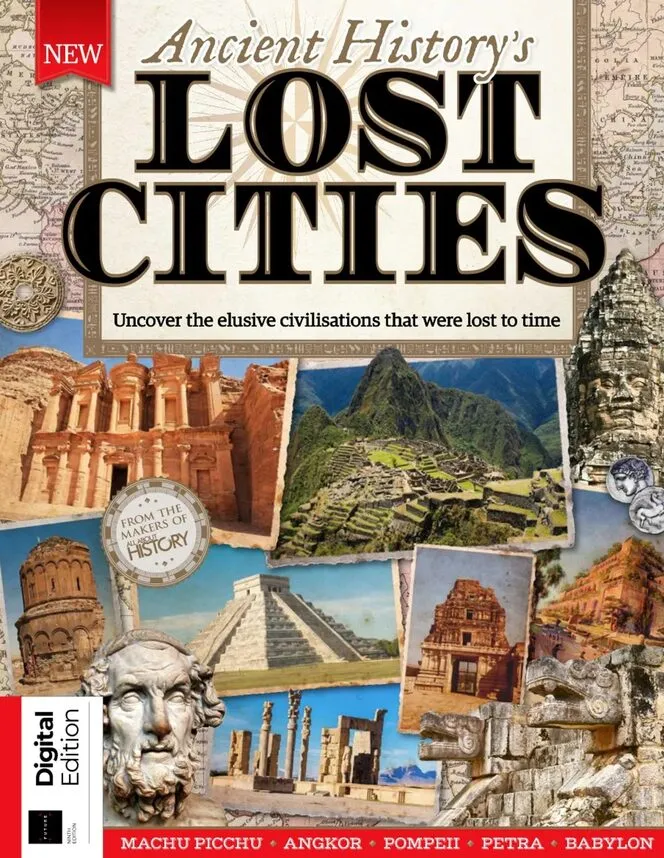
Summary
Machu Picchu, Angkor, Pompeii, Petra, and Babylon headline All About History's Lost Cities 9th Edition, May 2026, exploring the civilisations that vanished through natural disaster, war, disease, and economic collapse. The volume examines how cities become lost — from volcanic ash to jungle reclamation — and the archaeology that brings them back to light.
The book opens with a framework chapter "How cities become lost" covering four mechanisms: natural disasters, ravages of war, overpopulation, and trade-and-disease collapse. Case studies appear throughout, with illustrated site plans and artefact photography. Pompeii is treated as a natural-disaster archetype, Babylon as a war casualty. Angkor's reclamation by jungle demonstrates how abandonment, not destruction, erases a city. Petra's rock-cut architecture survived because its inhabitants left it intact rather than destroying it. Machu Picchu's rediscovery by Hiram Bingham in 1911 is presented as a case in accidental preservation.
Each chapter includes a site map, a timeline of occupation and abandonment, and a sidebar on what remains visible to today's visitor. The edition closes with practical visitor information for each site, including UNESCO status and conservation alerts.
—————
Content Guide
▸ Natural Disasters
p.30 · Pompeii
The 79 AD Vesuvius eruption that buried Pompeii under 4 to 6 metres of volcanic ash is reconstructed through Pliny the Younger's letters and modern pyroclastic-flow modelling. The article reproduces the plaster casts of victims preserved in their final positions. The casts are the most direct evidence available of how a population responds when escape routes are cut off in under 30 minutes.
p.38 · Atlantis
The enduring myth of Plato's sunken civilisation is traced from the Timaeus and Critias dialogues through Renaissance revival to modern pseudoarchaeology. The article distinguishes Plato's philosophical allegory from later claims of Minoan or Santorini connections. The source-text comparison table shows exactly which details Plato invented and which were borrowed from contemporary Greek shipwreck accounts.
▸ Wars & Conquest
p.52 · Babylon
The city's destruction by Sennacherib in 689 BC and its later rebuilding under Nebuchadnezzar II is documented through cuneiform tablets and the Babylonian Chronicle. The article reproduces the Ishtar Gate reconstruction photograph from Berlin's Pergamon Museum. The gate's blue glazed bricks demonstrate Babylonian firing technology that was not equalled in Europe until the 15th century.
p.124 · Troy
Heinrich Schliemann's 1870s excavations at Hisarlik are re-examined through modern stratigraphic analysis that identifies nine settlement layers. The article determines that Troy VI-VII — destroyed around 1180 BC — is the most likely candidate for the Homeric city. The layer diagram shows which destruction event matches the Homeric account and which contradicts it.
▸ Abandonment & Rediscovery
Angkor
The Khmer capital's abandonment after the 15th century is attributed to water-management failure rather than military conquest. The article reproduces the LiDAR scans of the medieval hydraulic network. The canal system diagram is the key piece of evidence that over-engineering, not under-engineering, caused the city's collapse.
Machu Picchu
Hiram Bingham's 1911 rediscovery is contextualised within earlier Peruvian and Spanish knowledge of the site. The article argues that Machu Picchu was a royal estate rather than a defensive citadel, based on artefact distribution across the 200 structures. The distribution map shows residential quarters separated from ceremonial spaces.
Petra
The Nabataean capital's rock-cut architecture is analysed as a water-management system first, a city second. The article explains how the sandstone channels and cisterns supported 20,000 inhabitants in a desert environment. The channel gradient diagram shows an engineering precision of 1 centimetre per 10 metres over 6 kilometres.
—————
Editor's Take
All About History's Lost Cities 9th Edition is a competent tour of well-known sites that offers little new to anyone who has read basic archaeology. The Pompeii and Babylon chapters are solid but derivative. Weakest parts: the Atlantis chapter is unnecessary in a lost-cities volume — it is not a city and never existed. The Machu Picchu chapter ignores the current debate on whether Bingham was a scientist or a looter. This edition suits the casual traveller planning a UNESCO-site itinerary rather than the archaeology student.
Strengths
• Angkor LiDAR scan showing hydraulic collapse cause
• Petra water-channel gradient data
• Troy layer diagram matching Homeric and geological evidence
Weaknesses
• Atlantis chapter belongs in a mythology book, not a lost-cities volume
• Machu Picchu avoids the Bingham-looting controversy
Verdict: Selective read — Good travel prep, thin for serious archaeology readers.
