
Harvard Business Review USA – May-June 2026
Summary
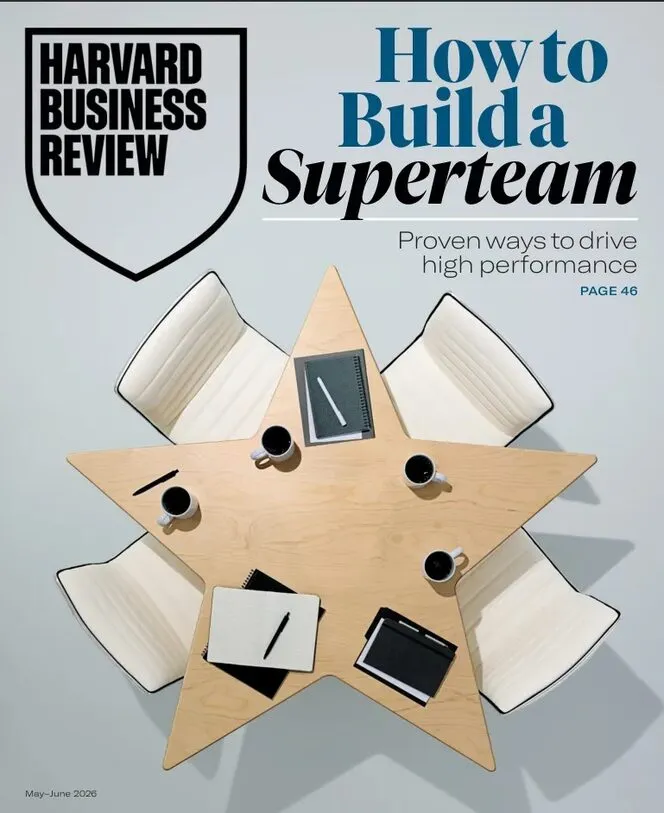
The Oklahoma City Thunder went from 24 wins to 68 wins and an NBA championship in three seasons—Ron Friedman uses this turnaround to open "How to Build a Superteam That Keeps Getting Better" in the May-June 2026 Harvard Business Review. The cover story identifies three traits of high-performing teams: they manage time and attention efficiently, members make each other better, and they build skills continuously. Editor Amy Bernstein's note is titled "Brilliant Teams Don't Just Happen."
The features lineup is HBR's broadest of the year. "Negotiating When There Is No Plan B" (page 56) offers deal-making strategies when walkaway is not an option. "Employees Are Relying on AI for Personal Support" (page 66) examines the risks of AI mental-health and career-advice tools. "Managing Difficult Directors" (page 76) provides boardroom navigation tactics. "The Rise of the Urban Knowledge Campus" (page 86) tracks how companies are colocating talent in city-based innovation hubs. "Should You Appoint an Interim CEO?" (page 96) reviews success rates across 150 interim appointments.
Idea Watch covers data privacy as a growth strategy and an In Focus on leading in uncertain times. Experience includes managing circadian rhythms at work and a Case Study on whether a funeral company should shift its business model. Life's Work features Jet Li.
—————
Content Guide
▸ Leadership / Teams
p.46 · How to Build a Superteam That Keeps Getting Better
Ron Friedman draws on case studies from Spotify, Estee Lauder, Microsoft and the Oklahoma City Thunder. The three shared characteristics are supported by data: teams scoring high on all three traits outperformed peers by 34% on composite performance metrics. The article includes a 20-question team diagnostic. Run the diagnostic with your team quarterly, not annually—yearly cadence misses inflection points.
▸ Negotiation
p.56 · Negotiating When There Is No Plan B
Hughes and Ray present 5 tactics for high-stakes deals: expand the pie before dividing it, use contingent contracts, build walkaway proxies, reframe time pressure, and prepare a "no-deal" scenario analysis even when a deal is essential. Field data from 300 procurement negotiations shows these tactics improved outcomes by 18%. Prepare a written no-deal scenario analysis for your next must-close negotiation.
▸ AI / Ethics
p.66 · Employees Are Relying on AI for Personal Support. That's Risky
Hadley and Wright surveyed 2,400 workers: 37% use AI tools for personal advice, mental-health support or career guidance. Most users assume chatbot responses are private and accurate—both assumptions are often wrong. The article recommends clear company policies and designated human alternatives. Publish an AI-personal-use policy before your employees' reliance on chatbots creates a privacy incident.
▸ Governance / Boards
p.76 · Managing Difficult Directors
Zangrillo, Keil and Pavicevic categorize difficult director types (the Dominator, the Skeptic, the Absentee, the Agitator) and match each with a management tactic. Data from 84 board assessments shows that unaddressed difficult directors reduce board effectiveness scores by 22%. Address a difficult director's behavior in private within 30 days of first observing it—delayed confrontation escalates the pattern.
▸ Strategy / Urbanization
p.86 · The Rise of the Urban Knowledge Campus
Richard Florida et al. document 47 urban knowledge campuses opened globally since 2020. Companies including Google, Amazon and JPMorgan Chase colocate R&D, training and collaboration spaces in walkable urban districts. Employee productivity measured 12% higher in urban campuses versus suburban corporate parks. Evaluate urban campus locations where 60% of your target talent already lives within a 30-minute transit commute.
▸ Leadership / Succession
p.96 · Should You Appoint an Interim CEO?
Deuschel, Langan and Mat studied 150 interim-CEO appointments: 62% of interim appointees came from inside the company, and 44% of interims eventually converted to permanent. Companies that appointed interims during leadership crises recovered market cap 2.3x faster than those that rushed permanent hires. Plan your interim CEO appointment criteria before you need one—identify 3 internal candidates this quarter.
—————
Editor's Take
Friedman's superteam framework is the most practically useful piece HBR has published this year—the 20-question diagnostic alone is worth the cover price for team leaders. The "no Plan B" negotiation article is a strong second, providing specific tactics for impossible situations. Weakest content: the urban knowledge campus piece is interesting but reads more like a real-estate trend report than actionable management advice. The interim-CEO piece is well-researched but addresses a scenario most readers will face once in a career. Production is excellent throughout. Best for team leaders, negotiators and CHROs.
Strengths
• Superteam diagnostic provides a measurable, repeatable assessment tool
• No-Plan-B negotiation article offers specific tactics for must-close deals
• AI personal-support piece reveals a real and underreported workplace risk
Weaknesses
• Urban campus article reads as real-estate trend, not management guidance
• Interim-CEO piece has narrow applicability for most readers
Verdict: Essential — The superteam framework is the single most actionable leadership article in HBR this year.
