
BBC Music – August 2026
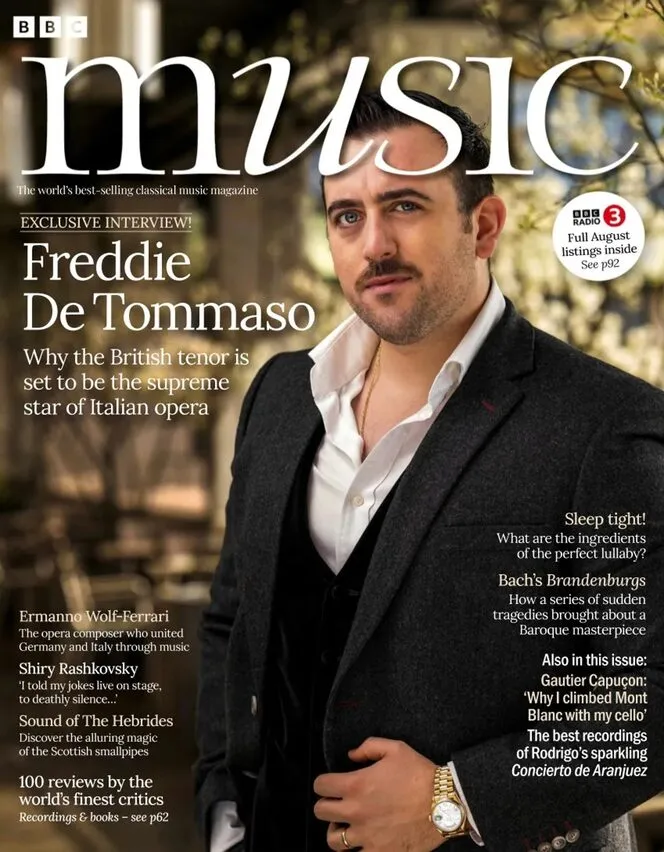
Summary
Freddie De Tommaso, the British tenor set to become the superstar of Italian opera, sits for an exclusive interview in BBC Music Magazine August 2026 — and tells Jeremy Pound why his musical heart will always lie firmly in Italy, not London.
BBC Music Magazine August 2026 leads with De Tommaso discussing his training at the Royal Academy of Music, his breakthrough at the Verona Arena, and the Italian repertoire that defines his career. Clifford Hall investigates how Bach's Brandenburg Concertos were nearly lost without trace before a series of sudden tragedies brought about their survival. Rebecca Franks profiles composers whose inventive powers extended beyond the musical score — inventors, architects and polymaths. Gautier Capucon explains why he carried his cello to the top of Mont Blanc. Madeline Castrey, a musicologist and physician, analyses the formula for an effective lullaby. Freya Parr travels to the Isle of Skye to discover the Scottish smallpipes. Composer of the Month covers Ermanno Wolf-Ferrari, the opera composer who united Germany and Italy through music. Building a Library presents Rob Ainsley on the best recordings of Rodrigo's Concierto de Aranjuez.
Regular sections include Letters, The Full Score, Richard Morrison's column, Musical Destinations in Tampere Finland, August Radio and TV listings, and Music That Changed Me with tenor David Butt Philip. The Reviews section features over 100 reviews by the world's finest critics, including Recording of the Month: the Amsterdam Piano Trio performing Tchaikovsky and Schoenberg.
—————
Content Guide
Cover Story / Features
p.24 · Freddie De Tommaso
The British tenor on why Italian opera is his home turf, his training at the Royal Academy, and the Verona Arena debut that changed his career trajectory. He names the specific arias that tested his technique. Listeners should queue up his recording of Nessun dorma to hear the difference between technical mastery and genuine emotional reach — De Tommaso explains both.
p.30 · Bach from the Dead
Clifford Hall traces how Bach's Brandenburg Concertos nearly disappeared after the composer's death, surviving only through a series of improbable events and the intervention of a princess. The piece names the specific library where the manuscript was rediscovered. Read this before your next Brandenburg listen to hear them as a near-loss rather than a certainty.
p.34 · Bright Sparks
Rebecca Franks profiles composers who were also inventors, architects and scientists — musicians whose creativity did not stop at the stave. The article includes patent dates and instrument diagrams. The examples cited make a strong argument for keeping STEM and music education together.
p.38 · Gautier Capucon — Peak Performer
The cellist tells Anthony Cheng why he took his instrument to the summit of Mont Blanc. The temperature, the altitude, and the risk of damaging a 300-year-old cello all factor into a story that reads like an adventure log. The lesson: performance preparation includes physical endurance training.
p.42 · Hush Little Baby
Madeline Castrey applies her dual training as musicologist and physician to decode the ingredients of an effective lullaby. Tempo, key signature and repetition patterns are all measured. Parents can apply the tempo range directly to bedtime playlists.
p.48 · Pipe Dreaming
Freya Parr on the Scottish smallpipes of the Isle of Skye, a quieter cousin to the Highland bagpipes with a bellows-blown system that allows indoor playing. The article names the living makers who still build them by hand.
Reviews
p.62 · Recording of the Month
Amsterdam Piano Trio — Tchaikovsky & Schoenberg. The Trio's Tchaikovsky Piano Trio in A minor is described as a triumph. The Schoenberg coupling gives the disc its programming edge.
p.58 · Building a Library
Rob Ainsley compares the best recordings of Rodrigo's Concierto de Aranjuez, with recommendations spanning the original 1950s mono recordings through modern digital remasters. The winning version is named with catalogue number.
Regulars
p.52 · Musical Destinations: Tampere, Finland
Claire Jackson explores the Finnish city's classical music scene, from the Tampere Hall to the local orchestra calendar. A practical travel guide tucked inside a music magazine.
p.54 · Composer of the Month: Ermanno Wolf-Ferrari
George Hall profiles the German-Italian opera composer whose work bridged two national traditions. Recommended recordings are listed for each key opera.
—————
Editor's Take
The Freddie De Tommaso interview is a genuine career-capture — he is still early enough in his trajectory that this feature will read differently in five years, which is exactly when you want to have interviewed someone. The Capucon Mont Blanc story is the most shareable piece in the issue; it works as a human-interest narrative regardless of classical music interest. The lullaby feature (Castrey) is a clever crossover that pulls in readers who might not otherwise buy a BBC Music Magazine. Weaknesses: the Scottish smallpipes piece runs longer than its subject probably deserves in a monthly issue with finite pages. The "Bright Sparks" composers-as-inventors feature is interesting but the examples skew heavily toward the 19th century, missing obvious modern parallels. Bach from the Dead is well-researched but the prose occasionally reads more like a lecture script than magazine journalism.
Strengths
• Freddie De Tommaso interview captures a rising star at the right moment
• Gautier Capucon Mont Blanc story transcends the classical niche
• Madeline Castrey's lullaby analysis offers practical, science-backed advice
Weaknesses
• Smallpipes feature overstays its page count
• Bach feature prose style leans academic
Verdict: Recommended — The De Tommaso interview and Capucon adventure piece make this issue worth the cover price for classical listeners and casual readers alike.
