
National Geographic Kids UK – Issue 260 2026
Summary
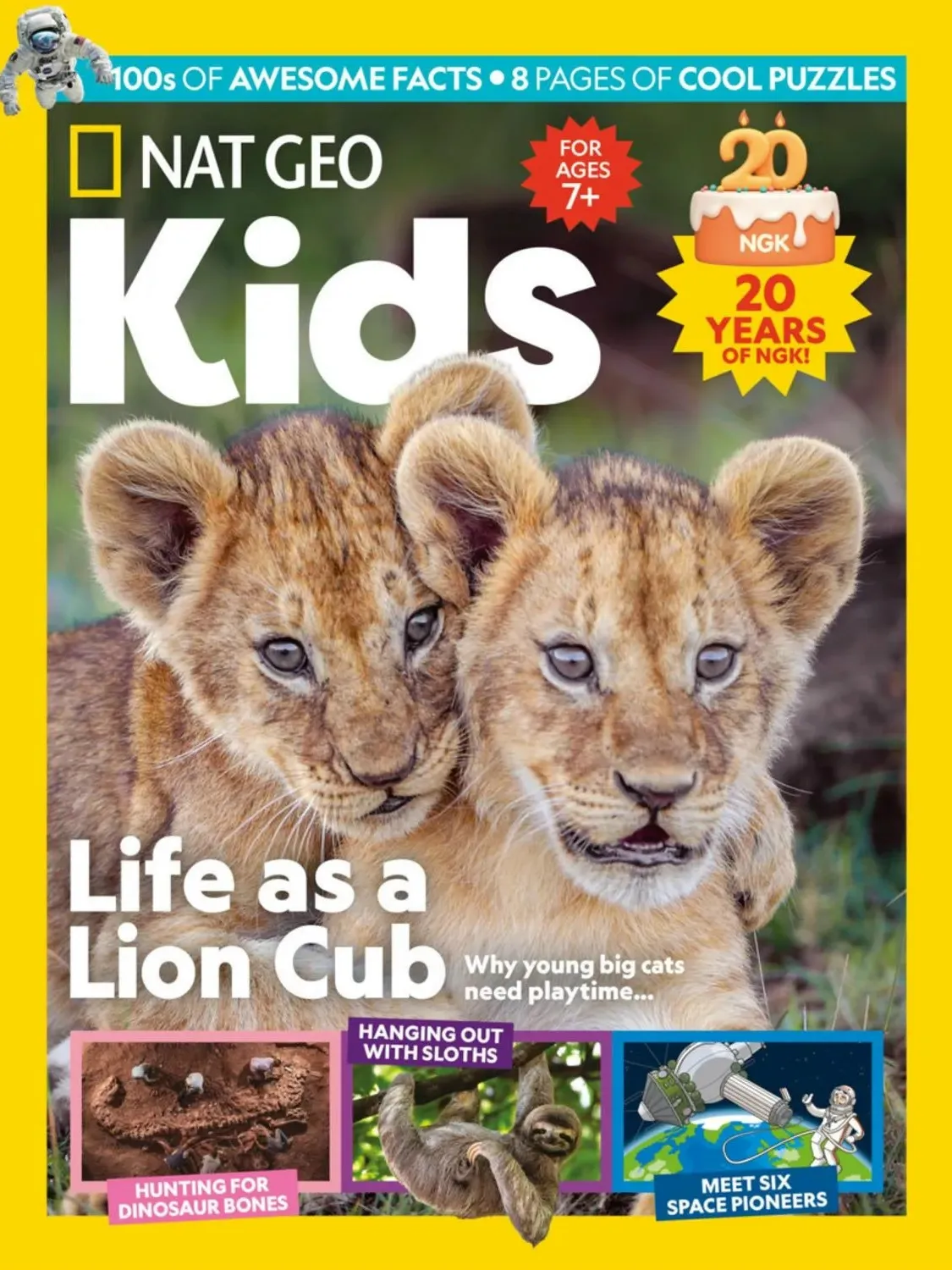
National Geographic Kids UK Issue 260 (2026) celebrates 20 years of publication with a birthday-themed cover and a trip-down-memory-lane feature (p.14). The editorial line-up mirrors the global edition network: lion cub life in Botswana (p.8), six space pioneers (p.22), a palaeontologist digging up dinosaurs (p.30), sloths hanging upside-down (p.34), and a reader's greeting from Borneo. The 20th-anniversary branding appears on the cover, contents page and across the birthday feature.
The lion cub feature (p.8) tracks a Botswana pride through 18 months of play-based learning. The birthday feature (p.14) reprints covers from 2006 to 2025, including the very first issue featuring a snow leopard. Space Heroes (p.22) profiles Katherine Johnson, Mary Jackson, Dr. Mae Jemison and three international astronauts — including the first person from Mongolia to reach orbit. Digging Up Dinos (p.30) interviews Dr. Nizar Ibrahim about his Moroccan Sahara dig. Hanging With Sloths (p.34) covers three-toed sloth metabolism and fur-algae symbiosis. Explorer HQ (p.38) runs puzzles, a crossword with NGK characters, a hedgehog cake recipe (p.44), Junior Explorers' Club letters (p.46) and Ask Nat Geo on see-through frogs (p.48). The issue uses 100% recycled paper, printed in the UK.
—————
Content Guide
▸ Cover Story
p.8 · Lion Cub Life
Botswana lion cubs spend 18 months learning to hunt through play. Females execute 90% of hunts, and cubs begin joining kill attempts at 11 months. The article follows a single litter through stalking exercises, pounce practice and failed grabs — the miss rate drops from 90% in month one to 30% by month 12. Count how many times a house cat bats at a toy and misses — the ratio is the same as a lion cub's.
▸ Features
p.14 · It's Our Birthday!
Twenty years of Nat Geo Kids UK: the first issue (2006) featured a snow leopard on the cover and cost £3.50. The feature reprints 10 landmark covers including the giant squid issue (2010), the plastic ocean campaign (2018) and the 15th-anniversary redesign (2021). The first issue sold 42,000 copies — today, the magazine reaches 180,000 readers per issue. Find a copy of the first cover online and compare it with the current one — the snow leopard is still the best-selling cover in NGK history.
p.22 · Space Heroes
Katherine Johnson calculated the Apollo 11 lunar descent manually — she verified the computer's numbers by hand. Mary Jackson became NASA's first Black engineer. The article adds three international astronauts: the first from Mongolia, Afghanistan and Nigeria — none of those countries had a space programme in 2000. The article ends with a challenge: design a mission patch for your own imaginary space flight.
p.30 · Digging Up Dinos
Dr. Nizar Ibrahim's team carried 30 kilograms of water and plaster 20 kilometres into the Sahara daily to excavate a new five-metre horned dinosaur. The fossil was preserved in 100-million-year-old sediment. The article includes a field guide to identifying dinosaur bones: look for porous texture, darker colouration than surrounding rock and curved shapes. Take the field guide to a natural history museum and test it on a real fossil.
p.34 · Hanging With Sloths
A three-toed sloth's metabolism is so slow that it takes a month to digest a single leaf. Sloths descend their tree once every seven to 10 days to defecate — that is the moment they are most vulnerable to predators. The fur hosts algae that provides camouflage and moths that live nowhere else. Make a green pipe-cleaner sloth and hang it from a lampshade — that is accurate enrichment for a captive sloth.
▸ Regulars
p.38 · Explorer HQ
Crossword with NGK-themed clues, a spot-the-difference and a brain boaster. The crossword answer for "UK's most famous fossil hunter" is Mary Anning — she discovered the first complete ichthyosaur skeleton at age 12.
p.44 · Make It: Hedgehog Cake
No-bake: 150g shredded wheat crushed and mixed with 100g melted chocolate, 75g golden syrup and 50g butter. Shaped into a dome, chilled for two hours, then decorated with chocolate drops for eyes and flaked almonds for spines. The recipe serves six — the chocolate sets best at room temperature, not in the fridge.
p.48 · Ask Nat Geo: See-Through Frogs
The glass frog has transparent abdominal skin — you can see its heart beating, its liver digesting food and its intestines coiled inside. The transparency is a camouflage technique: the frog blends into the underside of leaves when light passes through its body. Shine a torch through your own hand — the red glow is blood in your capillaries, the same effect that makes glass frogs visible.
—————
Editor's Take
National Geographic Kids UK Issue 260's 20th-birthday feature gives it an edge over the global edition clone content: the reprinted covers and 42,000-to-180,000 circulation story are genuinely interesting for long-term readers. The lion cub, space heroes, dinosaur and sloth features are the same syndicated content appearing in the Australia and US editions — no exclusive editorial beyond the birthday pages. The hedgehog cake recipe is identical to the Australia edition. The 100% recycled paper claim printed on the cover is a strong environmental position for a children's magazine. Ask Nat Geo's glass frog page (p.48) is the issue's most visually striking spread — the transparent abdomen photo has genuine wow factor. But for a 20th-anniversary issue, the lack of reader-contributed content (letters, artwork, memories) beyond the standard Junior Explorers' Club page is a missed opportunity.
Strengths
• 20th-anniversary feature reprints 10 landmark covers from snow leopard to plastic ocean
• Ask Nat Geo glass frog page shows transparent abdominal skin with visible heartbeat
• 100% recycled paper claim on cover offers a strong environmental position
Weaknesses
• Syndicated lion cub, sloth and dinosaur content duplicates global editions
• 20th-anniversary issue lacks reader-contributed memories beyond standard JEC page
Verdict: Recommended — The birthday feature adds value for long-term subscribers; casual buyers get the same content as other editions. (19 words)
