
History of War History of the Luftwaffe – 1st Edition – June 2026
Summary
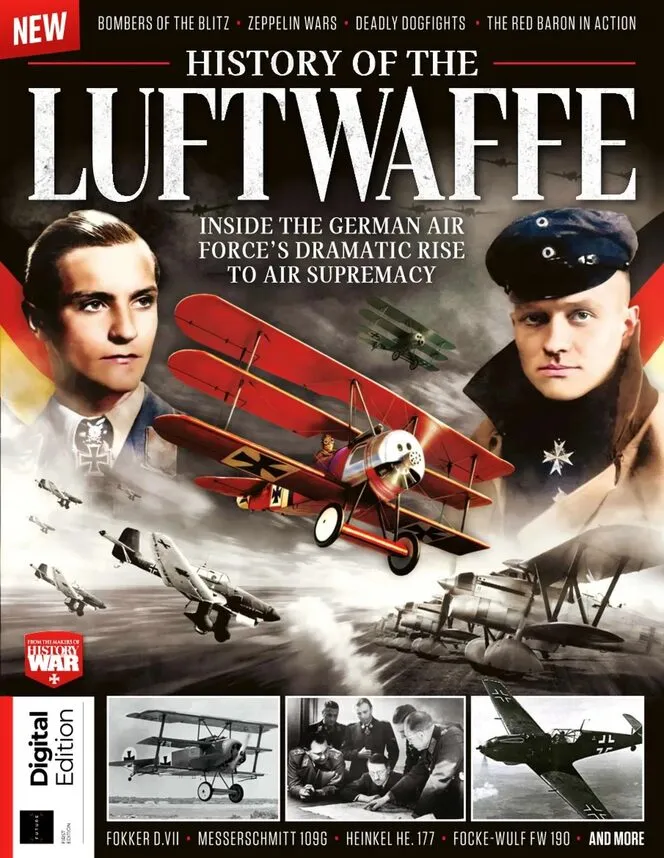
The Messerschmitt Bf 109G and Focke-Wulf FW 190 defined German air power across two world wars but the Luftwaffe's story begins with Zeppelin raids over Britain in 1915. History of the Luftwaffe 1st Edition June 2026 traces the German air force from its First World War origins through the Blitz to the final disintegration in 1945.
The special edition opens with the question Who Were The Luftwaffe then moves through the Zeppelin wars of 1915-18 and the Red Baron's final combat. Aircraft profiles cover the Fokker Eindecker with its revolutionary synchronised firing system the Fokker D.VII that arrived too late and the Albatros D.Va. The interwar rise of the Luftwaffe leads into Hitler's aces profiles and the Iron Airmen feature. The Battle of Britain and the Blitz are covered from the German perspective including a timeline of the Blitz and Blitz aircraft analysis. The Eastern Front gets dedicated coverage with the Air Battle for Kursk and the Heinkel He.177. Late-war profiles of the Bf 109G and FW 190 precede Operation Bodenplatte the last major Luftwaffe offensive. The edition closes with the dismantling of the Luftwaffe after surrender.
—————
Content Guide
▸ Early Years
p.06 · Who Were The Luftwaffe
The opening chapter establishes the identity and organisation of the German air force across both world wars. The piece traces the transition from Imperial German Flying Corps to the Third Reich's Luftwaffe. Key command structures and personnel are named.
p.08 · Zeppelin Wars
The first strategic bombing campaign in history took place when Zeppelin airships raided British cities from 1915. The article names the specific Zeppelin types deployed and the civilian casualties inflicted. The British defence response including searchlights and incendiary ammunition is documented.
p.14 · The Red Baron's Demons
Manfred von Richthofen the most famous fighter pilot of any era is examined beyond the victory tally. The piece draws on his letters to reveal the psychological toll of aerial combat. His final mission on 21 April 1918 is reconstructed from witness accounts.
▸ Aircraft Profiles
p.24 · Fokker Eindecker
The plane that changed air warfare with its synchronised machine gun firing through the propeller arc. The article details the interrupter gear mechanism and the Eindecker's combat debut in 1915. The tactical advantage it gave Germany over the Allies is quantified in victory ratios.
p.30 · Fokker D.VII
A German flying powerhouse that entered service too late to change the war's outcome. The D.VII's performance figures are given with specific altitude and speed data. The Allied demand for its surrender in the Armistice terms is cited.
p.106 · Messerschmitt Bf 109G
The backbone of the Luftwaffe and a World War II icon. The G variant's engine upgrades and armament options are listed. The aircraft's service across every European theatre is mapped.
p.112 · Focke-Wulf FW 190
The radial-engined fighter that outperformed the Spitfire in early encounters. The article traces its development from 1939 through to 1945. The specific variants and their operational niches are identified.
▸ World War II Operations
p.44 · The Rise of the Luftwaffe
How Germany rebuilt its air force in secret during the interwar years. The 1935 formal establishment with Hermann Goering as commander is documented. The aircraft types that formed the core of the new Luftwaffe are named.
p.66 · Victory in September
The Luftwaffe's role in the lightning campaign against Poland. The article quantifies the aircraft committed and the Polish Air Force losses. The campaign is presented as the template for Blitzkrieg.
p.80 · Hitler's Bombers
The Heinkel He 111 Dornier Do 17 and Junkers Ju 88 are profiled as the mainstays of the bombing offensive. Each aircraft's payload range and defensive armament are compared. The shift from tactical to strategic bombing is explained.
p.90 · Timeline of the Blitz
A chronological breakdown of the German bombing campaign against British cities from September 1940 to May 1941. Key raids are identified by date target and aircraft count. The shift to night bombing is marked with its operational rationale.
p.96 · The Air Battle for Kursk
The largest aerial battle on the Eastern Front is examined. Soviet and German aircraft losses are compared. The Luftwaffe's declining effectiveness in the face of Soviet air superiority is traced.
p.118 · Bodenplatte
The last major Luftwaffe offensive on 1 January 1945 caught Allied airfields by surprise. The article names the units involved and the aircraft lost on both sides. The operation's cost in irreplaceable pilots is stated as the final blow to German air power.
p.128 · Dismantling the Luftwaffe
The aftermath of surrender saw the Allied powers divide and destroy what remained of the German air force. The article documents the aircraft seized and the personnel interrogated. The specific disposal methods used for different aircraft types are listed.
—————
Editor's Take
This single-volume survey covers the Luftwaffe across both world wars which is both its strength and its weakness—the First World War sections are strong but the interwar rebuilding gets compressed treatment. The aircraft profile format with specs tables gives readers a reference they can return to. The closing Bodenplatte and dismantling chapters bring genuine narrative closure. The issue lacks a dedicated Battle of Britain chapter from the German tactical perspective which feels like a gap for the target audience.
Strengths
• Dual world war coverage in a single volume
• Aircraft profiles with technical specifications
• Zeppelin wars and Red Baron sections add WWI depth
Weaknesses
• Battle of Britain spread across multiple entries rather than a standalone chapter
• Interwar rebuilding period compressed into too few pages
Verdict: Recommended — a solid Luftwaffe reference with strong aircraft profile content.
