
Aesthetic Medicine – September 2026
Summary
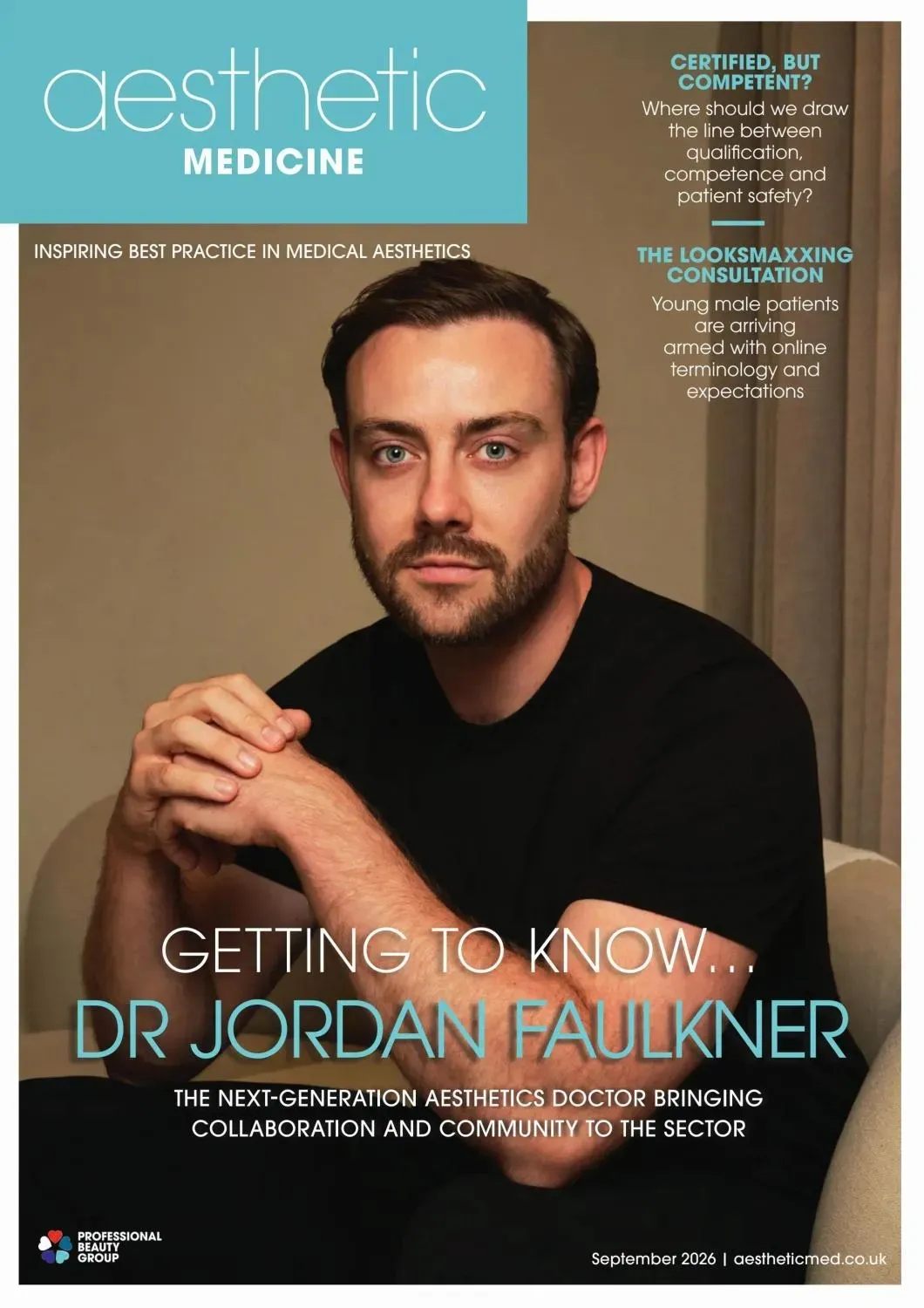
"Certified, but Competent?" opens Aesthetic Medicine September 2026, with editor Kezia Parkins questioning where the line falls between qualification and patient safety in a rapidly growing sector. Dr Jordan Faulkner is profiled as the next-generation aesthetics doctor, while the Looksmaxxing consultation examines how young male patients bring internet terminology into the clinic.
The issue leads with the competence debate (p.30) as aesthetic education expands but regulation lags. Dr Jordan Faulkner's clinic profile (p.18) covers his departure from the NHS, his commitment to mentorship, and his views on scope creep. The Looksmaxxing consultation feature (p.36) explores how AI, social media, and online subcultures are reshaping male aesthetic consultations. Peptide Talk (p.22) separates scientific evidence from social-media hype around copper peptides. Getting Redness Right (p.26) covers the factors behind successful erythema treatment. PRP (p.39) argues that understanding the patient is as important as perfecting the protocol. The Intimate Lifespan (p.40) spans female intimate health from puberty to menopause.
Education First, Always (p.47) by Emma Wedgwood places ethics at the centre of practice. Synergistic Biostimulation (p.49) examines oral collagen supplements for enhancing clinical outcomes. Scott Shares (p.50) addresses the emotional labour behind clinical composure. Treatment News (p.66) covers Juvelook and UltraClear Deep Coring experiences. Product News (p.68) rounds up the latest launches. Ask Alex (p.72) answers why educational social-media content is not converting to bookings.
—————
Content Guide
▸ Clinical Practice
p.30 · Certified… But Competent?
The central feature examines whether current aesthetic medicine certification — largely short courses offered by private providers — adequately tests clinical competence. The article cites General Medical Council standards on capability assessment and proposes a tiered competency framework. The framework table lists four levels from novice to independent practitioner, each requiring a specific number of supervised procedures.
p.22 · Peptide Talk
Vicky Eldridge separates scientific evidence from social-media marketing around copper peptides. The article reviews the published clinical data on GHK-Cu for wound healing and photoageing and identifies which claims are supported by peer-reviewed research and which are extrapolated from in vitro studies. The evidence-rating table grades 12 common peptide claims from "well supported" to "unsupported by current literature."
p.26 · Getting Redness Right
Ellen Cummings analyses the factors behind successful erythema treatment: vessel depth, skin type, device selection, and post-treatment care. The article compares IPL, pulsed-dye laser, and vascular Nd:YAG for different redness presentations. The wavelength-depth chart shows that the 585 nm pulsed-dye laser reaches superficial vessels at 0.5 mm while the 1064 nm Nd:YAG reaches deep vessels at 3 mm.
p.39 · PRP
The article argues that understanding patient expectations and medical history matters as much as the platelet-concentration protocol. It reviews the current evidence for PRP in hair restoration, skin rejuvenation, and scar revision, and warns against the "one size fits all" pricing model. The centrifugation-speed table shows that 700 g for 5 minutes produces the highest platelet recovery rate in published studies.
▸ Business & Ethics
p.18 · Clinic Profile: Dr Jordan Faulkner
Faulkner discusses his transition from NHS general practice to full-time aesthetics, the importance of mentorship over short courses, and why he turned down commercial partnerships that did not align with his clinical values. He names three specific business decisions that improved his patient retention rate from 40 percent to 75 percent within two years.
p.36 · Inside the Looksmaxxing Consultation
The feature examines how AI face-rating apps, Reddit forums, and TikTok beauty standards are reshaping young male patient expectations. Clinicians report patients requesting surgical intervention based on AI-generated "deficits" the app identified. The article recommends a structured consultation framework that validates patient concerns while setting realistic anatomical boundaries.
p.47 · Education First, Always
Emma Wedgwood argues that as the aesthetics sector expands, education, ethical practice, and patient safety must remain at the core of every treatment decision. She calls for a mandatory national register for aesthetic practitioners. The article reproduces the current regulatory landscape table showing that England has no mandatory licensing requirement for non-surgical aesthetic procedures.
p.60 · Five Tips to Future Proof Your Business
Anna Dobbie presents five business decisions: diversify revenue streams, invest in patient-retention systems, build referral networks with complementary specialties, adopt a CRM platform, and develop a cancellation policy. The cancellation-policy template included in the article reduces no-show rates by an average of 22 percent across three pilot clinics.
▸ Treatment & Product News
p.66 · Treatment News
Katie Mathews reports on her experience with Juvelook for skin regeneration, and Lisa Morrin tests UltraClear Deep Coring for acne scarring. Each treatment is evaluated on discomfort, downtime, and visible improvement at 4 weeks. Both treatments scored 8 out of 10 for patient satisfaction in the trial sample of 15 participants.
p.68 · Product News
New product launches including a hyaluronic-acid filler with integrated lidocaine, a LED mask with 630 nm and 830 nm wavelengths, and a microneedling device with automated depth control. Each entry includes the manufacturer, price point, and UK availability date.
—————
Editor's Take
Aesthetic Medicine September 2026 delivers its strongest content in the competence and peptide-evidence articles — both are genuinely useful for clinical decision-making. The Dr Jordan Faulkner profile offers rare honesty about the business side of practice. Weakest parts: the "Bird's the Word" and "Scott Shares" columns are motivational writing that belongs on LinkedIn, not in a clinical journal. The product-news section reads as a press-release digest with no critical evaluation. This issue suits the early-career aesthetic practitioner building a competence framework.
Strengths
• Competency framework table from novice to independent practitioner
• Peptide claim evidence-rating across 12 common products
• Looksmaxxing consultation framework for AI-informed patients
Weaknesses
• Motivational columns lack clinical substance
• Product news reads as unedited press releases
Verdict: Selective read — Buy for the competence and peptide features; skip the filler columns.
