
History of War US Militarys Greatest Battles – 8th Edition – 20 August 2026
Summary
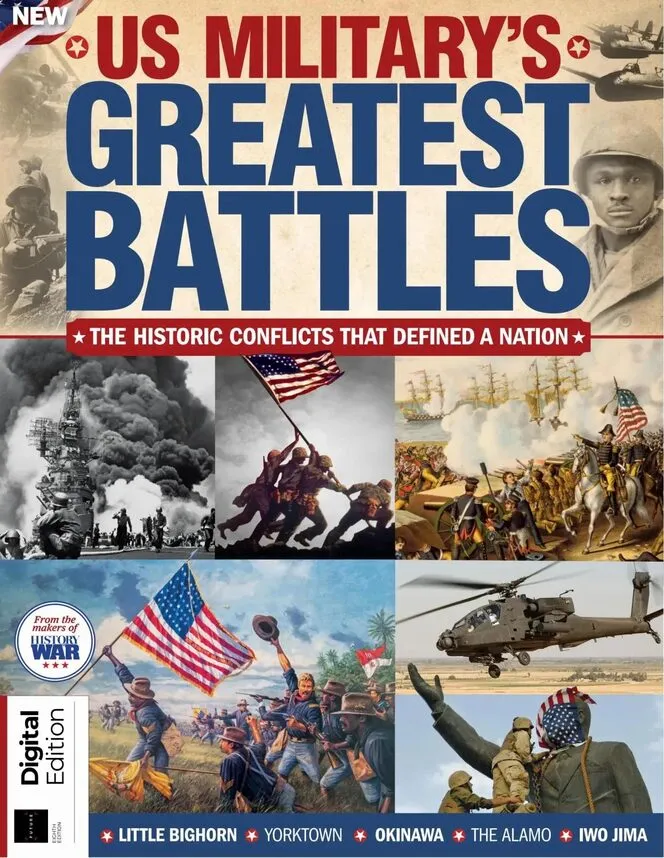
History of War: US Military's Greatest Battles — 8th Edition (20 August 2026) spans three centuries of American warfare across 33 battle entries: from the 1775 Battles of Lexington and Concord through the 1993 Battle of Mogadishu. The cover promotes Little Bighorn, Yorktown, Okinawa, the Alamo and Iwo Jima — five battles that each represent a different era of US military history.
The 160-page edition is organised into three chronological sections. The 1700s (p.14) covers the Revolutionary War from Lexington (p.14) through Siege of Yorktown (p.34) to the Battle of Wabash (p.42). The 1800s (p.46) spans the Barbary Wars, the War of 1812, the Texas Revolution, the Civil War, the Plains Wars and the Spanish-American War — including Gettysburg's 51,000 casualties (p.76) and Custer's Last Stand at Little Bighorn (p.84). The 1900s (p.94) covers both World Wars, Korea and Vietnam, from Saint-Mihiel (p.94) through Iwo Jima (p.116) and Okinawa (p.124) to the Black Hawk Down incident in Mogadishu (p.142). An opening feature profiles US presidents who served as soldiers (p.8). A Weapons of War appendix (p.156) closes the book with technical specifications of 20 key firearms, vehicles and aircraft.
—————
Content Guide
▸ The 1700s — Revolutionary War
p.14 · Battles of Lexington and Concord
19 April 1775: 700 British regulars marched from Boston to seize colonial weapons. At Lexington Green, a shot was fired — "the shot heard round the world" — and eight militiamen died. The British retreated to Boston under continuous fire from 3,800 colonial militiamen, losing 273 soldiers. The article includes a map of the 16-mile battle road from Concord to Boston with key ambush points marked.
p.34 · Siege of Yorktown
The decisive battle of the American Revolution (28 September-19 October 1781). General Cornwallis surrendered 8,000 British troops to George Washington's 17,000 combined American and French forces. The French navy blockaded Chesapeake Bay, preventing British reinforcement. The article includes the surrender terms: Cornwallis claimed illness and sent his second-in-command to present his sword.
▸ The 1800s — Civil War & Western Expansion
p.58 · Battle of the Alamo
23 February-6 March 1836: 200 Texan defenders held the former mission against 2,000 Mexican troops under General Santa Anna. All defenders died — including Davy Crockett and Jim Bowie. The 13-day siege bought time for Sam Houston's army. Santa Anna's casualties: 600 killed or wounded against 200 Texan dead. The battle cry "Remember the Alamo" became the rallying cry for Texan independence.
p.76 · Battle of Gettysburg
1-3 July 1863: 51,000 casualties across three days — the bloodiest battle of the Civil War. The article walks through each day: Day 1 Confederate victory (Union retreat through Gettysburg's streets), Day 2 Little Round Top defence, Day 3 Pickett's Charge (12,500 Confederate soldiers across one mile of open field — 50% became casualties). President Lincoln delivered the Gettysburg Address at the dedication of the Soldiers' National Cemetery four months later.
p.84 · Battle of the Little Bighorn
25 June 1876: Lieutenant Colonel George Custer divided 700 men of the 7th Cavalry into three battalions and attacked a Lakota-Cheyenne encampment of 2,000 warriors. Custer and 267 men of his immediate command were killed within an hour — no survivors. The article analyses Custer's tactical errors: underestimating the enemy's numbers and splitting his force into uncoordinated units.
▸ The 1900s — World Wars & Beyond
p.106 · Battle of Midway
4-7 June 1942: The US Navy sank four Japanese aircraft carriers — Akagi, Kaga, Sōryū and Hiryū — against the loss of USS Yorktown. The battle turned the Pacific War. US codebreakers had intercepted Japanese plans; Admiral Nimitz positioned three carriers to ambush the Japanese fleet. Japan lost 248 aircraft and 3,057 men; the US lost 150 aircraft and 307 men.
p.116 · Battle of Iwo Jima
19 February-26 March 1945: 70,000 US Marines assaulted 21,000 Japanese defenders on a 21 km² volcanic island. The iconic photograph of six Marines raising the flag on Mount Suribachi was taken on 23 February — the fifth day of a battle that continued for 32 more days. US casualties: 6,821 killed, 19,217 wounded; Japanese casualties: 18,844 killed, 216 captured.
p.142 · The Real Black Hawk Down
3-4 October 1993: Task Force Ranger's mission to capture Somali warlord Mohamed Farrah Aidid's lieutenants became a 15-hour urban firefight. Two UH-60 Black Hawk helicopters were shot down. 18 US soldiers killed, 73 wounded. The article includes the casualty evacuation sequence: one medic, Sergeant First Class Randall Shughart, was posthumously awarded the Medal of Honour for defending the second crash site.
—————
Editor's Take
History of War: US Military's Greatest Battles 8th Edition is the strongest military history publication in this batch — 33 battle entries across 160 pages with consistent four-to-six page spreads per battle, a balanced chronological spread and genuine tactical analysis. The Gettysburg entry's three-day breakdown (p.76) and the Midway codebreaker narrative (p.106) each deliver enough detail to satisfy readers familiar with those battles while remaining accessible to newcomers. The "Mr President: From Soldier to Statesman" opener (p.8) is a smart editorial addition that connects military service to political leadership. The weakness is the 1900s section: 27 of 33 battles fall after 1900, but the World War II entries (Atlantic, Coral Sea, Midway, Overlord, Leyte Gulf, Iwo Jima, Okinawa) begin to blur together — seven sequential Pacific/European campaigns without a summary map to show the overall strategic picture. The "Weapons of War" appendix (p.156) is a wasted two-page table that lists 20 firearms and vehicles with no illustrations.
Strengths
• Gettysburg entry provides a day-by-day tactical breakdown with casualty data per assault
• Midway entry explains the codebreaker advantage and carrier ambush strategy
• Mr President opener connects military service to political leadership across eight commanders-in-chief
Weaknesses
• Seven sequential WWII entries lack a strategic overview map showing the Pacific/European theatre picture
• Weapons of War appendix lists 20 items in a text-only table with no illustrations
Verdict: Essential — The best single-volume US military history primer available; the Gettysburg and Midway entries justify the cover price alone. (20 words)
