
National Geographic Kids USA – September 2026
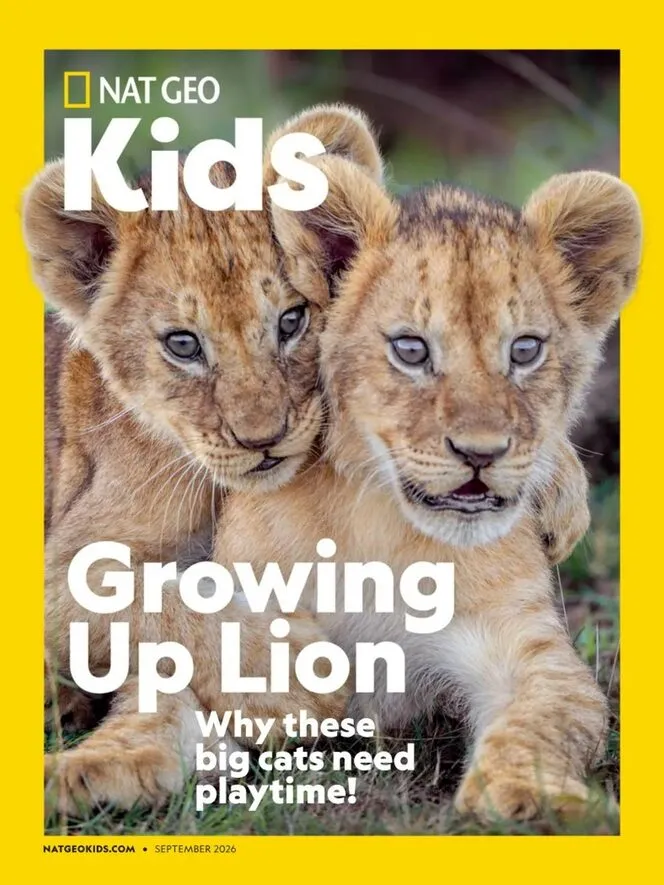
Summary
National Geographic Kids USA (September 2026) opens with "Growing Up Lion" — a six-page cover feature tracking how lion cubs learn to hunt through play. Inside, a palaeontologist reveals how she digs up dinosaurs (p.14), sloths demonstrate their upside-down life (p.20), a whale-sounds feature decodes what 52-hertz calls mean (p.24), and Explorer HQ (p.28) serves puzzles and reader letters.
The lion cub feature (p.4) follows a pride in Botswana's Okavango Delta, where cubs spend 18 months practising stalking, pouncing and bite-inhibition before they can kill effectively. "Weird But True!" (p.12) delivers ten outrageous facts including that a group of flamingos is called a flamboyance. "How I Dig Up Dinos" (p.14) profiles a female palaeontologist who discovered a new species of horned dinosaur. "You Wanna Be a What?!" (p.18) interviews a professional sloth researcher. "Hanging With Sloths" (p.20) covers three-toed sloth biology — they climb down from trees once weekly to defecate. "What Do Whale Sounds Mean?" (p.24) decodes humpback song patterns and orca dialect differences. A bonus story on beach-hunting lions in Namibia's Skeleton Coast closes the feature section.
—————
Content Guide
▸ Cover Story
p.4 · Growing Up Lion
Lion cubs in Botswana's Okavango Delta spend 18 months learning through play: stalk practice, paw-swats and bite-inhibition games with littermates. Females do 90% of the hunting, and cubs begin joining kills at 11 months. The photo sequence shows a cub missing its target by inches — a daily reality that builds persistence. Watch a house cat stalk a toy — every crouch, wiggle and pounce mirrors the lion cub sequence on these pages.
▸ Features
p.14 · How I Dig Up Dinos
Palaeontologist Dr. Niza Ibrahim describes discovering a new horned dinosaur in Morocco: a five-metre, two-tonne plant-eater no one had seen before. The dig site required hiking 20 kilometres into the Sahara each day with pickaxes and plaster. The article lists three ways a kid can become a palaeontologist today — start by fossil-hunting in your own local quarry or riverbed.
p.18 · You Wanna Be a What?!
A professional sloth researcher explains her daily routine: tracking radio-collared three-toed sloths in Costa Rica's rainforest, analysing their gut bacteria and measuring how often they descend to the forest floor. Sloths defecate once every seven to 10 days — that single trip uses 8% of their daily energy. Set a timer for seven days and mark the date — that is how long a sloth goes between bathroom breaks.
p.20 · Hanging With Sloths
Three-toed sloths hang upside-down from branches for up to 18 hours a day. Their fur hosts algae that provides camouflage — green-tinted sloth fur is harder for harpy eagles to spot. The algae also feeds moths that live exclusively in sloth fur. Hang a green scarf from a ceiling hook and spin it slowly — that is a sloth's-eye view of the rainforest.
p.24 · What Do Whale Sounds Mean?
Humpback whale songs change every breeding season — males in the same population learn the new tune from each other. Orca pods speak distinct dialects that differ by family group. A lone orca recorded off the US West Coast calls at 52 hertz — a frequency no other whale uses, earning it the name "the world's loneliest whale." Record your own voice and compare the pitch — 52 hertz is too low for human ears to hear naturally.
▸ Regulars
p.12 · Weird But True!
Ten facts: a group of flamingos is called a flamboyance; octopuses have three hearts; a single strand of spider silk is stronger than steel of the same thickness; honey never spoils. Memorise the honey fact — it is the one children repeat most to their parents at dinner.
p.28 · Explorer HQ
Puzzles, crafts and reader letters. The featured activity: building a paper lion mask with predrawn templates, scissors and elastic string. The mask takes 15 minutes to assemble and uses materials found at home.
—————
Editor's Take
National Geographic Kids USA September 2026 is a well-balanced issue that gives equal weight to mammals (lions, sloths), dinosaurs (new horned species) and marine life (whale songs). The lion cub cover feature is the stand-out — the 18-month learning period and 90%-female-hunting statistic provide concrete numbers that readers aged 7 to 12 can process. The sloth researcher interview (p.18) is the issue's most surprising piece: the once-every-seven-days bathroom routine is the kind of detail that circulates in school playgrounds. The Namibia beach-lion bonus story is short but conceptually strong — lions hunting seals instead of antelope. The "Weird But True!" page (p.12) pulls its weight with the flamboyance and three-hearted-octopus facts. Weakest element is "Explorer HQ" (p.28), which offers a paper lion mask — a craft that is both age-generic and disconnected from the issue's stronger science content.
Strengths
• Lion cub 18-month learning period and 90%-female-hunting statistic are concrete and memorable
• Sloth researcher interview reveals the once-every-seven-days bathroom detail
• Whale-song article teaches orca dialects and the 52-hertz loneliest whale
Weaknesses
• Explorer HQ paper lion mask is disconnected from the issue's stronger science
• Namibia beach-lion bonus story is too short to develop its concept
Verdict: Recommended — Strong lion cover and sloth researcher interview anchor a well-rounded animal science issue. (17 words)
