
Lose Weight with the Anti-inflammatory Diet 2025
Summary
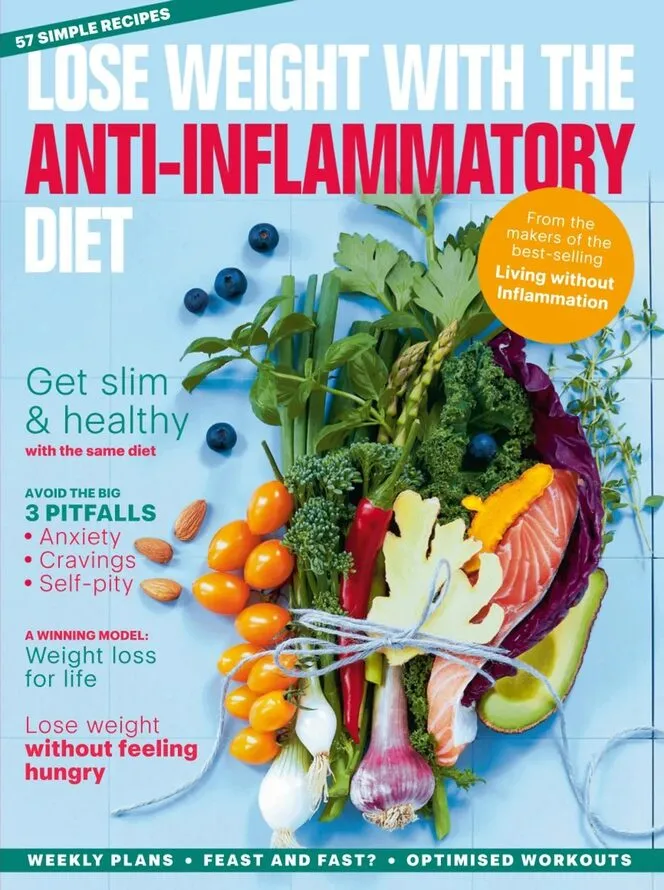
Lose Weight with the Anti-inflammatory Diet 2025 delivers 57 simple recipes across a structured weight-loss framework that uses anti-inflammatory nutrition principles without requiring calorie counting. The guide provides four core strategies — the vegetable strategy (1 kilo of vegetables daily), the plant fat strategy (omega-3-rich fats for satiety), the fish strategy (2-3 servings weekly for omega-3 density) and the fruit strategy (low-glycaemic fruits for antioxidant support) — alongside a weekly food plan at 1,550 calories that promises satiety throughout the day. The makers of the best-selling Living Without Inflammation series produced this targeted weight-loss edition.
The 144-page guide is structured in four parts: "Healthy and Slim with the Same Food" establishes the anti-inflammatory weight-loss principles and the four core strategies, with emphasis on eating vegetables by volume rather than restriction. "Lose Weight Without Feeling Hungry" covers protein maximisation, the satiety continuum, fat selection and carbohydrate reduction, including a 1,550-calorie daily meal plan. "Optimise Your Weight Loss with Exercise" provides an eight-week cardio walking programme and a simple 15-minute strength routine. "Achieve Your Ideal Weight and Maintain It Forever" addresses the three biggest weight-loss pitfalls — anxiety, cravings and self-pity — with a behavioural model for long-term lifestyle change.
The recipe section spans 70 pages across five meal categories: breakfast (p.74), lunch (p.82), snacks (p.94), dinner (p.98) and dessert (p.140), plus a basic ingredients section (p.144). Each recipe includes preparation time, anti-inflammatory ingredient call-outs and portion guidance.
—————
Content Guide
▸ The Four Strategies
p.10 · The Vegetable Strategy
Eat 1 kilo of vegetables daily — approximately half the volume of each meal plate — to maximise fibre, antioxidant and polyphenol intake while naturally reducing calorie density. The guide provides a one-day sample: 300g at lunch, 300g at dinner and 400g distributed across snacks and a side salad. Start your lunch and dinner with a vegetable-first approach: eat the vegetables on your plate before touching the protein or starch.
p.12 · Antioxidants Are Gold for Your Cells
A colour-based guide to phytochemicals: red (lycopene from tomatoes, watermelon), orange (beta-carotene from carrots, sweet potato), green (chlorophyll from leafy greens, broccoli) and purple (anthocyanins from berries, red cabbage). The more colours on your plate, the broader your antioxidant coverage. Aim for 5 different vegetable colours across each day.
p.16 · The Plant Fat Strategy
Healthy fats from olives, avocados, nuts and seeds provide satiety and anti-inflammatory omega-3s without the processed oil drawbacks. The recommended daily intake: 1-2 tablespoons of extra-virgin olive oil, a handful of walnuts or almonds, and half an avocado. Add 1 tablespoon of ground flaxseed to your morning smoothie or porridge for an instant omega-3 boost.
p.18 · The Fish Strategy
Fatty fish (salmon, mackerel, sardines, herring, anchovies) provide pre-formed EPA and DHA omega-3s that plant sources cannot match. Target 2-3 servings weekly, each approximately 150g cooked weight. Canned sardines or mackerel on a salad count as one serving and cost significantly less than fresh salmon.
▸ Weight-Loss Mechanics
p.30 · Maximise Proteins
Protein at every meal is the single most effective strategy for appetite control during a calorie deficit. The guide recommends 25-35g protein per meal from sources including eggs, Greek yoghurt, poultry, fish, legumes and tofu. A 3-egg omelette with vegetables delivers approximately 20g protein; add 100g smoked salmon for another 20g.
p.38 · Eat Little but Often
Four to five small meals spread across the day maintains steady blood glucose and prevents the hunger-driven overeating that derails weight loss. Each mini-meal should contain protein, fibre and healthy fat. The sample 1,550-calorie day includes breakfast (300 cal), mid-morning snack (150 cal), lunch (450 cal), afternoon snack (150 cal) and dinner (500 cal).
p.43 · Weekly Food Plan — Feel Full All Day on Just 1,550 Calories
A complete 7-day meal plan at 1,550 calories designed to eliminate hunger through strategic protein distribution and high-volume vegetable inclusion. Each day averages 100g protein, 40g fibre and 50g healthy fat. Prep Sunday: roast a tray of mixed vegetables, cook a batch of quinoa, grill 4 salmon fillets and hard-boil 6 eggs for grab-and-go weekday options.
▸ Exercise
p.50 · Walk Yourself Slim
The most accessible starting point for weight-loss exercise: a progressive walking programme building from 20 minutes daily to 60 minutes over eight weeks. Walking at a moderate pace (130 steps per minute) for 45 minutes burns approximately 200-250 calories while imposing minimal recovery demands.
p.54 · Eight Weeks of Cardio Training on Foot
A structured programme alternating steady-state walks with interval-style walks (3 minutes brisk, 2 minutes moderate). Week 1: 20 minutes steady. Week 4: 35 minutes with intervals. Week 8: 50 minutes with intervals. Target a perceived exertion of 6-7 out of 10 during brisk intervals.
▸ Behaviour Change
p.66 · Challenge 1: "I'm Suddenly Feeling Hungry"
Coping with breakthrough hunger is the number one reason dieters quit. The guide provides a decision tree: drink 500ml water, wait 10 minutes, if still hungry eat a pre-approved snack (apple with almond butter, Greek yoghurt, vegetable sticks with hummus). Distinguish boredom hunger from physical hunger by asking: would I eat an apple? If the answer is no, you are not physically hungry.
p.68 · Challenge 3: "I Feel Sorry for Myself"
The self-pity trap that derails weight loss when social events, stressful weeks or minor setbacks trigger a "what's the point" spiral. The guide's model: acknowledge the emotion without judgment, identify the trigger, choose one small positive action (a 10-minute walk, a single healthy meal) rather than attempting a full reset. One imperfect day does not undo a week of consistent habits.
p.70 · Successful Model for Long-Term Lifestyle Change
A behavioural framework based on habit stacking, environmental design and self-compassion rather than willpower. The three pillars: (1) attach new habits to existing routines — do 10 minutes of stretching after your morning coffee; (2) remove obstacles — keep vegetables pre-chopped in the fridge; (3) forgive failures — one off-plan meal is data, not a catastrophe.
—————
Editor's Take
This anti-inflammatory weight-loss guide succeeds where most diet books fail by addressing the three specific failure points — hunger, cravings and self-pity — with concrete protocols rather than motivational slogans. The 1-kilo-of-vegetables daily target is measurable and achievable, and the weekly food plan at 1,550 calories is realistic for a sedentary woman or moderately active man. The weakness is the exercise section: the eight-week walking programme is appropriate for absolute beginners but offers no progression pathway beyond week eight, and the 15-minute strength programme is too brief to drive meaningful metabolic adaptation. This guide best suits women aged 35-65 who have tried restrictive diets and failed, and need a volume-based approach that prioritises satiety over calorie restriction.
Strengths
• Three behavioural challenge protocols are genuinely practical and evidence-informed
• 1-kilo vegetable daily target is specific, measurable and satiety-focused
• Weekly food plan at 1,550 calories includes specific protein and fibre targets per meal
Weaknesses
• Exercise section lacks progression beyond 8 weeks of walking
• 15-minute strength programme insufficient for metabolic adaptation in most adults
Verdict: Recommended — Strongest on behavioural psychology and meal structure, though the exercise component needs a clearer long-term pathway for sustained results.
