
Marine Corps Times – September 2026
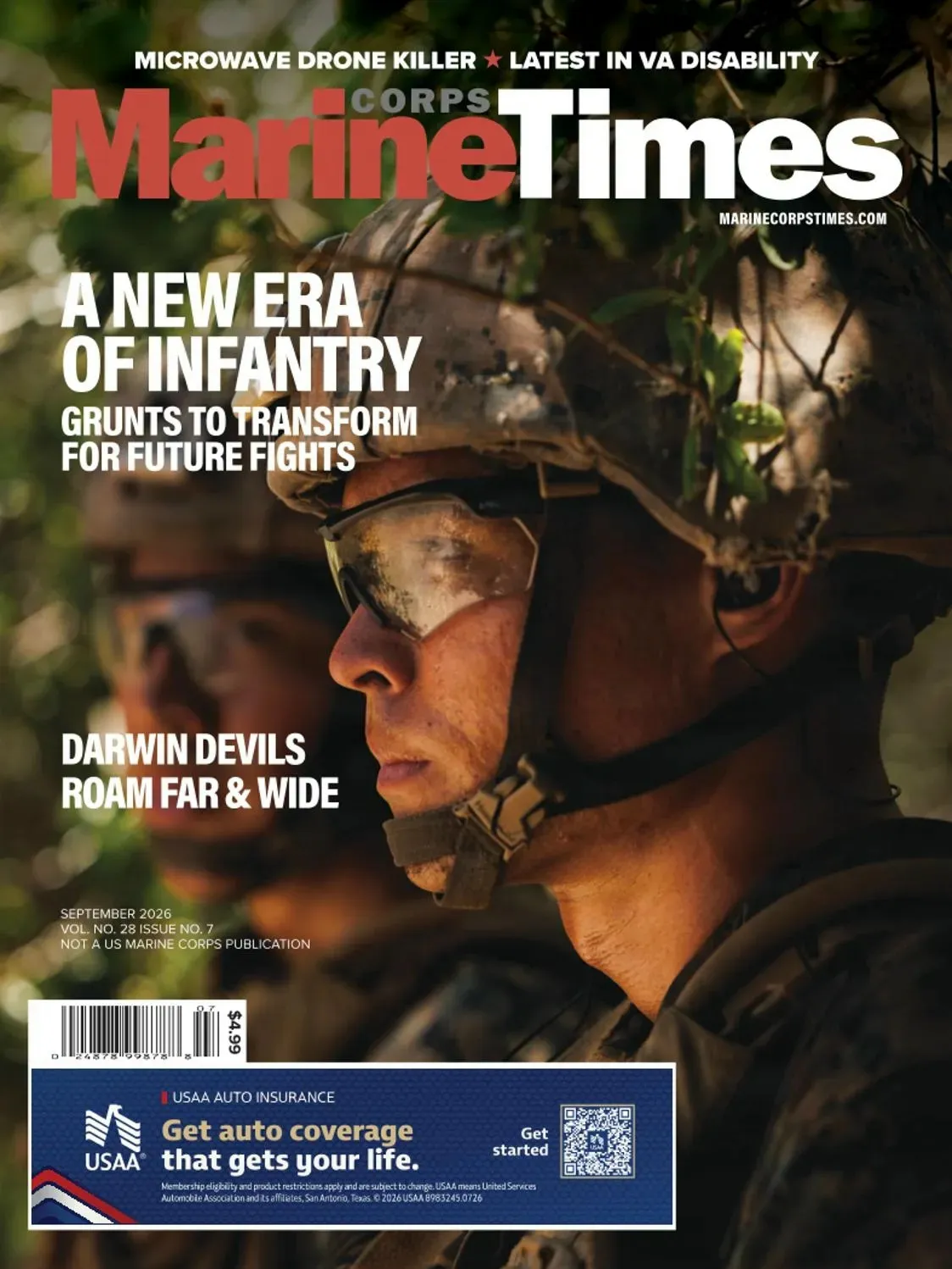
Summary
The Marine Corps is betting its future on drone-versus-drone combat — a new table of equipment for infantry battalions includes at least one counter-drone system per squad, according to the September 2026 issue of Marine Corps Times, which also reports that VR-based helicopter training has cut flight hours by 25 percent but triggered a debate on pilot readiness.
The lead feature, The Drone War Is Here (page 14), documents how every infantry battalion in the Corps is fielding counter-drone capabilities, with at least one system per squad. Enemy drones now dictate tactics at the squad level — a shift as significant as the introduction of the IED in Iraq. Infantry Transformation (page 18) reports on structural changes to fire teams and the new emphasis on electronic warfare. The Force Fitness section (page 22) publishes the latest heat-and-cold injury prevention guidelines, referencing WBGT (Wet Bulb Globe Temperature) thresholds and the 2,751 documented heat injuries across the force in FY2025. The issue also covers the new M27 IAR distribution timeline, the M855A1 ammunition recall, and the F-35B readiness rates at MCAS Yuma.
—–
Content Guide
▸ Cover Story
p.14 · The Drone War Is Here
Counter-drone capability is now fielded to every infantry battalion, with at least one system per squad. The article reports that enemy drone surveillance and loitering munitions have changed squad-level tactics more in three years than small-arms tactics changed in thirty. Marine Corps Times interviews squad leaders who have trained against drone swarms at Twentynine Palms and Quantico. The takeaway: every Marine should understand basic drone-defeat procedures, because the enemy's quadcopter sees you before your NCO does.
▸ Features
p.18 · Infantry Transformation
Structural changes to how infantry fire teams are organised, with a new emphasis on organic electronic warfare capability at the company level. The article breaks down the new table of organisation, showing how many EW operators are added per battalion and what equipment they carry. The change reflects lessons from Ukraine, where EW has become as common as mortar fire.
p.22 · Force Fitness — Heat and Cold Injury Prevention 2026
Updated guidelines for preventing temperature-related injuries across the force. The article publishes the specific WBGT thresholds for modified training, strenuous work and mission-essential operations. FY2025 saw 2,751 documented heat injuries across the Marine Corps — a 12 percent increase over FY2024. The new guidance requires unit leaders to record WBGT readings hourly during field exercises. Carry a Kestrel 5400 pocket weather meter; the digital WBGT readout is your legal defence if a heat casualty occurs.
p.26 · VR Flight Training — 25 Percent Fewer Hours, But Are Pilots Ready?
The Corps has reduced flight hours by 25 percent for CH-53K and MV-22 pilots through expanded VR simulation training. The article interviews instructor pilots who say VR builds procedural fluency but does not replicate the physical stress of a real cockpit. The debate centres on whether hour-count reductions go too far before the next generation of full-motion simulators arrives.
p.30 · M27 IAR Update
The M27 Infantry Automatic Rifle is now issued to every fire team across the Fleet Marine Force, with deliveries to reserve units scheduled for completion by Q2 2027. The article includes feedback from unit armourers on parts breakage rates and the suppressor programme.
p.34 · M855A1 Ammunition Recall
The recall covers specific lot numbers of 5.56mm M855A1 Enhanced Performance Round linked to accuracy degradation in cold-weather testing at extreme ranges. Units are instructed to quarantine affected lots and report via the ALMAR tracking system.
▸ Regulars
p.04 · Pentagon & The Hill
Congressional budget negotiations for FY2027: the House Armed Services Committee has authorised a 4.5 percent pay raise for junior enlisted and targeted funding for the new Light Amphibious Warship program. The article names specific representatives and their amendments.
p.08 · Your Marine Corps
Transfers, promotions and command changes across the Fleet Marine Force. Names the new commanding officers at major bases and the latest slate for the Gunnery Sergeant promotion board. Essential reading for career Marines tracking the next assignment cycle.
p.36 · Off Duty
Reviews of the latest tactical gear, field rations and fitness equipment tested by Marine Corps Times staff. This month: the Mystery Ranch 3-Day Assault Pack vs. the new Eagle Industries YOTE pack — weight, durability and load-distribution scores for each.
p.38 · Pay & Benefits
The latest on BAH rate adjustments for 2027, the new dependent-care subsidy expansion, and the disability-claims processing timeline at the St. Louis regional office. Data-driven guidance for career and transition planning.
—–
Editor's Take
This is one of the most genuinely useful issues Marine Corps Times has published in the past twelve months. The drone-war feature (page 14) and the heat-injury prevention guide (page 22) both provide information that a platoon commander could use in tomorrow's training brief — the WBGT thresholds and the 2,751-injury FY2025 figure are specific enough to drive real decisions. The infantry-transformation piece (page 18) is well-sourced but reads like a staff paper; it could benefit from a single squad leader's voice to make the org-chart changes feel human. The VR flight-training debate is balanced and timely — the 25-percent hour reduction figure will generate strong opinions in the pilot community. On the weak side, the M27 IAR update and the M855A1 recall notice are essential reading but short, occupying less than a full page each when the topics deserve deeper analysis. The Pentagon & Hill coverage (page 4) is standard appropriations reporting without the sharp edge that characterises the best defence journalism. The ad load is moderate — the back cover is a full-page USAA recruitment ad, and the inside front cover promotes the Marine Corps Ball 2026 merchandise — but the ratio of editorial to advertising in the front well is acceptable. This issue suits the active-duty NCO and company-grade officer; retired readers and defence-policy wonks may find the gear reviews and pay tables more valuable than the tactical coverage.
Strengths
• Drone-war feature with squad-level counter-drone tactics
• Heat-injury guide with WBGT thresholds and 2,751-case FY2025 data
• VR flight-training debate with 25-percent hour-reduction figure
Weaknesses
• Infantry-transformation piece lacks a frontline voice
• M27 update and M855A1 recall are too brief for the topics
Verdict: Essential — The drone-war and heat-injury features both deliver actionable information for tomorrow's training; this is the kind of issue Marines keep in their packs.
