
Residential Design – Vol. 4 2026
Summary
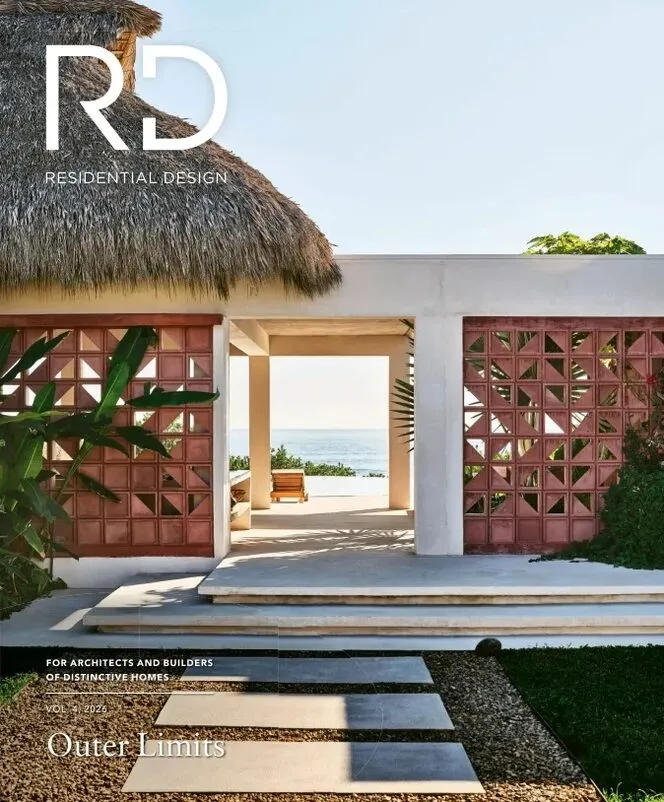
Three rural houses by Sparano + Mooney Architecture, Amanda Martocchio Architecture and Baldwin Architects give Residential Design Vol. 4 its Outer Limits cover, and the issue pairs that Design Lab at page 32 with a Lake Michigan case study at 24.
Residential Design Vol. 4, for architects and builders of distinctive homes, opens with Editor's Note at 8 and AIA CRAN at 10, where custom residential architects are set to convene in San Antonio, Texas. Features carry Case Study: Full Transparency at 24, an expansive home on Lake Michigan, and Design Lab: Outer Limits at 32, with three rural houses offering a sensory reset. Pro-File Design at 12 covers Minarc's practical Icelandic lens.
RD Interior Architecture at 18 looks at Meyer Davis' Casa Maya embracing Mexico's culture and climate. Departments close with RD Products at 56 and Parti Shot at 58, where Specht Novak's Wildcat Hollow House addresses privacy and transparency. For architects the Design Lab and the Minarc profile are the working parts; the Lake Michigan case study is the one to show a client.
—————
Content Guide
▸ Features
p.32 · DESIGN LAB: OUTER LIMITS
Design Lab: Outer Limits is the cover feature at 32, presenting three rural houses by Sparano + Mooney Architecture, Amanda Martocchio Architecture and Baldwin Architects that offer occupants a sensory reset. The piece covers how each handles its site and materials. Study how each of the three handles the same problem of remoteness before you design your own rural house.
p.24 · CASE STUDY: FULL TRANSPARENCY
Case Study: Full Transparency at 24 covers an expansive home on Lake Michigan, described as just as good for hosting guests as for being alone. The piece deals with glass, layout and the balance between openness and retreat. Ask how the house handles privacy at night before you specify that much glass.
▸ Departments
p.12 · PRO-FILE DESIGN
Pro-File Design at 12 covers Minarc applying a practical Icelandic lens to solving design problems. The piece names the firm and its method. Look at how the Icelandic approach handles material limits, then test it on a current project.
p.18 · RD INTERIOR ARCHITECTURE
RD Interior Architecture at 18 looks at Meyer Davis' Casa Maya, which embraces Mexico's culture and climate. The piece covers the interiors and their response to place. Note how the interiors handle heat and light, since the climate drives the design.
p.10 · AIA CRAN
AIA CRAN at 10 reports that custom residential architects are set to convene in San Antonio, Texas. The column names the event and its focus. Register before the San Antonio date if you work in custom residential.
p.56 · RD PRODUCTS
RD Products at 56 lists fresh products for your next projects, with the items named. The section is a sourcing page. Request samples of two products here before specifying them.
p.58 · PARTI SHOT
Parti Shot at 58 closes with Specht Novak's Wildcat Hollow House, which addresses privacy and transparency. The piece gives the parti and the resolution. Sketch the parti yourself before reading how Specht Novak resolved it.
p.8 · EDITOR'S NOTE
Editor's Note at 8 opens the issue and sets its direction. It names the themes and the projects inside. Read it before the features, since it frames the Outer Limits cover.
—————
Editor's Take
Residential Design Vol. 4 is a short, focused issue and better for it: Design Lab: Outer Limits at 32, with three rural houses from Sparano + Mooney, Amanda Martocchio and Baldwin Architects, is the strongest piece, because three firms answering the same remoteness brief is far more useful than one house shown at length. Case Study: Full Transparency at 24, the Lake Michigan house, is the second best and the one a client will respond to. The weakness is scale: with eight listed entries, much of the issue is departments and products, and RD Products at 56 is a sourcing page rather than reading. The cover, three rural houses under Outer Limits, is clean and tells you exactly what is inside. This is for practising architects and custom builders; it is too thin and too trade-specific for a general design reader.
Strengths
• Three firms answer one rural-house brief
• Lake Michigan case study balances openness and retreat
• Minarc profile gives a usable design method
Weaknesses
• Only eight listed entries; thin for a volume
• RD Products is a sourcing page, not reading
Verdict: Recommended for architects — Design Lab and the case study earn it; the rest is departments.
