
National Wildlife – Summer 2026
Summary
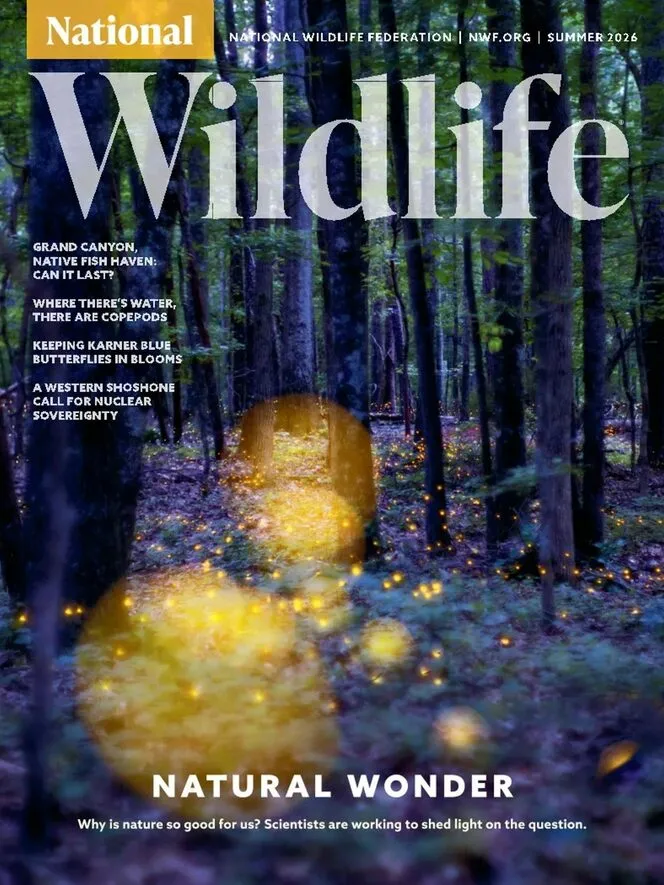
Fireflies glowing in synchrony in Athens, Georgia, photographed by Mark Magnarella, light the cover of National Wildlife Summer 2026 (Volume 64, Number 3). Collin O'Mara opens on 90 years of NWF, founded after a February 1936 gathering of hunters, anglers, hikers and birders in Washington DC.
Katarina Zimmer's How Nature Nurtures at p28 is the cover story: nature boosts health, and scientists are working out why, from lowering cortisol to supporting immune health. PLIGHT OF THE BUTTERFLY at p22 follows teams saving Karner blue butterflies, and A GRAND GESTURE at p34 covers a 277-mile stretch of the Colorado River in Grand Canyon outperforming the rest of the waterway at protecting native fish.
Diana Kruzman's THE NUCLEAR OPTION at p48 reports Western Shoshone activists protesting nuclear testing on ancestral land they say was never ceded. Small Wonders at p42 finds copepods wherever there is water — 70% of Earth's surface. Membership runs a $15 minimum with $5 for the subscription, and renewal brings a navy cap.
—————
Content Guide
▸ Cover Story
p.28 · HOW NATURE NURTURES
Katarina Zimmer reports that while it is common wisdom that nature boosts our health, scientists are trying to understand the reasons, from lowering cortisol levels to supporting immune health. Jennifer Wehunt's editor's notebook frames it as the cover story, noting she watched an opossum walk the fence and a red-tailed hawk feed repeatedly from her south-facing window. Spend twenty minutes outside without a screen today and note how you feel after.
▸ Species
p.22 · PLIGHT OF THE BUTTERFLY
Lauren Owens Lambert writes and photographs how teams of experts across the north-eastern US work together to bring Karner blue butterflies back from the brink. Cooperative recovery is how small-range species survive at all. Ask whether your state has a Karner blue or similar recovery plan.
p.42 · SMALL WONDERS
Avery Schuyler Nunn writes and Angel Fitor photographs copepods, which abound anywhere there is water, covering 70% of the planet's surface, and play key roles in aquatic ecosystems and especially the ocean. The smallest animals carry the largest food webs. Fill a jar from a pond and look for copepods with a lens this week.
p.48 · THE NUCLEAR OPTION
Diana Kruzman reports that Western Shoshone activists are protesting ongoing nuclear testing on ancestral land, plus the threat of expanded testing and nuclear storage, on territory they say was never ceded. Land rights and nuclear policy are the same story here. Read the tribe's own statements before any official account.
▸ Conservation and Habitat
p.34 · A GRAND GESTURE
David Herasimtschuk writes and photographs how, in recent years, a 277-mile stretch of the Colorado River through Grand Canyon National Park has outperformed the rest of the waterway at protecting native fish from predatory invasive species, and whether that will change. A single managed stretch holding the line is worth more than a plan. Ask what happens to that 277 miles under current policy.
p.12 · COMMUNAL HABITAT — Tallying rodenticides' deadly toll
The communal habitat department tallies the deadly toll of rodenticides. Rodenticides kill the predators that eat the rodents. Stop using rodenticide at home and check what your neighbour puts down.
p.14 · GARDEN FOR WILDLIFE — How to support nesting birds
Nesting bird support gets the garden column. Nest success decides populations more than any winter feeding. Leave one hedge uncut until after the nesting season.
p.16 · RESOURCE REPORT — The wide-ranging costs of algal blooms
Algal blooms and their wide-ranging costs are reported here. Blooms close beaches and poison water supplies in the same week. Check your local water body's advisory before swimming this summer.
▸ Departments
p.6 · PRESIDENT'S VIEW — 90 years of speaking up for wildlife
Collin O'Mara, president and CEO, marks 90 years since the February 1936 gathering in Washington DC that highlighted America's wildlife crisis, when conservationists even through the Depression and Dust Bowl pushed Congress and President Franklin D. Roosevelt to legislate that wildlife and habitat be protected and restored for the public rather than managed for a wealthy few, laying the foundation of the North American Model of Wildlife Conservation. NWF counts 7 million members, 4,000-plus partners, and notes over a third of US wildlife species face elevated extinction risk. Read the 90-year figure before you dismiss the lobbying.
p.5 · EDITOR'S NOTEBOOK — Powering down to charge up
Jennifer Wehunt writes on recharging offline, about 12 years after getting her first work laptop. She endorses the issue's nature and health cover story. Count your own hours offline for one day.
p.10 · NEXT GENERATION — Vishal Kennedy is mapping the future
Vishal Kennedy is profiled for mapping the future. Young mapmakers decide what conservation can measure. Look up one youth-led mapping project and follow it.
p.18 · SOCIAL STUDY — Ivory-bills live on in the minds of fans
The social study covers how ivory-bills live on in the minds of fans. Belief in a lost species is a social fact even without a bird. Read it before you argue about ivory-billed woodpeckers online.
—————
Editor's Take
How Nature Nurtures earns the cover of National Wildlife Summer 2026 by admitting the interesting part is the mechanism, not the claim, and Katarina Zimmer's cortisol and immune angles give readers something to test. The 277-mile Grand Canyon stretch outperforming the rest of the Colorado at protecting native fish is the best reported feature, and the copepods covering 70% of the surface is the kind of fact that reframes a pond. Weakest is the photo contest correction carried into this issue: one winning image was a composite, which damages trust in a magazine built on photography. The President's View is anniversary writing with 90 years and 7 million members doing the work. Buy this for the river and butterfly features; the anniversary pages are for members.
Strengths
• Cover story asks how nature works, not whether
• Grand Canyon gives a 277-mile managed stretch
• Copepods cover 70% of the surface
• Rodenticide and algal bloom pages are practical
Weaknesses
• Photo composite correction damages trust
• President's View is anniversary writing
Verdict: Recommended — the river and butterfly reporting, weaker anniversary pages.
