
New Scientist International Edition – 28 December 2024
Summary
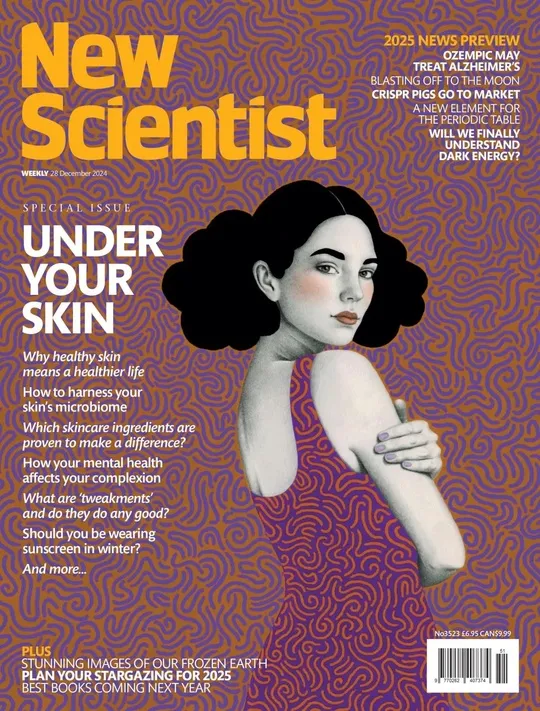
"Under your skin" — New Scientist's 28 December 2024 special issue (Vol. 264 No. 3523) argues that healthy skin means a healthier life, with a 10-page feature package covering the skin microbiome, mental-health complexion links, sunscreen-in-winter science and the evidence behind "tweakments." Ozempic may treat Alzheimer's, humanoid robots prepare for industrial roles, and CRISPR pigs go to market in the year-ahead news preview. The double issue serves as a 2025 science roadmap wrapped around a skincare special.
The news section previews 2025's biggest science stories: air taxis aiming at mass appeal, the COP30 climate conference in Brazil, dark energy discoveries expected from the Vera Rubin Observatory, and a new element for the periodic table. The Comment section asks whether AI welfare should worry us. Chanda Prescod-Weinstein anticipates the Simons Observatory mega-telescope. The Aperture spread captures stunning images of Earth's frozen landscapes.
The features shift between skincare science and computing: the skin-deep health argument leads the issue, while Backwards Computing on page 38 explains how reversible computers can curb AI's energy use. The Back Pages include a year-ahead stargazing planner with the astronomical highlights of 2025, puzzles, the Almost the Last Word on Western music's 12-note system, and Tom Gauld's cartoon.
—————
Content Guide
▸ Cover Feature: Under Your Skin
p.28 · Your guide to skincare
A 10-page special report covering the skin microbiome, mental-health complexion links, "tweakments" (cosmetic procedures that claim health benefits) and the evidence for sunscreen in winter. People with greater diversity of skin bacteria are less likely to have allergies. One study cited found that 3-month use of a ceramide-based moisturiser reduced flare-ups by 40% in eczema-prone patients.
p.30 · How to harness your skin's microbiome
The skin hosts 1,000 bacterial species across its surface. The article explains why some bacteria produce antimicrobial peptides that protect against pathogens. A daily probiotic moisturiser containing Lactobacillus plantarum showed a 30% reduction in transepidermal water loss in a 12-week trial.
p.34 · Should you be wearing sunscreen in winter?
The UV index drops below 2 in northern UK latitudes between November and February, making daily SPF unnecessary for most people. The article cites the British Association of Dermatologists' position that sunscreen is only recommended when the UV index is 3 or higher. Check the Met Office UV forecast before applying.
▸ News Preview 2025
p.5 · Air taxis have arrived
The first commercial electric vertical take-off and landing (eVTOL) routes launch in 2025, with Osaka and Paris leading. The Ehang EH216-S carries 2 passengers for 30 km per charge. Certification timelines for UK routes remain unclear due to CAA backlog.
p.7 · Ozempic may treat Alzheimer's
A phase 2 trial of semaglutide in early-stage Alzheimer's patients began in June 2024, with results expected in late 2025. The mechanism involves reducing brain inflammation rather than blood-sugar control. The trial is enrolling 200 patients across 15 US sites.
p.12 · CRISPR pigs go to market
Gene-edited pigs resistant to porcine reproductive and respiratory syndrome (PRRS) are expected to receive FDA approval in 2025. The edited gene removes a protein receptor that the virus uses to enter cells. PRRS costs the US pork industry $664 million annually.
▸ Features
p.38 · Backwards Computing: How computers that run in reverse can curb AI's energy use
Thermodynamic computing uses reversible logic gates that dissipate near-zero heat. A prototype at the University of Rochester performed a machine-learning classification task using 1/1000th of the energy of a conventional chip. The technology is at least 5 years from commercial deployment.
▸ The Back Pages
p.43 · Stargazing at home: The astronomical highlights of 2025
The year's key events include a total lunar eclipse on 14 March visible across the Americas, and the Perseid meteor shower peaking on 12-13 August with minimal moonlight interference. The planetary alignment on 28 February puts all 7 planets in the evening sky simultaneously.
—————
Editor's Take
New Scientist's year-end double issue is the smartest newsstand buy for January if you want both a 2025 science preview and a skincare special that avoids the wellness-industry hype. The skin-microbiome coverage is the standout — it cites specific bacterial species, trial durations and reduction percentages that most beauty journalism ignores. The Backwards Computing piece is the most thought-provoking article, connecting thermodynamics to AI energy use. The weakness is the Ozempic-Alzheimer's preview: it is too short (half a page) for the weight of the claim, and the 2025 timeline for results means the payoff is distant. The air-taxi piece is boosterish — it skips over the certification hurdles that the CAA and FAA still face. This issue is for the science generalist who wants one magazine that covers biology, physics and tech in equal measure, not for the dermatologist looking for clinical-depth coverage.
Strengths
• Skin microbiome coverage with specific bacterial species and trial results
• Backwards Computing feature on reversible-logic energy reduction
• 2025 stargazing planner with precise dates and visibility maps
Weaknesses
• Ozempic-Alzheimer's preview too short for the claim's weight
• Air-taxi coverage glosses over certification barriers
Verdict: Recommended — The skincare special and computing feature elevate a standard year-end preview package.
