
New Scientist International Edition – 5 September 2026
Summary
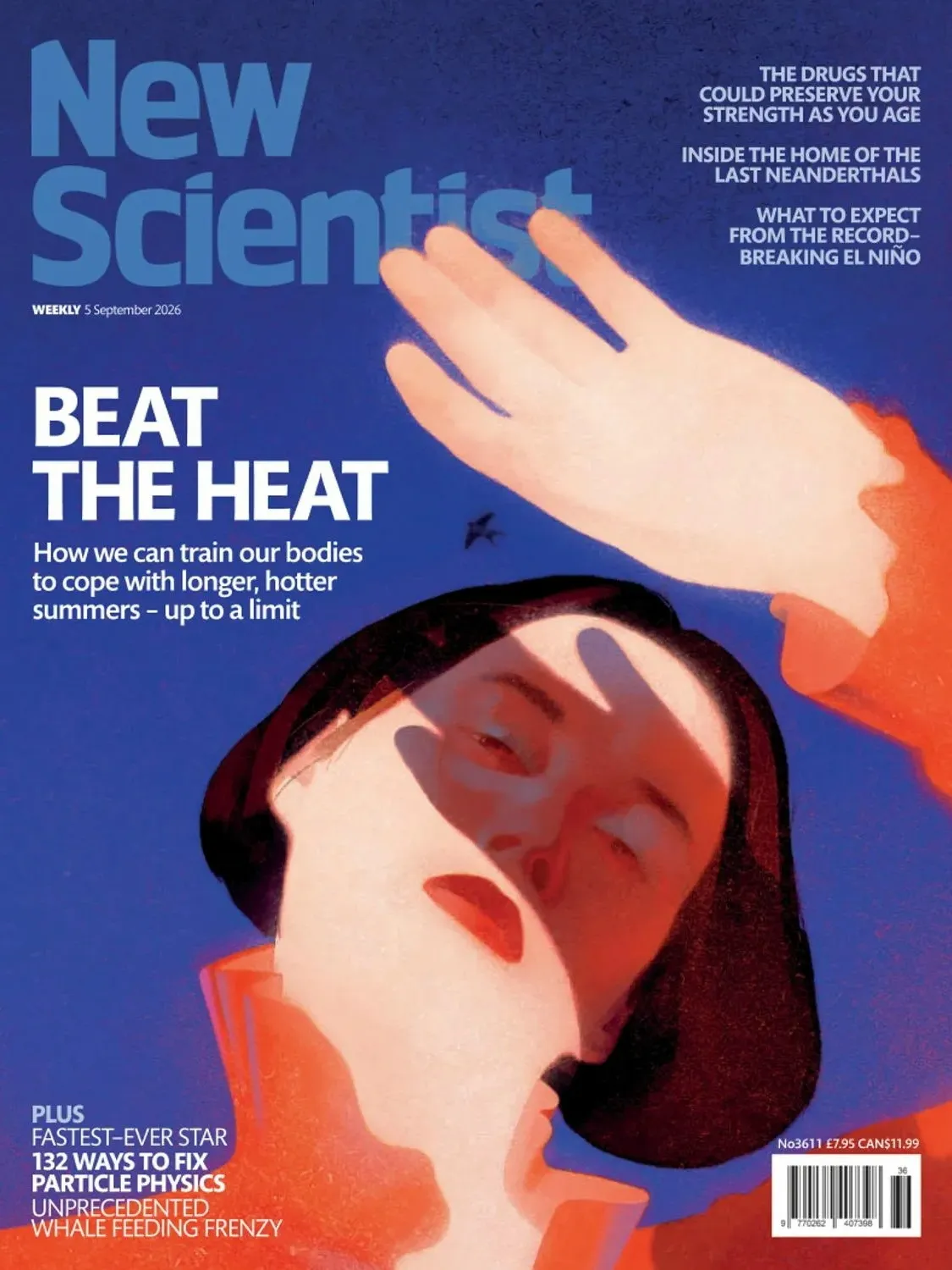
Vol 271 No 3611's cover story "Beat the heat" warns that record-breaking El Niño pushing 2027 toward the hottest year on record means our bodies can adapt to longer summers—but only up to a limit, as New Scientist's 5 September 2026 issue reports. Six pages inside detail how training the cardiovascular system and rethinking summer habits can help, while Alec Luhn witnesses Alpine glaciers vanishing firsthand on page 12.
The issue's three features anchor the package: the heat-adaptation cover (p.30), Ukraine's war-driven prosthetics industry (p.36), and the cave where Neanderthals lived and died (p.40). News covers nanoparticle Alzheimer's therapy (p.6), a no-exertion exercise patch (p.10), and dice that solve a decade-long maths problem (p.14). Helen Thomson asks how much water we really need to stay sharp (p.18), and Michael Le Page investigates muscle-boosting drugs (p.20).
Regular back-page puzzles, Tom Gauld's cartoon, and Feedback's look at a fabricated scientist story round out the issue. The leader calls for aggressive emissions cuts beyond adaptation, insisting prediction alone won't contain the crisis.
—————
Content Guide
▸ Cover Story / Climate
p.30 · The heat is on — You can help your body better adapt to high temperatures, but only up to a point
Collett walks through how heat acclimation works: plasma volume expands, sweat rate rises, core temperature stabilises lower. The article drills into the hard limit—wet-bulb temperature around 35°C—beyond which no human can shed heat. Readers get a practical checklist for personal heat training during the hottest weeks.
p.4 · What to expect from the record-breaking El Niño
This news feature lays out how the 2026 super El Niño stacks up against 2015-16 and 1997-98, with sea-surface temperature anomalies that already exceed both. It projects knock-on effects on global food supply, wildfire risk, and the likelihood that 2027 becomes the hottest calendar year on record. Two graphs show month-by-month warming forecasts.
p.12 · Rhone runoff — The impact of the Alps' disappearing glaciers
Alec Luhn reports from the Alps, where vanishing glaciers are rerouting the Rhone and disrupting hydro-power and irrigation for six countries. He interviews Swiss glaciologists who have watched 20 percent of the remaining ice mass vanish in the past four years. A satellite image pair (2006 vs 2026) makes the loss plain.
▸ Health / Medicine
p.6 · Budding nerve cells — Nanoparticle drug holds hope for Alzheimer's treatment
Researchers at Oxford have engineered nanoparticles that cross the blood-brain barrier and stimulate neurogenesis in mouse models of Alzheimer's. The piece explains the mechanism—targeted delivery of a Wnt pathway activator—and notes that human trials could begin within 18 months if safety data holds. A diagram maps the nanoparticle's journey from injection to neuron growth.
p.10 · Not breaking a sweat — Exercise patch delivers some of the benefits of a workout without the exertion
A wearable patch placed on the skin releases a compound that mimics the metabolic effects of moderate exercise. Early studies show increased fatty-acid oxidation and improved insulin sensitivity in sedentary test subjects. The catch: it does not build muscle or cardiovascular endurance, so it is a supplement, not a substitute.
▸ Technology / Society
p.36 · Ukraine's growing industry — Injuries from the war have forced the country to develop highly advanced prostheses
Ukrainian engineers and amputees have built a civilian prosthetics sector that now rivals Western offerings in socket design and myoelectric control. The article profiles three veterans who received bionic hands and returned to work. A cost comparison table shows Ukrainian-made limbs at roughly one-third the price of imported equivalents.
p.14 · A roll of the dice — Dice discovered that solve decade-long maths problem
Mathematicians have found a set of five dice whose pairwise win probabilities form a perfect intransitive loop—solving a puzzle that had resisted proof since 2016. The piece explains the discovery's significance for game theory and its unexpected application in distributed computing load-balancing.
▸ Natural World
p.40 · Neanderthals' downfall — Inside the cave where Neanderthals lived and died
Excavations in a cave system in southern France have yielded the most complete Neanderthal stratigraphy ever found, spanning 90,000 years of occupation. The team found evidence of controlled fire use, tool making, and butchery, alongside a child's burial. The final layer, dated to 40,000 years ago, shows no more Neanderthal presence—only Homo sapiens tools.
p.24 · Book of the week — A remarkable book unravels the secrets of snow leopards
A review of a new photographic work that follows six snow leopards across the Himalayas over three winter field seasons. The reviewer calls the freeze-frame behaviour shots the best ever captured in the wild.
▸ Regulars
p.45 · Puzzles — Try our crossword, puzzle and quick quiz
A full page of brainteasers including a cryptic crossword, a logic grid, and the quick quiz. The quiz asks five science-current-events questions drawn from the issue's news pages.
p.46 · Almost the last word — If the sun suddenly disappeared, how long would life on Earth last?
Readers answer the classic hypothetical: darkness arrives after 8 minutes, photosynthesis halts within days, and the surface freezes within weeks. The most cited estimate for total ecosystem collapse is one year.
—————
Editor's Take
This is the strongest New Scientist issue of September 2026. The "Beat the heat" cover feature earns its real estate with concrete acclimation protocols and a candid acknowledgment of physiological limits—no breathless scaremongering, no silver-bullet promises. Ukraine's prosthetics feature (p.36) delivers the kind of frontline science journalism the magazine does best: specific, human, and policy-relevant. The Neanderthal cave piece (p.40) is a pleasure to read. Weakest moment: "The next health hack" (p.20) reads as a thinly sourced speculation loop about muscle drugs that never lands on a conclusion. The full-page watch ad on the inside front cover repeats in four other issues this quarter, which feels like filler. Best suited for climate-concerned general readers and AS-level biology students hunting real-world examples; less useful for professional climate scientists who already know the limits of acclimation.
Strengths
• Concrete heat-acclimation protocols backed by physiology
• Ukraine prosthetics story: specific, human, policy-relevant
• Neanderthal stratigraphy that reads like a detective story
Weaknesses
• "Next health hack" speculates without landing a conclusion
• Repeated full-page watch ad inside front cover
Verdict: Recommended — A tight, non-sensational climate feature anchored by two strong supporting features; skip the muscle-drugs column.
