
All About History History of Vampires – 8th Edition – 3 September 2026
Summary
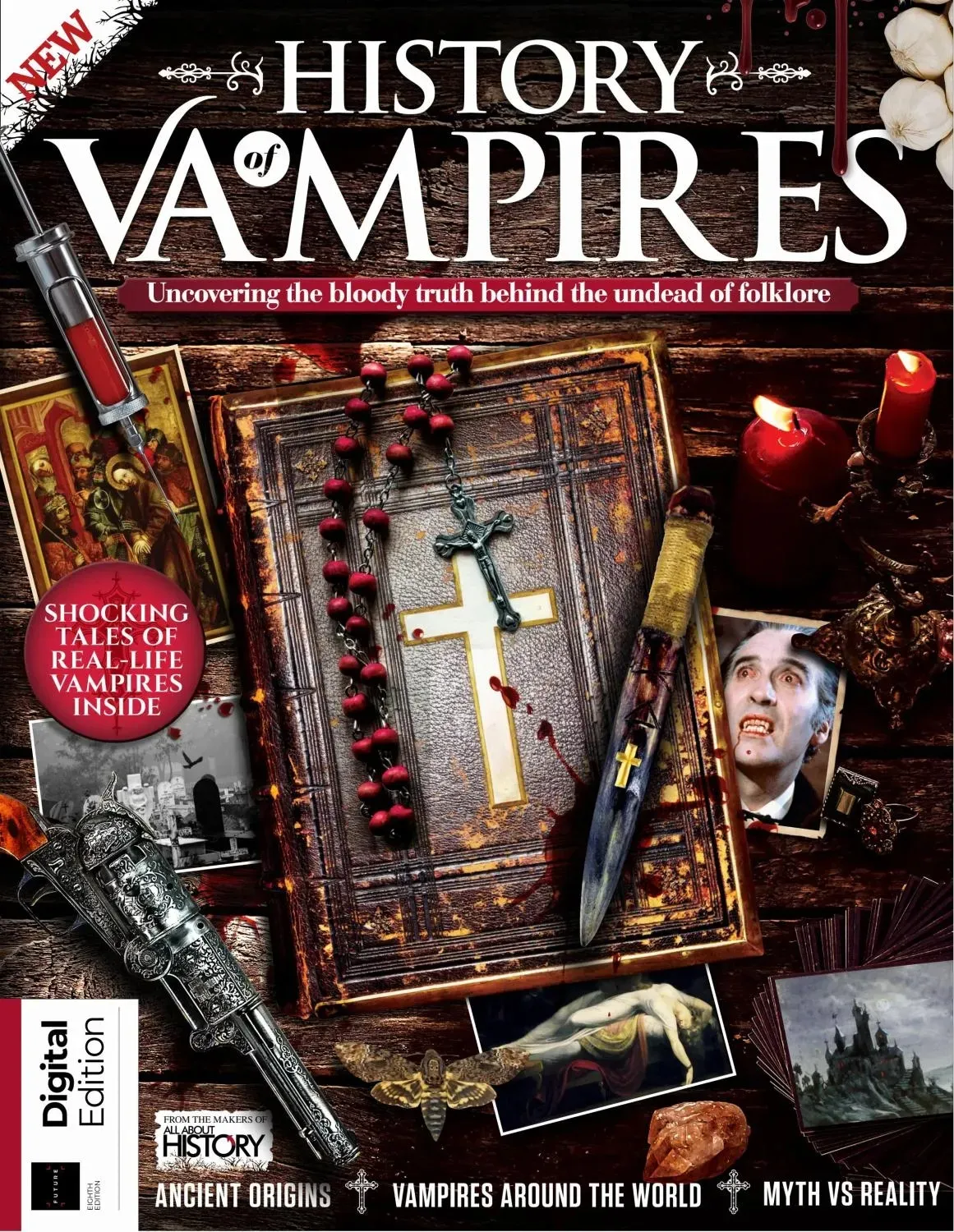
Vlad the Impaler, Elizabeth Bathory, and the New England vampire panic of 1892 anchor All About History's History of Vampires 8th Edition, 3 September 2026. Editor Sarah Bankes assembles 124 pages covering ancient origins, global bloodsucker legends, real-life historical figures, and pop-culture vampires from Dracula to Twilight.
Pagan origins are traced through Mesopotamian ekimmu spirits and Greek lamiai. "Debunking the Vampire Myth" (p.20) explains how decomposition symptoms — bloated corpses, blood at the mouth — were misinterpreted as vampiric activity. "The Vampire Hunter's Handbook" (p.22) reproduces 18th-century exhumation and staking procedures from Serbian parish records. Regional legends cover European shrouds-eaters, Chinese jiangshi, African adze, and South American lobisomem. "Plague Carriers and Ice Cannibals" (p.54) links vampire panics to epidemic disease, showing how rabies and tuberculosis symptoms matched vampire folklore.
The real-life vampires section profiles Vlad the Impaler (p.62), whose 20,000-impaled victims created his Dracula reputation, and Elizabeth Bathory (p.70), the Hungarian countess accused of 600 murders. The New England vampire panic (p.78) focuses on Mercy Brown, exhumed in 1892 after her family's tuberculosis deaths. Pop-culture chapters cover Dracula's literary evolution (p.104), vampire cinema from Nosferatu to Interview with the Vampire, and the secret lives of modern vampire subcultures.
—————
Content Guide
▸ Origins
p.10 · The Origins of Vampires
Mesopotamian ekimmu — spirits of the unburied dead — and Greek lamiai are established as the earliest literary vampire archetypes, predating the Slavic folklore that shaped the modern image. The article traces the word "vampire" through 18th-century Austrian administrative reports. The first recorded use in English appeared in 1734 in The London Journal.
p.20 · Debunking the Vampire Myth
Medical explanations for classic vampire evidence: natural decomposition causes corpses to shift position, purge blood from the mouth, and retain hair and nail growth. The article cites 18th-century physician Michael Ranft's 1728 treatise on the subject. Show the decomposition-stage table to anyone citing "the body looked alive" as proof of vampirism.
p.22 · The Vampire Hunter's Handbook
Actual 18th-century Serbian exhumation protocols are reproduced — staking through the heart, decapitation, and burning, with the order of operations prescribed by parish law. The woodcut illustrations show the correct angle for the stake. The protocols were standard practice in the Habsburg military frontier until 1755.
▸ Real-Life Vampires
p.62 · Vlad the Impaler
Vlad III Drăculea's 15th-century Wallachian reign is documented through Ottoman chronicles and German pamphlets. The article separates his historical military tactics — 20,000 impaled victims according to contemporary estimates — from the Bram Stoker fictionalisation. The German pamphlet woodcuts reproduced on page 64 show Vlad dining among his impaled victims, a detail Stoker used directly.
p.70 · Elizabeth Báthory
The Hungarian countess accused of 600 murders between 1590 and 1610 is examined through trial transcripts from 1611. The article concludes the evidence supports around 80 confirmed deaths rather than the legendary 600, with political motivations behind the prosecution. The castle-floor plan shows which rooms were cited in witness testimony.
p.78 · The New England Vampire Panic
The 1892 Mercy Brown case — a teen exhumed in Exeter, Rhode Island, after her family died of tuberculosis — is reconstructed from local newspaper accounts and medical records. Her heart was burned and fed to her surviving brother, who died two months later. The newspaper clippings show that the family's doctor approved the exhumation.
▸ Popular Culture
p.104 · Vampires in Literature
Bram Stoker's Dracula (1897) is placed in the context of earlier vampire fiction: John Polidori's The Vampyre (1819), Sheridan Le Fanu's Carmilla (1872). The article reproduces Stoker's working notes showing his research on Transylvanian geography and folklore. The notes reveal that Dracula's castle was based on a photograph of Slains Castle in Scotland.
p.124 · The Secret Lives of Vampires
Modern vampire subcultures — from the New York City Vampire Clan to online sanguinarian communities — are documented through ethnographic interviews. The article estimates 5,000 active participants in the US alone, based on forum membership data from 2025. The lifestyle-questionnaire results show that 70 percent identify as "psychic vampires" deriving energy from social interaction rather than blood.
—————
Editor's Take
All About History's History of Vampires 8th Edition is the most comprehensive single-volume vampire reference available at this price. The medical-debunking chapter and the Serbian exhumation protocols are genuinely original research. Weakest parts: the pop-culture chapters on film and literature are too compressed — Dracula's cinematic evolution deserves more than a page-and-a-half. The modern vampire subculture chapter feels like a magazine article stapled onto a book. This edition suits the folklore student and the Halloween-season impulse buyer equally well.
Strengths
• 18th-century Serbian exhumation protocols reproduced from parish records
• Decomposition-stage table linking natural processes to vampire claims
• Bram Stoker's working notes showing Slains Castle as Dracula's model
Weaknesses
• Dracula film history compressed to 1.5 pages
• Modern vampire subculture chapter feels tacked-on
Verdict: Recommended — Best-value single-volume vampire reference for folklore students.
