
Practical Reptile Keeping – June 2026
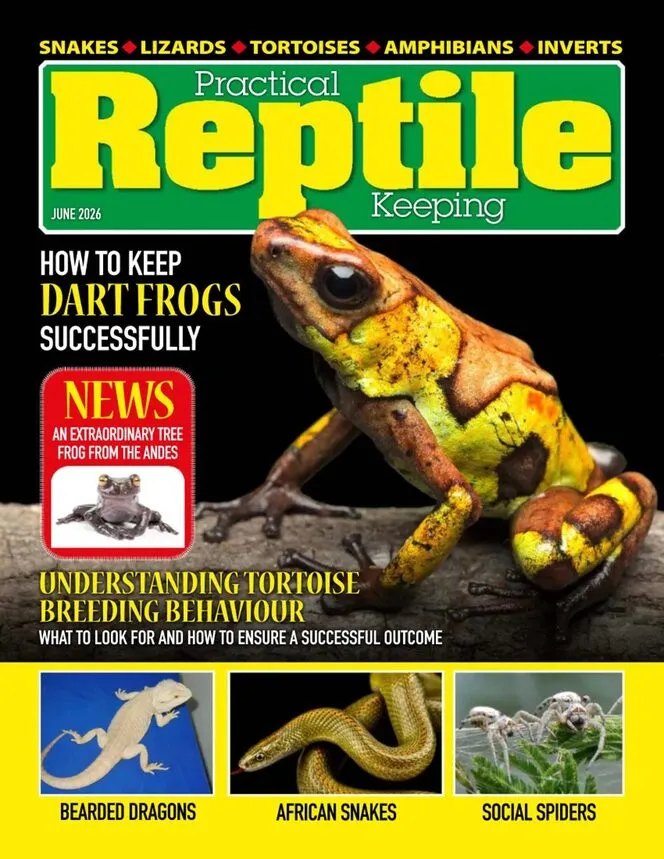
Summary
Practical Reptile Keeping June 2026 opens on a heatwave: UK and European summer temperatures have soared to record levels, threatening reptile health. Reptiles have no sweat glands and no effective panting mechanism, so without shade or a cooler area they overheat fast.
The warning lists the signs: gaping or breathing through the mouth, lethargy and weakness, rapid or laboured breathing, disorientation, colour change going pale or dark, and frantic searching for a cool spot — late stages bring loss of coordination, muscle tremors and collapse. Move the animal to shade, offer water and call a reptile vet at once.
The cover carries how to keep dart frogs successfully, an extraordinary free frog from the Andes, understanding tortoise breeding behaviour, bearded dragons, African snakes and social spiders. Features run p20 to p62, with Terri Sommella on dragons, Tim Zedi on African snakes and Dr Tariq Abou-Zahr on the southernmost boa constrictor.
—————
Content Guide
▸ Welcome — Heat and how to handle it
Why heat kills
UK and European summer temperatures have soared to record levels, threatening the health of reptiles. Reptiles lack sweat glands or an effective panting mechanism, so if they cannot reach shade or a cooler area they overheat quickly. Heat stress shows as lethargy and disorientation and can worsen rapidly to heatstroke and organ damage. Check your thermostat today before the next hot day rather than after.
The signs to watch
The magazine lists gaping or breathing through the mouth, lethargy and general weakness, rapid or laboured breathing, disorientation, colour change to pale or unusually dark, and frantic attempts to find a cooler area. Late stages bring loss of coordination, muscle tremors and even collapse. At any of these, move the animal somewhere cooler immediately, offer appropriate hydration and contact a reptile vet without delay. Print this list and keep it beside the enclosure.
Outdoor risk
Housing outside greatly increases escape risk. If you do take an animal out, go in the early morning or evening, provide ample shade, monitor air and ground temperature with a reliable thermometer since hot surfaces burn feet, keep it short especially for small or young animals, and supervise the entire time. Put a thermometer on the ground as well as the air before any outdoor session.
▸ News and Views (p4, compiled by G. Valentine)
A new Asian lizard
Between 2009 and 2022 a team surveyed southern China and collected lizards of the Calotes versicolor complex. Researcher Yong Huang says what was thought to be Calotes versicolor in southern China and northern Vietnam actually contains a new undescribed species and two subspecies. Wang's garden lizard, Calotes wangi, is under 9cm (3.5in) long, and one of its distinguishing features is an orange tongue. It lives in subtropical evergreen broadleaf and tropical monsoon forest in southern China and northern Vietnam, on forest edges in mountains, hills and plains, in farmland, scrub and even urban greenbelts. Threatened, it dashes into bushes or climbs trunks; at night it sleeps pressed against a sloping shrub branch. It is active April to October, or March to November and longer in the tropics, and eats insects, spiders and other arthropods. Researchers estimate it is not currently threatened but note habitat fragmentation in places, and since the body is used medicinally and the lizards are eaten, they recommend stronger environmental protection and close population monitoring. The citation is Huang Y, Li H, Wang Y, Li M, Hou M, Cai B (2023), ZooKeys 1187: 63-89. Under 9cm and an orange tongue is the detail worth remembering.
A snake overlooked for years
The newly described Waray dwarf burrowing snake, Levitonius mirus, is native to Samar and Leyte in the Philippines. It lives mostly underground and usually comes to the surface only after heavy rain, the way earthworms appear on lawns after a storm. Specimens collected in 2006 and 2007 were misidentified in the field, then sat in the University of Kansas Biodiversity Institute and Natural History Museum collection for years, overlooked even after more specimens were found in 2014. Only when KU graduate research assistant Jeff Weinell studied the specimens' genetics with molecular analysis did that change. Museum drawers hold species nobody has named. Ask what your local collection is hiding.
▸ Features
p.20 · Keeping and Breeding Dragons — Terri Sommella
Terri Sommella, who ran Fire and Ice Dragons in the US for 25 years, writes on keeping and breeding bearded dragons. Twenty-five years is the experience that makes a care piece worth reading. Compare her setup with your own this week.
p.24 · Don't Overbook African Snakes! — Tim Zedi
Tim Zedi writes on not overcommitting to African snakes. Collection size is the mistake experienced keepers still make. Count your animals before you add another.
p.36 · Enter the World of Poison Dart Frogs
An experienced keeper and breeder advises on dart frogs, the cover's lead. Dart frogs are the amphibian most beginners get wrong. Check your humidity and fruit fly culture against this piece.
p.46 · The Southernmost Boa Constrictor — Dr Tariq Abou-Zahr
Dr Tariq Abou-Zahr covers the southernmost boa constrictor. Locality is the detail that decides how you keep a boa. Ask what locality your own boa is from.
p.51 · Understanding the Breeding Behaviour of Tortoises
One of Britain's most successful tortoise breeders contributes this piece; the source does not name them. Breeding behaviour is the part of tortoise keeping owners misread most. Watch one courtship behaviour and name it.
p.62 · Introducing the Social Spider
Social spiders get the invertebrate feature. Invertebrates are the most overlooked corner of the hobby. Set up one invertebrate enclosure this month.
▸ Regulars
p.32 · Q & A
Keeper questions are answered here. Q&A is where real keeping problems surface. Send in one question of your own.
p.34 · Reptile Focus
The species focus page runs here. Focus pages are the most teachable thing in the magazine. Look up one species you cannot identify.
p.30 · Subscription Offer and Back Issues
Subscriptions and back issues are offered at p30. Back issues are how a new keeper catches up. Order one back issue on a species you keep.
—————
Editor's Take
The heat warning is the reason Practical Reptile Keeping June 2026 matters, because listing gaping, lethargy, laboured breathing, disorientation, colour change and frantic searching — then the late-stage tremors and collapse — and telling you to call a reptile vet at once is a page that could save an animal during a record summer. The Waray dwarf burrowing snake is the best news item: specimens collected in 2006 and 2007 sitting in a Kansas museum drawer, overlooked even after 2014, until Jeff Weinell ran molecular analysis is how discovery actually works. Wang's garden lizard at under 9cm with an orange tongue, with its full ZooKeys citation, is the most useful field note. Weakest is the features, where all six are listed by title and page with authors only for three of them, and no body text survives, so the dart frog and tortoise pieces cannot be quoted. Buy this for the heat page and the news; the features are a contents list.
Strengths
• Heat signs are listed in full, with escalation
• Outdoor advice gives real burn and escape risk
• Levitonius mirus gives 2006, 2007, 2014 and Weinell
• Calotes wangi gives under 9cm and a citation
Weaknesses
• No feature body text available
• Three of six features have no author named
• Andean frog cover story unconfirmed in text
Verdict: Selective read — the heat warning and news, features unquoted.
