
Practical Reptile Keeping – May 2026
Summary
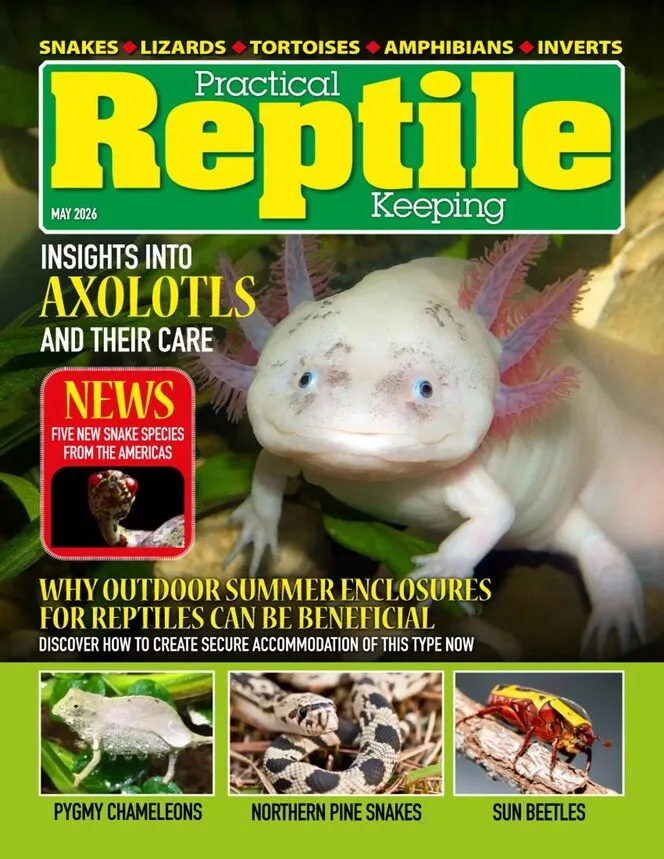
An axolotl (Ambystoma mexicanum) fronts Practical Reptile Keeping May 2026, with insights into axolotls and their care, five new snake species from the Americas, and why outdoor summer enclosures can be beneficial. The cover also promises pygmy chameleons, northern pine snakes and sun beetles.
The welcome leads with Casper, a rare hypomelanistic caramel saltwater crocodile photographed in Australia's remote Northern Territory by Wildman Adventures operators. Casper is a young female about 2.3 m (7.5 ft) long, estimated at 12 to 16 years old, with warm caramel and cream scales instead of the species' dark green-brown and heavy black markings.
The news pages report a rana danta, or tapir frog, named from Peru's Comunidad Nativa Tres Esquinas by Michelle Thompson of Chicago's Field Museum and Germán Chávez of the Instituto Peruano de Herpetología, a tiny burrowing frog with a long snout that local people knew about long before biologists found it.
—————
Content Guide
▸ Welcome — Casper the caramel crocodile
The crocodile
Tour operators with Wildman Adventures photographed a rare hypomelanistic caramel saltwater crocodile, Crocodylus porosus, in the remote Northern Territory of Australia. Nicknamed Casper, it is a young female about 2.3 m (7.5 ft) long, estimated at 12 to 16 years old, with scales in warm caramel and cream rather than the dark green-brown and heavy black markings typical of the species. Colour morphs like this are the animals people travel to see. Look up one colour morph in your own country's wildlife.
The predecessors
A saltwater crocodile called Michael Jackson, or MJ, with a pale head and darker body, was a local tourist attraction on the Adelaide River for about ten years. In August 2014 the 4.5 m (15 ft) male attacked and killed a fisherman who was dealing with entangled fishing line; MJ was identified and shot, and the man's remains were recovered from its stomach. In November 2017 a striking white hypomelanistic crocodile called Pearl, about 3 m (10 ft) long, was first seen in the same area, and some have speculated she could be MJ's offspring. She has been seen many times since and remains a significant tourist draw, though there have been no recent sightings; saltwater crocodiles can live more than 70 years, so she may well still be alive. Read the MJ story before you treat any crocodile as a photo opportunity.
Why it matters
The piece notes rare colour variants like Casper can boost ecotourism, bringing in visitors and funding habitat protection, and that crocodilian blood and tissue contain potent antimicrobial compounds, with Australian and American research teams isolating peptides active against antibiotic-resistant pathogens that could lead to new treatments. Conservation arguments work best when they are economic as well as ethical. Quote the antimicrobial research the next time someone calls crocodiles worthless.
▸ News and Views (p4)
New species roundup
G. Valentine compiles reports of a new snake from Paraguay, a gecko from Venezuela, up to five new species of snail-eating snakes, two large and colourful stick insects from Madagascar, and a frog resembling a South American mammal. The source text is truncated at the next item and these species are not named further. New-species pages are why herpetology magazines exist. Look up one of the five snail-eating snakes yourself.
The tapir frog
The frog is called rana danta, meaning tapir frog, for its long snout resembling the tapir, a large Amazonian mammal. It was found at Comunidad Nativa Tres Esquinas in Peru. Michelle Thompson of the Keller Science Action Center at Chicago's Field Museum and Germán Chávez of the Instituto Peruano de Herpetología worked with local guides and an international team to name and describe it. The frog is tiny, burrowing and long-snouted, long known to local people but never found by biologists until now; the genus ranges across the Amazon but each species has a small range because the frogs live underground and dig poorly. This one was found in Amazonian peatland, its size and appearance suited to the peatland's soft soil. Local knowledge found it before science did. Ask what your own area's residents know that biologists have missed.
▸ Features
p.26 · Breeding Pygmy Chameleons — John Courteney-Smith MRSB, FLS
Courteney-Smith writes on breeding pygmy chameleons from his experience with the bearded species from Tanzania. Breeding features are only as good as the failures they admit. Read the temperature and humidity data before you try this.
p.29 · The Elements Series — Earth
John Courteney-Smith's new reptile care book Earth follows his well-received Fire. Series books are where a keeper's method gets tested. Compare his Earth approach with your own setup.
p.30 · The World of Snakes — David Alderton
David Alderton, with more than 40 years' hands-on experience, reports new understanding of snake origins. Alderton's experience is the reason to trust the page. Read it before you repeat anything about snake evolution.
p.38 · Enrichment for Galápagos Giant Tortoises
The tools and techniques used at the breeding centre on Isabela Island in the Galápagos are set out. Zoo enrichment is the conservation work nobody photographs. Ask what enrichment your own animal gets.
p.44 · Outdoor Enclosures for Reptiles
The cover's outdoor summer enclosure piece gives practical advice. Summer outdoor housing is the upgrade most keepers never attempt. Measure one secure outdoor space this month.
p.49 · Meet the Peter Pan of the Amphibian World — Axolotls
The cover species gets its feature, the axolotl that never grows up. Axolotls are the amphibian most people keep badly. Check your water parameters against this piece tonight.
p.56 · Out of Africa — The evolution of venom — Paul Donovan
Professional herpetologist Paul Donovan writes on how venom developed. Venom evolution is the subject that gets simplified worst. Read it before you handle any venomous species.
p.61 · Keeping Sun Beetles
Sun beetles get a care page. Invertebrates are the most overlooked corner of the hobby. Set up one invertebrate enclosure this month.
▸ Regulars
p.20 · The Care & Breeding of Northern Pine Snakes — Timothy Zedi
Timothy Zedi covers northern pine snakes. Pine snakes are the species that separates experienced keepers from beginners. Compare your snake's setup with the article.
p.32 · Q & A
The questions page runs here. Q&A is where real keeping problems surface. Send in one question of your own.
—————
Editor's Take
The Casper welcome is the strongest thing in Practical Reptile Keeping May 2026: 2.3 m, 12 to 16 years, caramel and cream scales in the Northern Territory, and then the MJ history — a 4.5 m crocodile that killed a fisherman in August 2014 and Pearl, about 3 m, first seen in November 2017 — is a story told with dates and outcomes rather than awe. The rana danta is the best news item, because a frog local people knew before biologists did, named by Thompson and Chávez from a Peruvian peatland, is how discovery actually works. Weakest is the features, where all eight are listed with authors and page numbers but no body text survives, so the chameleon, snake and axolotl pieces cannot be quoted. The Exo Terra and book advertising runs throughout. Buy this for the welcome and news; the features are a list.
Strengths
• Casper gives 2.3 m, 12-16 years, caramel scales
• MJ gives 4.5 m, August 2014 and the fisherman
• Pearl gives about 3 m and November 2017
• Rana danta names Thompson and Chávez
Weaknesses
• No feature body text available
• News roundup truncated, species unnamed
• Advertising runs throughout
Verdict: Selective read — the welcome and news, features unquoted.
