
Reptiles Magazine – May-June 2026
Summary
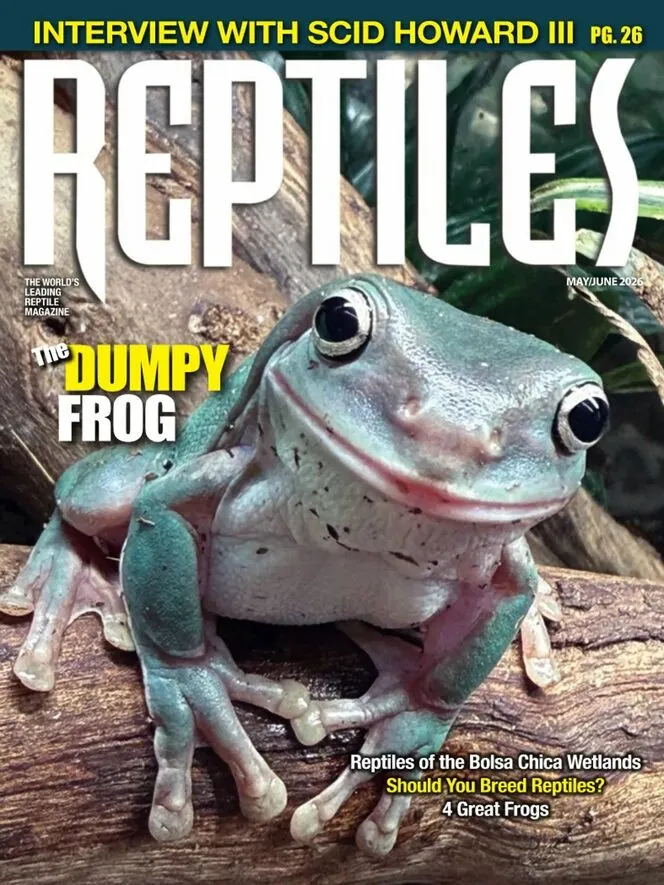
White's treefrog, the dumpy frog, takes the cover of Reptiles May/June 2026 (Volume 34, Number 3), photographed by Esmie Lueras. Editor John Virata opens by asking well, should you breed reptiles, and remembers a ball python seller offering a free normal with double or triple hets to anyone buying a pricier piebald.
The market numbers are the honest part: a morph that sold for $1,500 a few years ago now goes for $250, and Virata says every reptile show aisle sells the same four or five species. Five or more buyers hovered around that python table and he never saw a sale.
The features cover dermatologic issues in reptiles (p14, Eric Los Kamp DVM), whether you should breed (p18, Brian Vuillemenot PhD), Scid Howard III taking thousands of Oakland children herping in their own backyards (p26), Bolsa Chica Ecological Reserve (p34), keeping dumpy treefrogs (p42), four great pet frogs (p50) and an amphibian enclosure buyer's guide (p58).
—————
Content Guide
▸ Editor and Market
p.4 · From the Editor's Desk — Well, should you?
John Virata recalls a ball python breeder at a show years ago who, with every pricier piebald sold, threw in a free normal carrying double or even triple recessives — het pied or yellow belly. Five or more interested buyers gathered and he never once saw a deal close. Virata argues the market is saturated by a handful of species: "every aisle at a reptile show sells the same four or five species." A morph that sold for $1,500 a few years back now goes for $250. He closes by reminding readers to wash their hands before and after handling reptiles, and to wash children's hands too. Read this before you buy any morph at a show.
▸ Features
p.14 · Dermatologic Issues — Eric Los Kamp, DVM
The vet feature covers skin problems in reptiles. Skin is the first thing that goes wrong in captivity and the last thing owners understand. Photograph one patch of your reptile's skin before the next vet visit.
p.18 · Should You Breed Reptiles? — Brian Vuillemenot, Ph.D.
The breeding question gets a full feature, matching the editor's opening. The $1,500-to-$250 collapse is the argument's evidence. Ask what you would do with the offspring before you breed anything.
p.26 · Hood to Woods with Scid Howard III — Shane Fraser
Shane Fraser profiles Scid Howard III, a Black herper who has introduced thousands of people, including children, from Oakland, California and surrounding communities to backyard herping. Outreach is the part of the hobby that never gets covered. Take one child outside to look for reptiles this week.
p.34 · Reptiles of SoCal's Bolsa Chica Ecological Reserve — John Virata
The Bolsa Chica Ecological Reserve in Southern California gets a field piece. Urban reserves are where most people first meet wild reptiles. Visit one reserve near you rather than buying another animal.
p.42 · Keeping Dumpy Treefrogs — Esmie Lueras
The cover species gets its own care feature from the photographer. White's treefrog is the amphibian most beginners get wrong. Check your treefrog's humidity against this piece tonight.
p.50 · 4 Great Pet Frogs — John Virata
Four pet frog species are profiled. Species lists are the most useful thing a magazine prints. Compare the four before you buy your next frog.
p.58 · Amphibian Enclosure Buyer's Guide — Juliana Virata
The buyer's guide covers amphibian enclosures, following the frog features. Enclosures are the purchase that decides whether a frog thrives. Measure your space before you buy.
▸ Mailbag — Parental Care
Protection of offspring
Mike Garcia asked via Facebook about parental care, and the reply signed Ed sets out that most reptiles and amphibians have none, with real exceptions. Crocodilians guard nests for two to three months and help young for up to a year, carrying them to water in the mouth. Nile crocodiles protect their crèche for up to two years. Cunningham's skink, Egernia cunninghami, a large skink from south-eastern Australia, defends young from predators and has been seen driving off eastern brown snakes and chasing birds away. Pythons coil around eggs and shiver to regulate temperature but give no care after hatching. Name one of these species before you assume reptiles abandon their young.
Amphibian care
Dart frogs tend eggs or tadpoles for months until they become froglets. Male African bullfrogs guard tadpoles and, when the pool shrinks, dig channels so the tadpoles survive, keeping this up for two to three months. Glass frogs guard leaf clutches against predators and fungus for one to three weeks until they hatch. Amphibian parenting is better than reptile parenting, which surprises most keepers. Look up one amphibian that cares for its young.
▸ Departments and Notes
p.6 · Mailbag
The letters page carries the parental care question and a second from Mariella Cuotolo via Instagram about whether Hawaii's green sea turtle, the honu, is endangered. She photographed one snorkelling at Big Island and had seen a video of a marine biologist removing a hook from a juvenile turtle's mouth, and had read that handling them is illegal and that the correct procedure is to call the Hawaii Department of Land and Natural Resources. The reply is truncated in the source and cannot be confirmed. Call your local authority rather than handling any wild turtle.
p.12 · Reptile News
Reptile news runs here, with a related piece elsewhere in the issue on saving Southern California's red-legged frogs. Red-legged frogs are the species that brings herpers and regulators into conflict. Read the news before the next field season.
Subscription and contact
Reptiles is published bimonthly by Living World Media, ISSN 1068-1965, at $6.99 a copy, with six issues for $24 or twelve for $40 and a separate US annual rate of $30. New subscriptions take six to eight weeks to start. The editorial address is ReptilesEditor@gmail.com with John Virata as content director. Check the rate before you subscribe.
—————
Editor's Take
The editor's desk is the best page in Reptiles May/June 2026, because "every aisle at a reptile show sells the same four or five species" and the $1,500-to-$250 collapse is a market described by someone standing in it rather than selling into it. The Mailbag answer on parental care — crocodilians guarding nests two to three months, Nile crocodiles two years, Cunningham's skink driving off brown snakes, glass frogs one to three weeks — is the most informative thing in the issue. Weakest is the features: all seven are listed with authors and page numbers, but no body text is available, so the dermatology, breeding and frog care pieces cannot be quoted. The Zoo Med and RodentPro advertising takes up more space than the letters. Buy this for the editor's page and Mailbag; the features are promise only.
Strengths
• Editor gives the $1,500-to-$250 morph collapse
• "Same four or five species" is honest about saturation
• Mailbag gives real parental care durations
• Seven features have named authors
Weaknesses
• No feature body text available to quote
• Turtle letter reply truncated
• Advertising outweighs the letters
Verdict: Selective read — the editor's desk and Mailbag, features unquoted.
