
Psychology Now – Volume 1 4th Revised Edition – August 2023
Summary
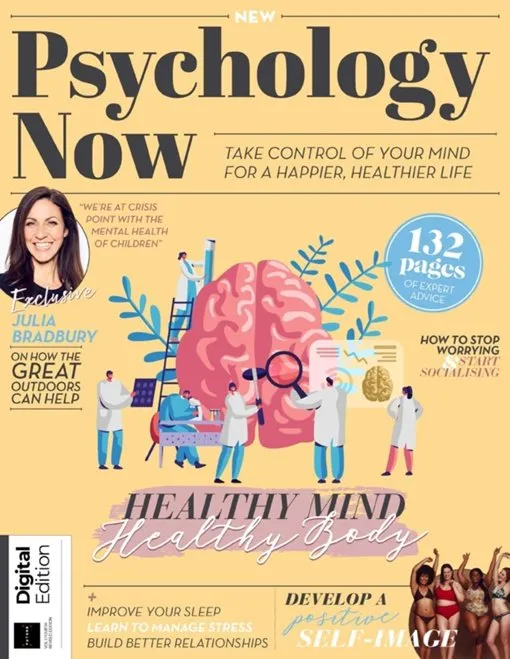
Ted Williams' body stored head-down in liquid nitrogen at -195 degrees Celsius — the Alcor Life Extension Foundation feature inside "10 Mysteries of the Mind" opens Psychology Now Volume 1, 4th Revised Edition (August 2023), a 132-page special issue that packages expert mental-health advice under the cover line "We're at crisis point with the mental health of children."
Jeanna Bryner's "10 Mysteries of the Mind" (page 10) covers consciousness research, cryonics, laughter theory, and phantom-limb science. Julia Bradbury — the TV presenter turned natural therapist — contributes an exclusive interview on why the great outdoors benefits children's mental health. The issue runs 24 articles spanning stress management, body image, imposter syndrome, mindfulness, dementia, and dream science.
Practical guides include "How to Stop Worrying" and "Start Socialising," "Eat More Mindfully" (page 76), "Say Yes to the Power of No!" (page 86), and "Build Better Relationships" (page 110). A dedicated stress section covers "The Science of Stress" (page 62) and "Managing Stress in the Workplace" (page 68).
—————
Content Guide
▸ Mind / Brain Science
p.10 · 10 Mysteries of the Mind — Jeanna Bryner
Consciousness, cryonics at Alcor (-195 degrees Celsius, Ted Williams named), nature-vs-nurture, phantom-limb sensations affecting 80 percent of amputees, and the neuroscience of laughter (Morreall, College of William and Mary). Each mystery gets a two-page summary of current research. Use the phantom-limb explanation as a conversation tool with patients or clients experiencing chronic pain after amputation.
p.59 · Why Do We Sleep?
The science of sleep cycles, the glymphatic system's waste-clearance function, and the cognitive cost of sleep deprivation. The recommended sleep-window chart for different age groups is a reference you can post in a clinic waiting room.
p.90 · 5 Strange Facts About Memory
Memory fallibility explained through five studies: false-memory implantation, the hippocampus as memory box, and why emotional memories feel more vivid. The false-memory demonstration cited here is useful for any professional who takes witness statements.
▸ Wellbeing / Practical
p.12 · Why the Great Outdoors Is Great for Kids — Julia Bradbury Interview
The TV presenter and advocate shares how nature exposure improves children's attention, mood, and resilience. She names specific outdoor activities that require no special gear. If you are a parent or teacher, the three-entry "nature prescription" list here costs nothing and takes 20 minutes.
p.22 · Develop a Positive Body Image
Strategies for shifting from appearance-based to function-based self-evaluation. The exercises use cognitive-behavioural techniques that have clinical evidence behind them. Try the mirror-reframe exercise described here before your next client session if you work in eating-disorder support.
p.34 · Overcoming Imposter Syndrome
A step-by-step breakdown of imposter syndrome's four subtypes and the thought-record technique used in CBT to counter each one. The subtype self-assessment quiz on the opening page helps readers identify their own pattern before they read further.
p.86 · Say Yes to the Power of No!
Boundary-setting skills for people who struggle with saying no at work or in relationships. The script templates — exact phrases for different scenarios — save readers from having to invent their own words under pressure.
▸ Stress / Anxiety
p.62 · The Science of Stress
The physiology of the stress response: cortisol's role, the autonomic nervous system split, and the difference between acute and chronic stress. The heart-rate-variability measurement technique described here gives readers a biofeedback tool they can use without a wearable device.
p.68 · Managing Stress in the Workplace
Organisational and individual strategies for workplace stress, with a focus on the hospitality and healthcare sectors where burnout rates are highest. The "control-impact matrix" in this article is a triage tool: use it to sort your stressors into things you can change and things you must accept.
▸ Dementia / Ageing
p.92 · Dementia: The Cruellest Disease
An overview of the major dementia types — Alzheimer's, vascular, Lewy body, frontotemporal — with symptom profiles and current treatment pathways. The communication tips for caregivers are practical and specific: use short sentences, eliminate background noise, and never correct a person with dementia in front of others.
▸ Sleep / Dreams
p.96 · Why Can't We Remember Our Dreams?
The neurochemistry of REM sleep and the mechanisms that prevent dream recall. The article includes a dream-recall training protocol that takes 14 days. Follow the wake-back-to-bed technique described here and you will remember at least one dream per night by day 10.
p.98 · Mindful Dreaming
Lucid dreaming techniques grounded in the research of LaBerge and others. The reality-testing method — checking a digital clock twice, looking away, then checking again — is the easiest to adopt. Use it during the day and it will begin to appear in your dreams within three weeks.
—————
Editor's Take
This 132-page special edition delivers strong value as a one-volume mental-health primer — the article count is generous and the range from brain science to practical CBT exercises covers most of what a general reader needs. The Julia Bradbury interview and the "10 Mysteries" opener are the strongest entries. Weakness: the articles are written at a consistent introductory level — readers already familiar with CBT, exposure therapy, or dream research will not find new material. The cover's "crisis point with children" promise is not fully delivered; only one article directly addresses child mental health. Best for readers new to psychology topics who want a survey course in one issue; skip if you already read Psychology Today or academic journals.
Strengths
• Julia Bradbury exclusive interview with specific outdoor-activity prescriptions for children
• "10 Mysteries of the Mind" with Alcor cryonics detail (-195 degrees Celsius, Ted Williams)
• 24 articles across 132 pages at a accessible introductory level for newcomers
Weaknesses
• Only one article (Julia Bradbury) addresses the cover's "children's mental health crisis" claim
• Content is introductory — no original research or deep dives for informed readers
Verdict: Recommended — A solid single-volume mental-health survey for newcomers; specialists and clinicians will find it too basic.
