
Rock Gem – August 2026
Summary
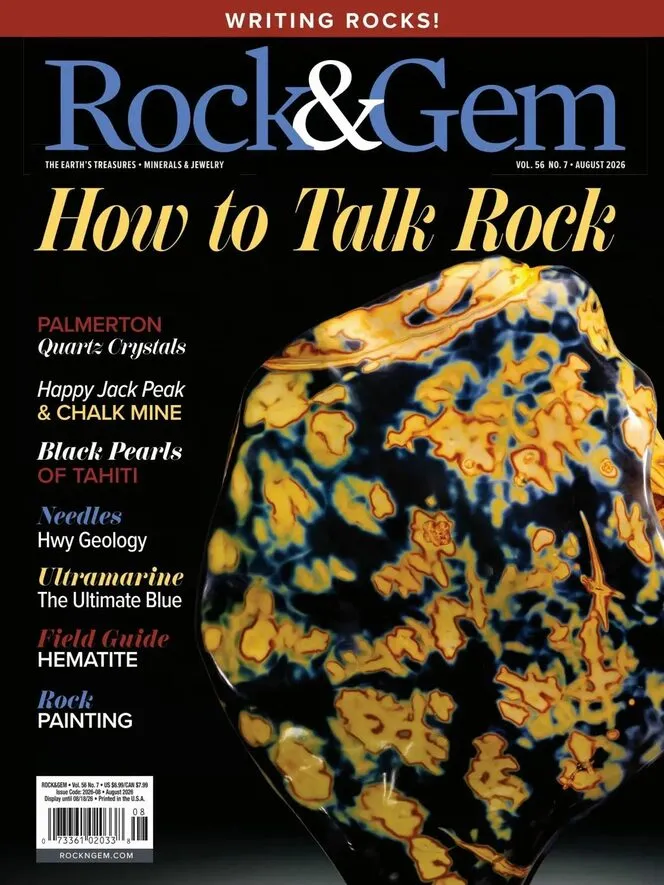
Black pearls of Tahiti lead Rock & Gem August 2026, and Vol. 56 No. 7 pairs that cover with How to Talk Rock at page 18, a hematite field guide at 42 and Palmerton quartz crystals at 32, priced US $6.99 with a display date of 08/18/26.
Rock & Gem magazine August 2026 (Vol. 56 No. 7) runs four cover-flagged pieces: Tahitian Black Pearls by Bruce McKay at 12, How to Talk Rock by Jim Brace-Thompson at 18, Happy Jack Peak & Chalk Mine by Sue Eyre at 26 and Palmerton Quartz Crystals by Robert Beard at 32. Dr. Stuart Mills and Pam Freeman build a hematite field guide at 42, Mark Oros writes on inspiration at 50, Amy Grisak drives through stone at 52, Helen Serras-Herman paints on rocks at 58, and Roger Clark with Doug Moore close on limestone agates at 64.
Regulars hold the frame: Editor's Letter at 1, Earth Science News at 4, R&G Kids at 38, What to Cut at 46, Show Dates at 70, Rock Science at 74 and Parting Shot at 80. The issue's value sits in the pairing of a language piece, a locality trip and a field guide, so a reader can name what they find, go see it and then identify it on the spot.
—————
Content Guide
▸ Cover Story
p.12 · TAHITIAN BLACK PEARLS
Bruce McKay opens Rock & Gem August 2026 on Tahitian black pearls, tracing how the pearls form and how growers judge them. He stays with the farming and grading process rather than the jewellery alone. Ask any seller for the grading criteria before you pay a black-pearl price.
▸ Features
p.18 · HOW TO TALK ROCK
Jim Brace-Thompson takes the issue's cover line at page 18 and builds a working vocabulary, so a collector can describe a specimen without waving at it. He names the terms that actually get used in the field and at shows. Practise three of the terms out loud before your next club meeting.
p.26 · HAPPY JACK PEAK & CHALK MINE
Sue Eyre heads to Happy Jack Peak and the chalk mine at 26, giving the locality, the material and the access reality. The piece reads as a trip report with the collecting detail attached. Confirm land status before you collect, because the ground is not all public.
p.32 · PALMERTON QUARTZ CRYSTALS
Robert Beard documents Palmerton quartz crystals at page 32, describing the habit and the conditions that produced them. He ties the specimens to their specific find rather than to quartz in general. Match any Palmerton label to the crystal habit before you buy.
p.42 · FIELD GUIDE: HEMATITE
Dr. Stuart Mills and Pam Freeman build a hematite field guide at 42, covering the tests that separate it from look-alikes outdoors. The guide is arranged for use without a lab. Carry a streak plate, because hematite's streak is the fastest field check.
p.50 · FROM THE STUDIO: THE ART OF INSPIRATION
Mark Oros writes on inspiration at page 50, looking at where cutters and carvers actually get ideas. He keeps it practical, tied to studio work rather than vague creativity. Keep a photo file of forms you see, since that is the source named most often.
p.52 · DRIVING THROUGH STONE
Amy Grisak turns the issue into a road piece at 52, driving a route where the roadcuts expose the geology. She names the stops and what each one shows. Plan the drive in daylight, because roadcut exposures are unsafe to read at night.
p.58 · PAINTING ON ROCKS
Helen Serras-Herman covers rock painting at 58, giving the surface prep and materials that make paint hold on stone. The piece names products and steps instead of just showing finished work. Seal the rock before you paint, or the colour will lift.
p.64 · RETRO ROCKS: LIMESTONE AGATES
Roger Clark and Doug Moore close on limestone agates at 64, looking back at how these materials were collected and named. They use specific old labels and localities. Re-check any "limestone agate" in your cabinet against the named sources.
▸ Regulars
p.4 · EARTH SCIENCE NEWS
Earth Science News at 4 rounds up the month's research, naming institutions and findings so readers can find the source. It is the fastest summary of what moved this month. Skim it before the features, since several items connect.
p.38 · R&G KIDS
R&G Kids at 38 gives young collectors a hands-on page built on rocks and minerals. It offers an activity rather than reading alone. Set up a sorting tray with labelled compartments for a beginner's first finds.
p.46 · WHAT TO CUT
What to Cut at 46 names rough worth cutting and the yield to expect from it. The column works as a buying shortlist. Buy one piece of the rough it names and cut it before the next issue lands.
p.70 · SHOW DATES
Show Dates at 70 lists gem and mineral shows with locations and dates, the page most collectors turn to first. A trip can be planned straight from the listing. Circle the two nearest shows and book rooms before dealers fill them.
—————
Editor's Take
Rock & Gem Vol. 56 No. 7 is the most useful issue in this run, because How to Talk Rock at 18 fixes a real problem: collectors who cannot describe what they own. Pair that with the hematite field guide at 42 and Palmerton quartz at 32, and the issue teaches naming, finding and identifying in one pass. The weakest link is From the Studio at 50, which drifts toward inspiration talk where Oros is usually sharper on money and cutting. Bruce McKay's Tahitian black pearls at 12 is a solid opener but familiar ground for anyone who has read the magazine for a year. The cover, a Chinese "Versace stone" jasper from the Yushui mine in Guangdong at 26 x 22 cm, is attractive but oddly matched to a Tahitian-pearl cover line. This one is for collectors who want vocabulary and field method, not for readers chasing a single showpiece.
Strengths
• How to Talk Rock fixes real collector vocabulary gaps
• Hematite field guide works without a lab
• Palmerton quartz ties habit to specific finds
Weaknesses
• From the Studio drifts into vague inspiration
• Cover specimen mismatched to pearl cover line
Verdict: Recommended — Best issue here for field method and vocabulary, despite a soft studio column.
