
Rock Gem – October 2026
Summary
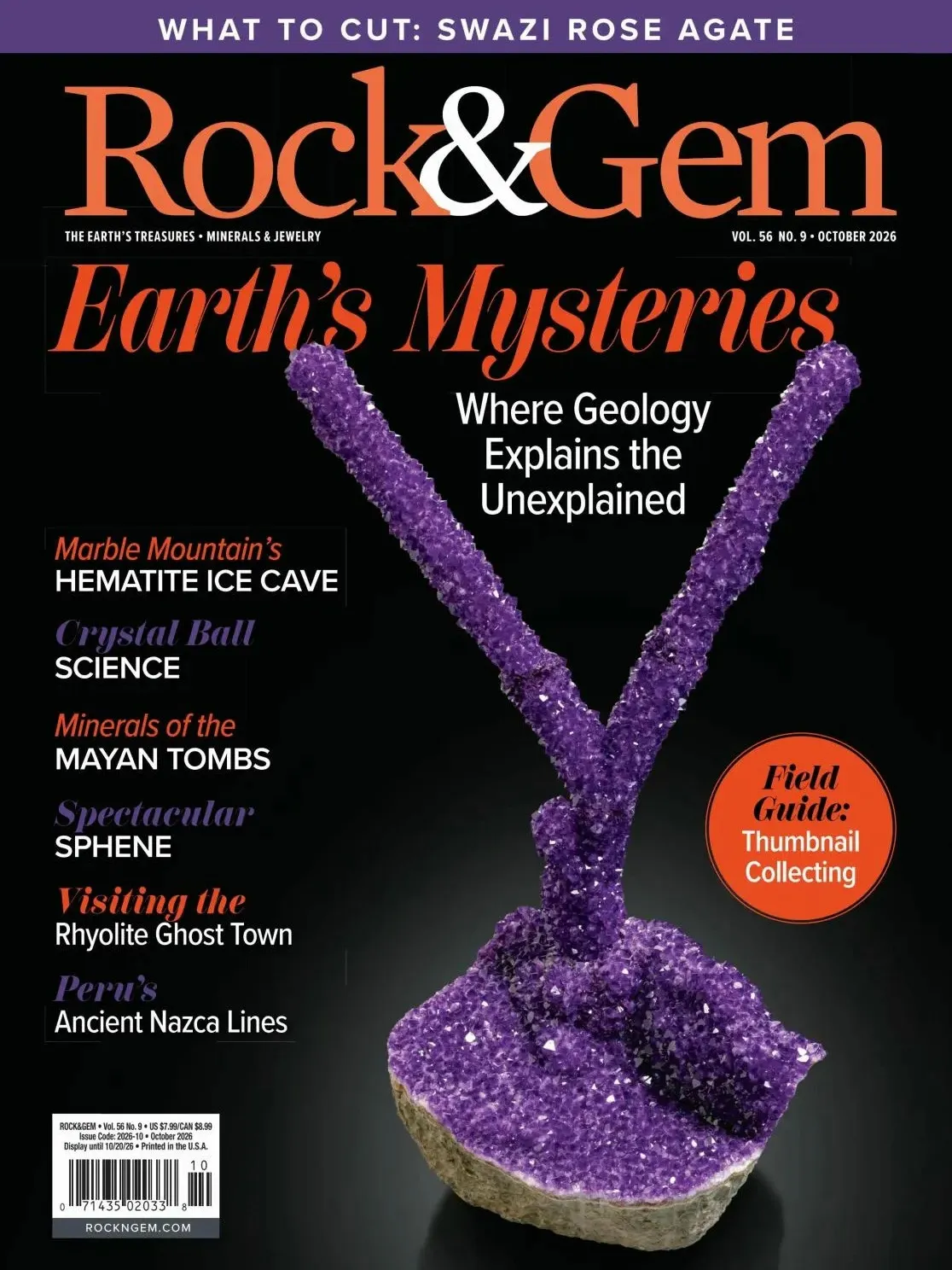
A 35-centimetre amethyst-replacement-after-calcite specimen from Uruguay's Artigas Department fronts Rock & Gem October 2026, and Vol. 56 No. 9 backs it with a geology-and-the-unexplained theme, from When Geology Gets Spooky at page 12 to Retro Rocks on arsenic at 64.
Rock & Gem magazine October 2026 (Vol. 56 No. 9) opens on Halloween-adjacent ground with When Geology Gets Spooky by Amy Grisak at page 12, then runs Crystal Ball Science by Steve Voynick at 18, Marble Hill Ice Cave by Robert Beard at 26 and Minerals of the Mayan Tombs, also Voynick, at 32. A thumbnail-collecting field guide by Dr. Stuart Mills, Alex Venzke and Pam Freeman sits at 42, Mark Oros handles investment buying at 50, Maureen Pratt covers sphene at 52, Audrey Pavia visits Rhyolite ghost town at 58, and Voynick closes on arsenic at 64.
The regulars stay put: Editor's Letter at 1, Earth Science News at 4, R&G Kids at 38, What to Cut at 46, Show Dates at 70, Rock Science at 74 and Parting Shot at 80. At US $6.99, the issue is built for collectors who want one delivery that carries a field guide, a locality trip and a buying column, and the Show Dates page is the one that gets used first.
—————
Content Guide
▸ Cover Story / Features
p.12 · WHEN GEOLOGY GETS SPOOKY
Amy Grisak opens Rock & Gem October 2026 on the places where rock and legend meet, tying the issue's unexplained theme to ground a reader can actually visit. She names the formations and the stories attached to them rather than leaning on atmosphere alone. Pick one site from the piece and check its public access rules before you drive out.
p.18 · CRYSTAL BALL SCIENCE
Steve Voynick takes the crystal-ball idea literally at page 18 and reports what the mineral record actually shows, separating folklore from the measurable behaviour of crystals. The piece stays with named materials and the claims made about them. Test any "crystal power" claim against the mineral's actual properties before repeating it.
p.26 · MARBLE HILL ICE CAVE
Robert Beard documents Marble Hill's hematite ice cave, giving the locality detail and the mineralogy that makes the cave worth the trip. He describes what the ice and the hematite do together inside the formation. Bring a warm layer and a headlamp, because cave interiors stay cold regardless of the season.
p.32 · MINERALS OF THE MAYAN TOMBS
Steve Voynick reports on minerals found in Mayan tomb contexts at page 32, naming the materials and what their presence tells excavators. The piece keeps to the archaeological record and the species recovered. Cross-check any tomb-sourced specimen against export rules before you buy.
p.42 · FIELD GUIDE: THUMBNAILS
Dr. Stuart Mills, Alex Venzke and Pam Freeman build a thumbnail-collecting field guide at 42, aimed at the small-specimen collector rather than the cabinet-filler. The guide covers what makes a worthwhile thumbnail and how to store one. Start a labelled thumbnail tray, because small pieces get lost fastest.
p.50 · FROM THE STUDIO: INVESTMENT BUYING & RESELLING
Mark Oros turns to the money side at page 50, working through what makes a specimen hold value and how reselling actually works. He names the market behaviour behind prices instead of guessing at appreciation. Write down your purchase price and source on every label you file.
p.52 · SPOOKTACULAR SPHENE
Maureen Pratt covers sphene at 52, describing the gem's colour and the reason it stays a collector's stone rather than a commercial one. She ties the material to its sources and cutting challenges. Handle sphene gently, because its softness limits everyday wear.
p.58 · RHYOLITE GHOST TOWN
Audrey Pavia visits the Rhyolite ghost town at page 58, combining the town's remains with the geology of the ground it sits on. The piece gives directions-level detail for anyone planning a stop. Add Rhyolite to a Nevada road trip and walk it in daylight.
p.64 · RETRO ROCKS: ARSENIC
Steve Voynick closes the features on arsenic at 64, looking back at how the element's minerals were collected, named and misunderstood. He uses specific historical specimens and their labels. Store any arsenic-bearing mineral away from food and handling areas.
▸ Regulars
p.4 · EARTH SCIENCE NEWS
Earth Science News at 4 gathers the month's research items, naming institutions and findings so readers can chase the original papers. It is the quickest route to what changed this month. Read it before the features, since several items feed them.
p.38 · R&G KIDS
R&G Kids at 38 runs a beginner page built on rocks and minerals, with activities instead of long text. It gives a parent or a club leader something to run with a new collector. Set up one sorting tray with labelled compartments for a first collection.
p.46 · WHAT TO CUT
What to Cut at 46 names rough with cutting potential and what a lapidary should expect from it. The column reads as a shortlist rather than a show-and-tell. Buy one piece of the rough it names and cut it before the next issue.
p.70 · SHOW DATES
Show Dates at 70 lists upcoming gem and mineral shows with locations and dates, which is the page collectors use most. The listing is arranged so a trip can be planned straight from it. Circle the nearest two shows now and book rooms early.
—————
Editor's Take
Rock & Gem Vol. 56 No. 9 commits to its Halloween framing harder than most issues, and When Geology Gets Spooky at 12 plus Crystal Ball Science at 18 make the theme feel chosen rather than seasonal-decorative. The strongest practical piece is the thumbnail field guide at 42, which is the rare column a working collector will keep. The weakest stretch is the middle: Minerals of the Mayan Tombs at 32 and Sphene at 52 are short, and Steve Voynick appears on three features, which thins the voice across the issue. The cover specimen, a 35 cm Uruguayan amethyst after calcite from the Gene Meieran collection shot against a plain ground, is the best thing in the package and worth the US $6.99 by itself. This issue suits field collectors and small-specimen specialists; casual readers should wait for a stronger month.
Strengths
• Uruguayan amethyst cover from Gene Meieran collection
• Thumbnail field guide built for working collectors
• Halloween theme carried by real localities
Weaknesses
• Voynick writes three of nine features
• Mayan Tombs and Sphene pieces run short
Verdict: Recommended — Strong cover and field guide offset a thin, repetitive middle.
