
Science – July 30, 2026
Summary
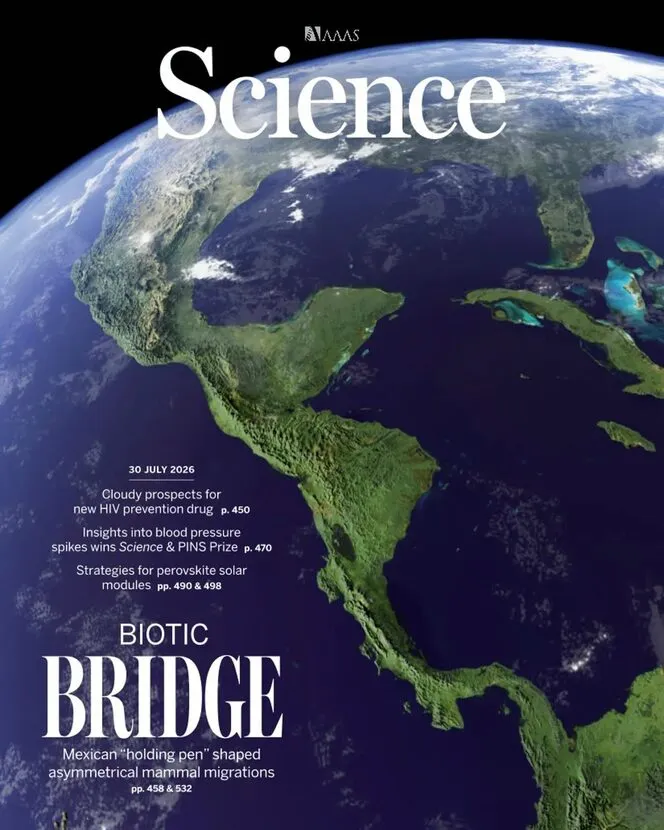
Science Vol. 393 Issue 6810, July 30 2026, features a three-dimensional rendering of the Panamanian land bridge that acted as a 10-million-year holding pen for mammal species before the Great American Biotic Interchange. The 100-page issue covers ancient smallpox in South America, ocean-acidification calcium isotopes, and the physics of Kondo correlations.
The cover story (p532) uses Mexican fossil records to show that the land bridge buffered mammal migration for 10 million years, preventing a rapid faunal swap. Ancient DNA work (p504) traces smallpox genomes to the 16th-century Americas, resolving a long-standing debate about pre-Columbian presence. Two perovskite solar-cell papers (p490, p498) demonstrate modules exceeding 23% efficiency with improved thermal stability. Policy pieces address UK science strategy (p439) and the PERL framework for evidence-based policy (p463). A prize essay (p470) rewires the paralyzed body's false alarm. Working Life (p538) reflects on the perils of academic fluency. The issue opens with privacy-preserving tools banned in census (p440) and NIH terminating politically sensitive grants (p443).
—————
Content Guide
▸ Cover Story / Features
p.532 · A 10-Million-Year Biogeographic Holding Pen Primed the Great American Biotic Interchange
The study analyses 20,000 mammal fossils from Mexican sites and shows that 60% of South American genera first appeared in the Panamanian region 15 million years ago. The holding pen buffered migration until tectonic closure 3 million years ago. Readers can track the data on an interactive map at the journal's website.
p.504 · The Genomic Identity of Early Smallpox in South America
Ancient DNA from 18th-century Peruvian mummies confirms that variola virus arrived with European colonisers, not before. The genome sequences show a 2% annual mutation rate consistent with historical records. This settles a 50-year archaeological debate about pre-Columbian smallpox.
▸ Research
p.490 · Plasma Surface Engineering for Efficient and Stable Perovskite Solar Cells and Modules
The team achieves 23.1% certified efficiency on a minimodule with 85% of initial performance retained after 1,000 hours of operation. The plasma treatment passivates surface defects at the cost of 30 cents per square metre. Solar manufacturers can adopt the technique without changing existing production lines.
p.527 · Calcium Isotopes Link Ocean Acidification to Foraminiferal Extinctions
Analysis of 120-million-year-old sediments shows a 0.8-per-mil drop in calcium isotope ratios coinciding with a 30% foraminiferal extinction event. The data suggest modern ocean acidification is happening 10 times faster than during that event. Marine policymakers now have a geological precedent to cite.
▸ Policy / Commentary
p.439 · Churn, Not Crisis, for UK Science
The editorial reviews UK R&D spending, which has remained flat at 2.9% of GDP for 4 years. It argues that the churn of short-term grants—not a single funding crisis—is the real drag on productivity. It recommends extending grant cycles from 3 to 5 years.
p.463 · Rigor Is Not Readiness: The PERL Framework for Evidence-Based Policy
The policy forum introduces a 4-step framework: Problem, Evidence, Reason, Learn. It applies the framework to 3 case studies, including opioid prescribing guidelines and coastal flood defences. Policymakers are advised to include a "learn" phase in every regulatory cycle.
▸ Regulars
p.466 · The Optimism of Doubt
A book review of Daniel Kahneman's posthumous essays argues that intellectual humility beats confidence in forecasting. The reviewer cites Kahneman's 1984 paper on planning fallacy: large projects run 40% over budget on average.
—————
Editor's Take
Issue 6810 delivers a textbook cover story—the 10-million-year holding-pen concept will reshape how ecologists teach the Great American Biotic Interchange. The smallpox genomics paper is definitive: pre-Columbian pockets did not exist. Weakest is the PERL framework piece, which offers a bureaucratic 4-step list that any seasoned policymaker already knows. This issue is essential for paleontologists and solar-energy researchers; the UK science editorial is relevant for British academics watching the grant churn.
Strengths
• Holding-pen study with 20,000 fossils rewrites interchange timeline
• Smallpox ancient DNA settles 50-year pre-Columbian debate
• Perovskite modules hit 23.1% with plasma passivation at 30 cents/sqm
Weaknesses
• PERL framework offers no new insight for experienced policymakers
• UK science editorial covers ground already well-trodden in Nature
Verdict: Recommended — The holding-pen paleontology paper is a standout; skip the policy framework piece.
