
Science Illustrated Australia – Issue 124 2026
Summary
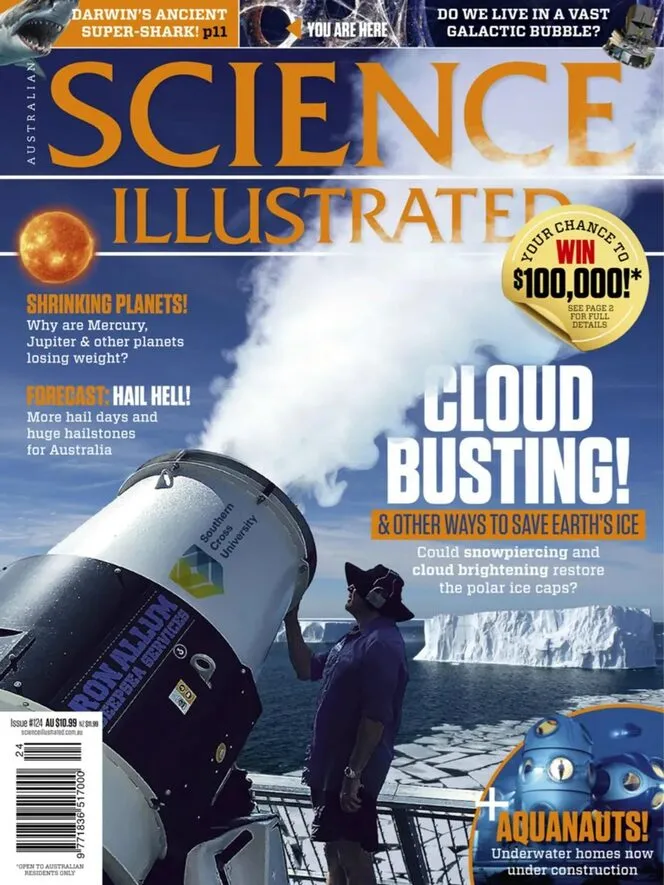
Issue 124 of Science Illustrated Australia, published 29 June 2026, opens with a 10-million-dollar subscriber giveaway and a cover story asking whether cloud-busting technology can save Earth's vanishing ice. The 82-page issue packs seven features spanning planetary shrinkage, Denisovan hunters, and a galactic bubble hypothesis that challenges our place in the cosmos.
Melting ice takes centre stage at page 28, where the magazine examines geoengineering proposals to slow polar ice loss. Shrinking planets (p36) investigates why worlds including Mercury are losing mass, while a forecast feature (p44) warns that climate change is supercharging hailstorms. Denisovan fossils (p50), aquanaut training (p58), cosmic voids (p64), and food toxicity (p70) round out the features. Regulars include a 14-page science news section, a readers' Q&A (Ask Us!, p20), and a 4-page quiz.
Megapixels (p6) opens with two striking science images—NASA's moon-base blueprints and a caterpillar building a head-hat—each with a 100-word caption. Great Scientists (p78) profiles Niels Bohr in a two-page spread that connects his quantum leaps to today's neutrino detectors. Test Yourself (p82) closes the issue with 18 multiple-choice questions covering the articles inside, making it a solid classroom or coffee-table read.
—————
Content Guide
▸ Cover Story / Features
p.28 · Melting Ice
Can humans engineer a way to save the ice? The feature weighs cloud-brightening, stratospheric aerosol injection, and underwater curtains against their costs and side effects. It cites a Sussex University geoengineering model that predicts a 1.5°C reduction if aerosols stay in the stratosphere. Readers finish knowing why no single fix works without emissions cuts at the source.
p.36 · Why Are Planets Shrinking?
Mercury has contracted 7 kilometres in radius over 4 billion years, and the mechanism applies across the solar system. The article walks through thermal cooling, core solidification, and tectonic readjustment as universal shrink-drivers. A comparison table shows each terrestrial planet's shrinkage rate.
p.44 · And the Forecast Is… Hail
Climate models now project hailstones exceeding 15 centimetres in diameter by 2050 in parts of the US and Australia. The piece explains the physics of hail formation and why warmer air holds more moisture, feeding supercell storms. It lists three practical steps for property owners in hail-prone regions.
p.64 · Bubble Voids in the Universe
Astronomers have mapped a 1.8-billion-light-year-wide void that may contain our entire Local Group. The feature explains how a KBC void—named after the researchers who first proposed it—could resolve the Hubble tension without new physics. Readers learn what a 40% density deficit means for measuring cosmic expansion.
▸ Regulars
p.10 · Science Update
Fourteen pages of short-form research roundups: a perovskite solar cell hitting 31% efficiency, synthetic bone grafts tested in sheep, and a CRISPR treatment for inherited deafness approved for human trials. Each item runs 80-120 words with a citation hyperlink.
p.20 · Ask Us!
"Why do alcohol wipes sting?" kicks off a two-page reader Q&A that also covers why some people are mosquito magnets and whether trees feel pain. Answers are written for a general audience—no biochemistry degree required.
p.78 · Great Scientists: Niels Bohr
A timeline infographic traces Bohr from his 1913 atomic model to his 1943 escape from Nazi-occupied Denmark. The text connects his complementarity principle to current quantum computing debates. It closes with a "what if" box speculating on Bohr's reaction to AI.
p.82 · Test Yourself!
Eighteen questions drawn entirely from this issue's features. A correct answer requires reading the Melting Ice piece on cloud-brightening aerosols or recalling that Mercury shrank by 7 km. Answers are printed upside-down at the bottom for self-marking.
—————
Editor's Take
Science Illustrated Australia Issue 124 delivers strong visual journalism and a genuinely fresh feature lineup, but its "Cloud Busting" cover promises more geoengineering depth than the 6-page spread delivers. The issue shines brightest on planetary science (Shrinking Planets, Bubble Voids) and weakest when the Food Toxicity piece recycles supermarket-scare territory without new data. This is for curious teenagers and armchair scientists who want one-stop science browsing rather than deep dives—the quiz alone justifies the cover price for classroom use.
Strengths
• Planetary shrinkage feature with 7-km radius data
• KBC void explainer ties Hubble tension to a single graphic
• Test Yourself quiz reinforces every feature
Weaknesses
• Melting Ice cover feature needed 2 more pages of solutions
• Food Toxicity lacks original reporting or interviews
Verdict: Recommended — A well-edited general-science browse with two standout planetary features and a useful quiz, though the cover story undersells its own ambition.
