
Science – September 10, 2026
Summary
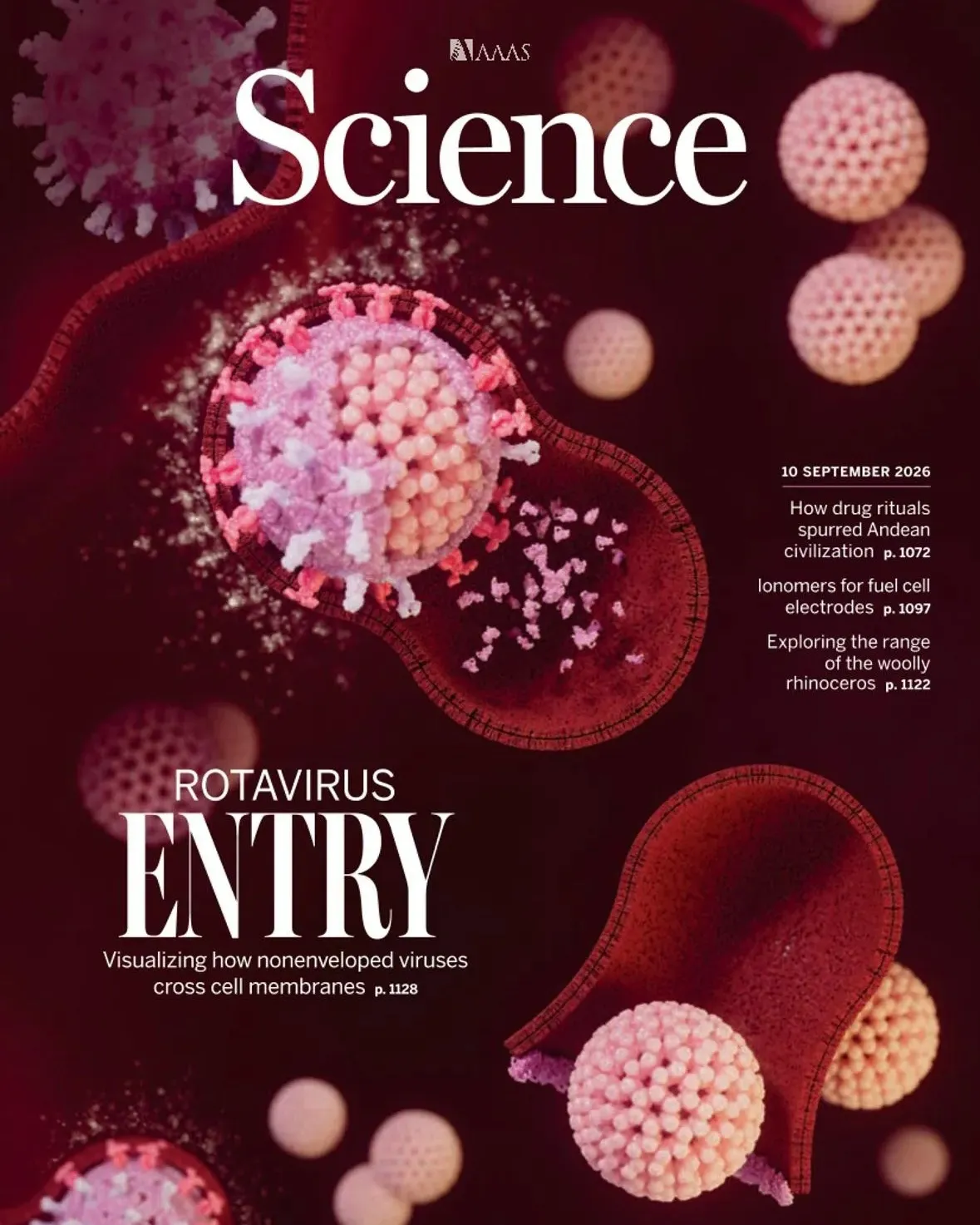
Science Vol. 393 Issue 6816, September 10 2026, uses a cryo-electron tomography image of rotavirus breaching a cell membrane to anchor a 96-page issue centred on virology, paleogenomics, and childhood chemotherapy side effects. The cover study (p1128) reveals how nonenveloped viruses punch through host membranes—a mechanism that had been invisible for 50 years.
Research highlights include the complete telomere-to-telomere sequence of a mouse Y chromosome (p1096), tree physiology data showing growth rate overrides extended growing season in boreal conifers (p1101), and platinum chemotherapy mutations in children's livers (p1100). Ancient DNA researchers reconstruct the genome of woolly rhinoceroses (p1122), while the special feature "High Culture" (p1072) by A. Lawler examines psychedelic rituals in the ancient Andes. The NCI director counters a gloomy budget forecast (p1067), and NSF looks for tech fixes to the Colorado River water crisis (p1066). Perspectives cover the discovery of interleukin-2 and PD-1 inhibition mechanisms. Working Life (p1158) profiles a postdoc learning to let go of certainty.
—————
Content Guide
▸ Cover Story / Features
p.1128 · Mechanism of Membrane Perforation in Rotavirus Cell Entry
M. de Sautu et al. use cryo-ET to show that rotavirus spike proteins insert into the membrane, form a pore, and release the core particle. The 3D structure resolves a 50-year debate about nonenveloped virus entry. Readers learn that blocking spike insertion is a potential target for broad-spectrum antivirals.
p.1072 · High Culture
A. Lawler reports on 3,500-year-old coca-leaf and ayahuasca residues found in a ceremonial structure in the Peruvian Andes. The article connects ritual drug use to the rise of the Chavin civilisation around 1,200 BCE. It closes with a map of 6 known ceremonial centres where similar residues have been found.
▸ Research
p.1096 · Complete Telomere-to-Telomere Sequence of a Mouse Y Chromosome
Q. Li et al. close the last gap in the mouse Y chromosome, revealing 95 previously unknown protein-coding genes. The assembly corrects a 20-year-old misannotation of the Sry gene. This resource is now freely available on the UCSC Genome Browser.
p.1100 · Extensive Platinum Chemotherapy Mutations in Livers of Children
A. Wenger et al. sequence liver tumours from 24 children treated with cisplatin and find a mutational signature specific to platinum exposure. The perspective (p1081) warns that liver aging may accelerate in survivors. It recommends annual liver screening for paediatric chemo survivors.
p.1101 · Growth Rate Overrides Benefit of Extended Growing Season
A. Cabon et al. analyse tree rings from 6,000 trees across 100 boreal-to-semiarid sites. Faster-growing trees show 20% greater wood density but are 30% more vulnerable to drought. Forest managers should prioritise slow-growth species for carbon-storage projects.
p.1122 · Paleogenomics of Woolly Rhinoceroses
X.-L. Lei et al. sequence 14 woolly-rhino genomes spanning 50,000 years. The data show a sharp population decline 18,000 years ago, before the peak of the last ice age. Habitat modelling suggests that climate change, not human hunting, drove the extinction.
▸ Regulars
p.1066 · NSF Looks for Technology Fixes to Colorado River Water Crisis
J. Mervis reports on 8 pilot projects funded by NSF's new water-sustainability programme, including atmospheric water capture and smart canal lining. Each project receives up to 2 million dollars. Municipal water managers can apply for the next round by December 2026.
p.1084 · An Agenda for Implementation Science in Education
N. Angrist et al. review 200 educational interventions and find only 30% show sustained effect beyond 2 years. The policy piece recommends teacher-coaching models over curriculum-only reforms.
—————
Editor's Take
Issue 6816 is the strongest Science research weekly in this batch, with three genuinely impactful studies: rotavirus entry, woolly-rhino extinction, and platinum-chemotherapy mutations in children. The High Culture feature on Andean psychedelics is well-reported but feels shoehorned into a basic-science issue. The weakest item is the NSF Colorado River piece, which reads like a press release for 8 pilot grants. This issue is essential for virologists, paediatric oncologists, and paleogeneticists; the education implementation policy piece is a bonus for deans.
Strengths
• Rotavirus cryo-ET resolves 50-year membrane-entry debate
• Woolly-rhino genomes show climate drove extinction, not humans
• Paediatric cisplatin study mandates annual liver screening
Weaknesses
• High Culture feature lacks connection to issue's research focus
• NSF water-tech piece reads as a grant announcement, not journalism
Verdict: Essential — Three research articles with immediate clinical and evolutionary relevance; a must-read for virology and oncology readers.
