
Techlife News – September 5, 2026
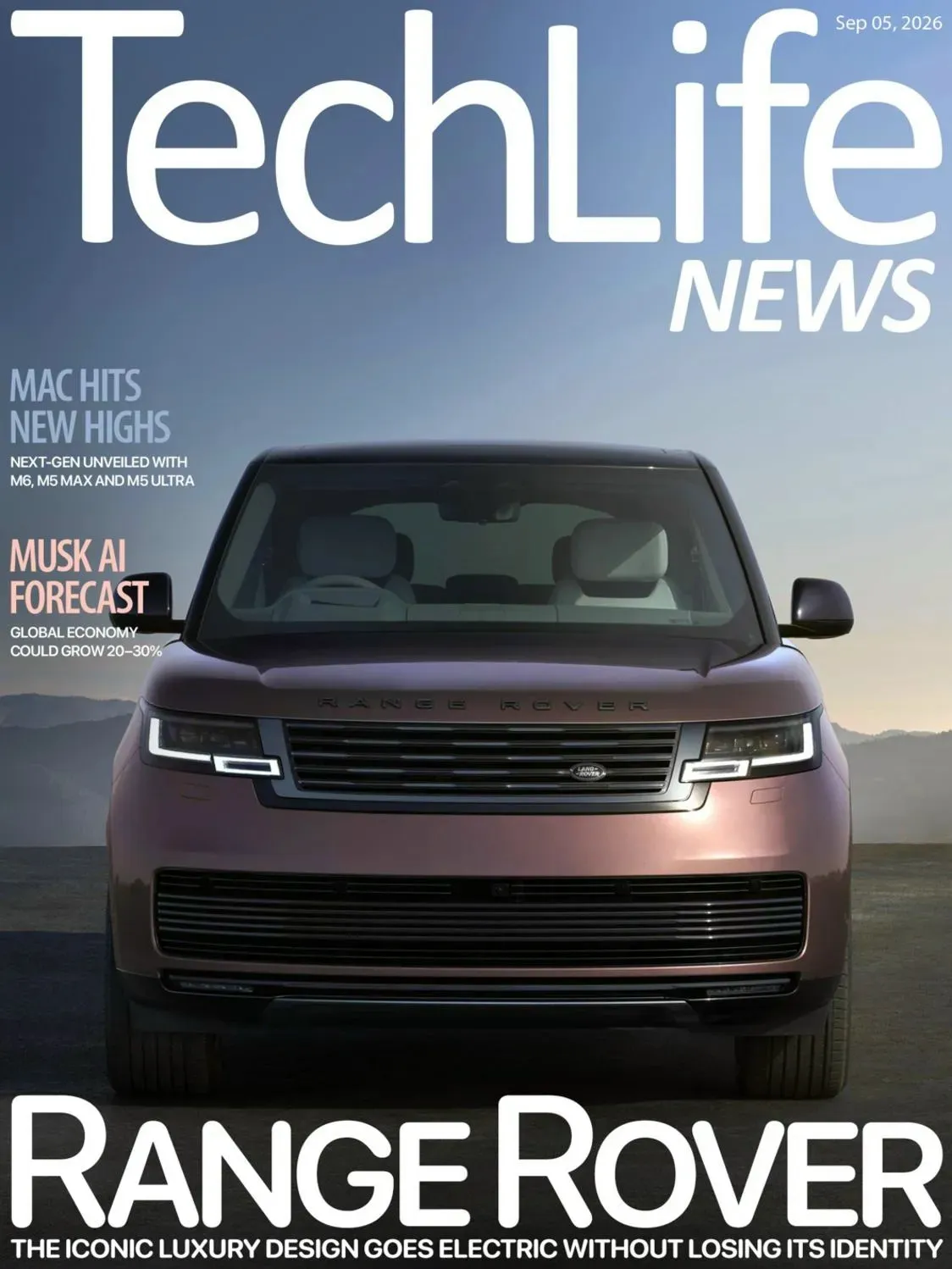
Summary
Tesla formally launched its steering-wheel-free Cybercab robotaxi in Austin nearly two years after the concept debuted, targeting a sub-$30,000 long-term price, while Nvidia confirmed its RTX Spark laptops with 20-core Grace CPUs and 6,144-core Blackwell GPUs will hit shelves in October — both lead stories in Techlife News' September 5, 2026 issue. The weekly also tracks Apple's M6 and M5 Max/Ultra Mac lineup, Meta's $18 billion settlement, and Vision Pro's first FDA-authorised surgical application. For anyone tracking consumer tech, autonomous vehicles or AI hardware, this 244-page issue delivers 19 news-driven feature articles with dateline urgency.
The cover story on Tesla's Cybercab details the two-seat robotaxi's production timeline: second-quarter manufacturing start, July employee rides at the Texas plant, and limited operations across six markets from Austin to Tampa. Nvidia's RTX Spark story explains the Grace-Blackwell superchip architecture and names ASUS, Dell, HP, Lenovo, Microsoft Surface and MSI as首批 launch partners. Apple coverage spans the M6 iMac coming this year in new colours, the HomeOS smart-home push, and the Mac Studio's M5 Max/Ultra benchmark numbers. The issue also reports on Apple Maps renaming Lake Ontario to "Lake America," Pentagon adding Grok and ChatGPT to its military AI portal, and Perp覆ity bringing hybrid local-and-cloud AI to the Mac.
Regular sections include a letters page, industry opinion briefs, and full-page ads from Luminar 4 (AI sky-replacement photo software), PublishChannel (publishing apps), and CBS All Access (15,000 episodes, $4.99/month). With 19 titled features, this is a rapid-fire brief for readers who want the week's tech headlines in one place — though few articles exceed two pages, and the editorial voice is wire-service neutral.
—————
Content Guide
▸ Cover Story / Autonomous Vehicles
p.06 · Tesla Launches Steering-Free Cybercab Robotaxi
Tesla formally released the two-seat Cybercab without a steering wheel or pedals, nearly two years after its concept unveiling. Production began in Q2; employees rode production cars around the Texas factory campus in July. The company aims for a long-term price below $30,000, though no retail price has been confirmed. Tesla's Robotaxi network has accumulated 2.4 million paid miles across six markets — Austin, Dallas, Houston, Miami, Orlando and Tampa — using modified Model Y vehicles. Anyone waiting to hail a Cybercab should watch for Nevada's Clark County permit, which requires human oversight and limits initial fleet size.
▸ AI Hardware / Laptops
p.26 · Nvidia's Game-Changing RTX Spark Laptops Are Coming in October
Nvidia confirmed October availability for RTX Spark laptops, which pair a 20-core Grace CPU with a 6,144-core Blackwell RTX GPU via NVLink-C2C interconnect. First-wave brands: ASUS, Dell, HP, Lenovo, Microsoft Surface and MSI, with Acer and Giga驖yte following. Unlike traditional laptop processors with discrete graphics, the superchip is designed to run large AI models locally rather than sending every task to a remote data centre. Developers evaluating on-device AI inference should benchmark the Spark against cloud-based alternatives before committing.
▸ Apple / Silicon
p.86 · Mac Boost – Next-Generation Macs Unveiled With M6, M5 Max and M5 Ultra
Apple announced its M6 chip alongside upgraded M5 Max and M5 Ultra configurations for the Mac lineup. While full benchmark data was limited in the source material, the M5 Ultra Mac Studio figures show significant multi-core gains over the previous generation. The M6 iMac is expected this year in new colours. Creative professionals running render-heavy workflows should wait for the M5 Ultra Mac Studio benchmarks before upgrading from M2-era machines.
▸ Smart Home
p.214 · Apple's Physical AI Future Begins With HomeOS
Apple's HomeOS represents its most ambitious smart-home push, integrating AI-driven automation across lighting, security and energy management. The article positions HomeOS as the bridge between Apple's existing HomeKit framework and a fully autonomous home ecosystem. Smart-home users invested in the Apple ecosystem should expect HomeOS-compatible devices to require the latest HomePod or Apple TV as a hub.
▸ AI Disruption
p.50 · AI Disruption: Thousands Report ChatGPT and Claude Problems
A widespread outage affected OpenAI's ChatGPT and Anthropic's Claude simultaneously, disrupting thousands of users across business and consumer tiers. The article tracks the incident timeline and service-restoration data but does not name a root cause. Businesses running mission-critical workflows on both APIs should implement fallback prompts or local model redundancy.
▸ Streaming / Pricing
p.74 · Apple TV and Peacock Bundles Rise by $3 Per Month
Apple TV+ and Peacock raised their bundled subscription price by $3 per month, marking the first increase since the partnership launched. No breakdown of which service triggered the hike was provided in the article. Cord-cutters on the bundle should evaluate whether standalone Peacock's ad-supported tier now costs less.
▸ Automotive / Robotaxis
p.234 · Tesla's Cybercab, Amazon's Zoox and Alphabet's Waymo Expand
A roundup of the three major autonomous-vehicle players: Tesla pushing Cybercab production, Zoox operating its purpose-built shuttle in limited geographies, and Waymo expanding its service area in California and Arizona. The article compares regulatory stances across states. Riders should check each service's geofence before relying on AVs for airport runs.
▸ AI / Military
p.158 · Pentagon Adds Grok and ChatGPT to Its Military AI Portal
The Department of Defense integrated xAI's Grok and OpenAI's ChatGPT into its military AI portal, granting service members access to both models for approved use cases. The article notes security classifications and data-handling protocols. Defence contractors bidding on AI projects should note that model choice now affects compliance review timelines.
▸ Medical Tech
p.172 · Vision Pro Receives Its First FDA-Authorized Surgical Application
Apple's Vision Pro headset gained FDA authorisation for a surgical application, marking the device's first regulated medical use. The article describes how surgeons overlay imaging data during procedures. Hospital procurement teams should evaluate Vision Pro's sterilisatiäö requirements before OR deployment.
▸ AI / Models
p.38 · Meta Says Its New AI Model Can Finally Compete With OpenAI and…
Meta claimed its latest large language model matches OpenAI's and Anthropic's performance on standard benchmarks, though the article title was truncated in the printed contents. No benchmark scores were disclosed. AI teams evaluating open-weight models should test Meta's latest on their specific domain tasks rather than relying on generic leaderboard claims.
▸ Mapping / Controversy
p.182 · Apple Maps Renames Lake Ontario as "Lake America"
Apple Maps updated its label for Lake Ontario to "Lake America" in a recent data push, sparking confusion and criticism from Canadian users. The article addresses whether the change is a glitch, a test or a deliberate geopolitical statement. Canadian iOS users should verify mapping data before relying on Apple Maps for cross-border navigation.
▸ Regulars
p.116 · New CEO John Ternus Opens His First Public X Account
p.128 · Elon Musk at G20: AI Will Probably Increase the Global Economy…
p.144 · Apple Says OpenAI Engineer Used Confidential Circuit Plans
p.192 · The Beast Power of the M5 Max and M5 Ultra Mac Studio in Numbers
p.204 · Perplexity Brings Hybrid Local-and-Cloud AI to the Mac
p.224 · OpenAI Walks Away From Cursor, and It Has Nothing to Do With Grok
p.244 · Apple Is Assembling the AI Puzzle John Ternus Now Inherits
—————
Editor's Take
This issue functions well as a weekly news digest but struggles to differentiate itself from a RSS feed. The Cybercab and RTX Spark features are genuinely informative, with specific production timelines and partner names that justify the cover placement. Weaknesses are conspicuous: roughly half the articles are title-only or headline-plus-one-graf, and the heavy ad load — Luminar 4, PublishChannel, CBS All Access — cuts into editorial real estate. The Pentag覆o and Vision Pro surgical pieces are genuinely newsworthy but buried in the back half. Best for time-pressed tech professionals who need a Monday-morning catch-up; not for readers who want depth.
Strengths
• Cybercab article includes production timeline and 2.4m-mile fleet data
• RTX Spark names all seven launch hardware partners
• Pentagon Grok/ChatGPT integration is a genuinely new policy signal
Weaknesses
• Heavy ad ratio dilutes editorial content
• Half the features are headline-only with no substantial reporting
Verdict: Selective read — A competent weekly news roundup, but too many thin articles and full-page ads to recommend for depth buyers.
