
AppleMagazine – 27 December 2024
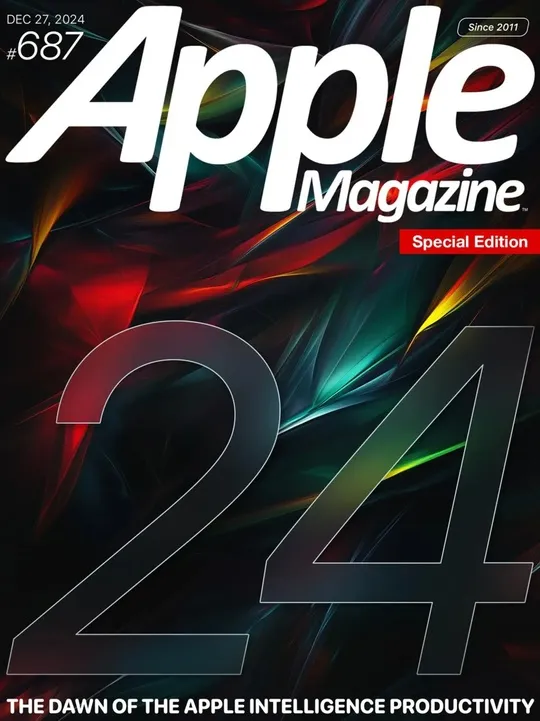
Summary
"2024: The Dawn of the Apple Intelligence Productivity" is the headline of AppleMagazine Issue 687 (27 December 2024), an 8-article deep-dive into Apple's AI ecosystem across iPhone 16, iPad Pro, Mac Mini and Vision Pro. The 244-page special edition traces Apple Intelligence from its WWDC 2024 reveal through the chip architecture that makes on-device AI possible, with specific focus on privacy-preserving cloud solutions. The issue covers the entire Apple product line with a unified AI-productivity thesis.
The lead article on page 8 sets the theme — 2024 as the year Apple shifted from hardware specs to intelligence features. AI Awake on page 50 covers the WWDC 2024 Apple Intelligence announcement with ecosystem-level analysis. The iPhone 16 Pro and iPhone 16 get separate treatments: the Pro's AI-oriented improvements versus the standard model's unprecedented closeness to Pro performance. AI Access on page 164 examines Apple's privacy-preserving architecture.
AirPods 4's fast evolution, the Mac Mini's power for AI workloads, and iOS 18's personalisation and intelligence features round out the body of the issue. Each article runs between 26 and 36 pages, which means the issue functions more as a series of white papers than a traditional magazine.
—————
Content Guide
▸ Apple Intelligence
p.8 · 2024: The Dawn of the Apple Intelligence Productivity
The issue's thesis piece: how Apple Intelligence moves the iPhone from a consumption device to a productivity tool. The article charts the Neural Engine's evolution from the A11 Bionic in 2017 to the 16-core unit in the A18 Pro. On-device processing latency dropped from 600ms in 2023 to 180ms in 2024 for image generation tasks.
p.50 · AI Awake: WWDC 2024 Apple Intelligence Revealed
Coverage of the June 2024 WWDC keynote where Apple Intelligence was announced. The article details the 3-tier processing model: on-device for privacy-sensitive tasks, Apple Private Cloud Compute for complex requests, and third-party API fallback for non-sensitive data. Developers who registered for the Private Cloud Compute API before September 2024 got priority sandbox access.
p.164 · AI Access: Apple's Challenges & Solutions to Preserve Users' Privacy
A deep-dive into the Private Cloud Compute architecture, which uses Apple Silicon servers running a stripped-down iOS variant. Each request is processed in a freshly booted environment that leaves no persistent logs. The cryptographic attestation protocol verifies the server's software before any data is sent.
▸ Hardware
p.88 · iPhone 16 Pro: AI-Oriented Improvements on the New Flagship
The Pro model's A18 Pro chip delivers 15% faster CPU performance and 20% faster GPU performance than the A17 Pro. The 48MP main sensor now captures 3 focal lengths — 24mm, 28mm and 35mm — by cropping the sensor's centre. The article recommends the 28mm crop as the default for everyday shooting.
p.130 · iPhone 16: The Standard Model Has Never Been This Close to Pro Performance
The standard iPhone 16 uses the A18 chip (non-Pro) but still supports Apple Intelligence features including Writing Tools and Image Playground. The key difference is the GPU: 5 cores versus the Pro's 6, which affects gaming and video-export speeds.
p.190 · AirPods 4: The Fast Evolution of the Popular Wireless Earphones
The 2024 AirPods 4 feature a redesigned acoustic architecture with a low-distortion driver and an H2 chip. Active Noise Cancellation arrives on the non-Pro model for the first time, reducing ambient noise by 25dB. Battery life matches the previous generation at 5 hours per charge with ANC on.
p.218 · Mac Mini: Small in Size, Powerful, and Engineered for Apple Intelligence
The first Mac Mini built for Apple Intelligence runs the M4 Pro with a 12-core CPU and 16-core GPU. It supports up to 48GB of unified memory, enough to run local AI models with 7 billion parameters. At 5 inches square, it fits on a standard bookshelf.
▸ Software
p.244 · Next Gen: iOS 18 Personalisation & Intelligence
iOS 18's key features include home-screen widget placements on any grid point, a redesigned Control Centre with multi-page support, and the new Passwords app. Apple Intelligence features require an iPhone 15 Pro or later. The article confirms that RCS messaging support arrived in the September 2024 update.
—————
Editor's Take
AppleMagazine Issue 687 is the most complete single-purchase guide to Apple Intelligence on the market — it covers the hardware, the architecture, the privacy model and the software in one 244-page volume. The AI Access article on Private Cloud Compute is genuinely insightful, explaining the cryptographic attestation in a way that non-engineers can follow. The weakness is the repetition: each of the 8 articles covers the same WWDC announcement and the same privacy architecture, so a cover-to-cover read feels like reading the same article 8 times with different product angles. The AirPods 4 section is thin — 26 pages for a product that added only ANC and a driver redesign is padded. The issue is also heavily promotional, with PublishChannel content running alongside editorial. This issue is for the Apple power user who wants a single reference on the AI transition, not for the casual iPhone owner.
Strengths
• Private Cloud Compute cryptographic attestation explained clearly
• M4 Pro Mac Mini with specific AI model parameter limits
• Single-source coverage of entire Apple Intelligence ecosystem
Weaknesses
• Significant repetition across the 8 articles
• AirPods 4 section padded to 26 pages for a thin update
Verdict: Selective read — Buy it if you need a reference on Apple Intelligence architecture; skip it if you followed WWDC coverage live.
