
The Healthy Mens Handbook – 1st Edition – June 2025
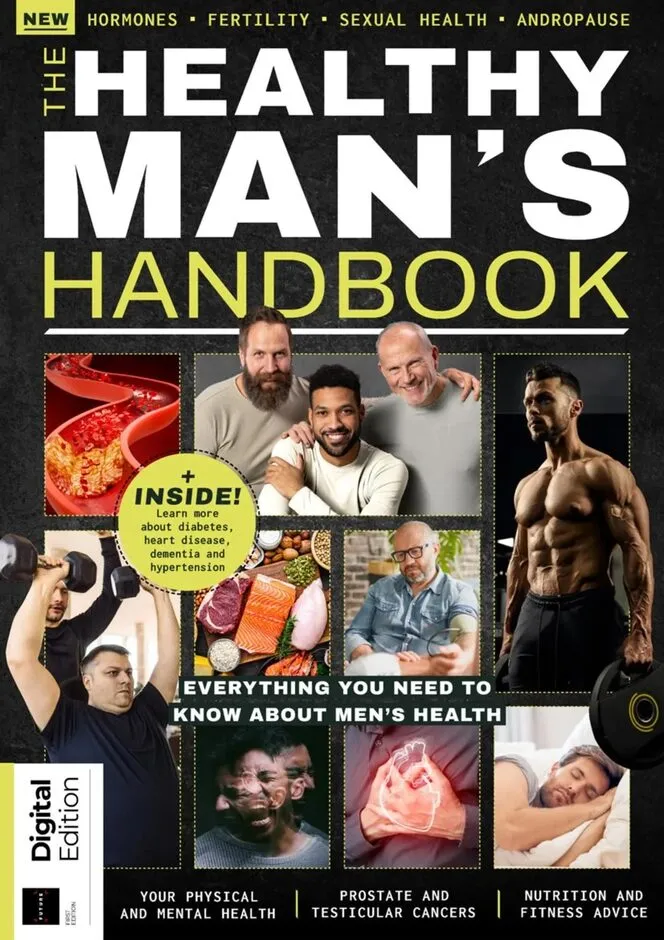
Summary
The Healthy Man's Handbook 1st Edition (June 2025) is the original version of the publisher's men's health reference, covering male anatomy, puberty, hormones, heart health, obesity, diabetes, fitness, nutrition, mental health, reproduction, sperm health, erectile function, contraception, fertility, sexual health, prostate care, male cancers, andropause, bone health, and dementia across 130+ pages. It precedes the 2nd Edition by one year and lacks the newer edition's GLP-1 drug coverage and inclusive healthcare chapter.
The handbook opens with the male anatomy (p.8) and adolescence (p.10), then covers key hormones (p.16) and understanding good health (p.20). Heart health (p.26), high blood pressure (p.32), obesity (p.36), diabetes (p.40), cardiovascular fitness (p.44), building strength (p.48), and nutrition (p.52) form the physical-health block. Mental health (p.58) addresses the fact that men die by suicide at 3.5 times the rate of women. The reproductive chapters cover reproduction (p.62), sperm health (p.66), erectile problems (p.68), contraception (p.72), fertility factors (p.74), sexual health (p.78), and libido (p.82). Cancer coverage includes male cancers (p.86), prostate care (p.92), urinary health (p.96), pancreatic health (p.100), bowel health (p.104), and other cancers (p.108). Health screenings (p.112) and inclusive healthcare (p.114) are followed by andropause (p.116), arthritis (p.122), bone health (p.124), Parkinson's (p.126), and dementia (p.128).
—————
Content Guide
p.16 · Key Hormones
Explains testosterone production, the HPG axis, and what happens when the feedback loop breaks. The chapter covers DHT's role in prostate growth and male-pattern baldness. Readers gain a basic understanding of why blood tests need to include LH and FSH, not just total testosterone.
p.44 · Cardiovascular Fitness
Recommends 150 minutes of moderate-intensity aerobic exercise per week plus two resistance-training sessions. The chapter includes a 4-week starter program for previously sedentary men, progressing from 10-minute walks to 30-minute jog-walk intervals. The program requires no gym membership.
p.62 · Reproduction in Men
Traces the journey from spermatogenesis through ejaculation, explaining the role of the epididymis, vas deferens, and seminal vesicles. The chapter clarifies that sperm count has declined by 50% globally over the past 50 years — a statistic that often surprises readers. Couples trying to conceive gain a biological framework for understanding male-factor infertility.
p.86 · Male Cancers
Covers testicular self-examination (monthly, after a warm shower), prostate cancer screening (PSA discussion starting at age 50, earlier for Black men and those with family history), and less common penile cancers. The chapter emphasises that testicular cancer is the most common cancer in men aged 15-35.
p.116 · Andropause
Discusses the gradual testosterone decline beginning around age 30, symptom differentiation from depression, and the controversy around TRT. The chapter advises against over-the-counter testosterone boosters, citing lack of efficacy data. Men experiencing low-energy symptoms get a framework for the doctor conversation.
—————
Editor's Take
This 1st Edition covers the same ground as the 2nd Edition but without the pharmacology updates — there is no GLP-1 discussion and the obesity chapter lacks the newer medication options. The cardiovascular fitness starter program is a genuinely useful inclusion that the 2nd Edition dropped. The weakness is that much of the content has been superseded: the cancer screening guidelines reference 2023 recommendations rather than 2025-2026 updates. The andropause chapter is more cautious about TRT than the 2nd Edition, which some readers will prefer and others will find outdated. For a current purchase, the 2nd Edition is the better choice unless you specifically want the fitness starter program. The 1st Edition now reads as a competent but dated reference.
Strengths
• Cardiovascular fitness starter program is practical and gym-free
• Covers the full range of men's health topics in one volume
Weaknesses
• Lacks GLP-1 and obesity pharmacology updates
• Cancer screening guidelines reference outdated recommendations
Verdict: Selective read — Superseded by the 2nd Edition, but useful as a secondary reference or for readers specifically wanting the 4-week fitness starter program.
