
Well Being Journal – May-June 2026
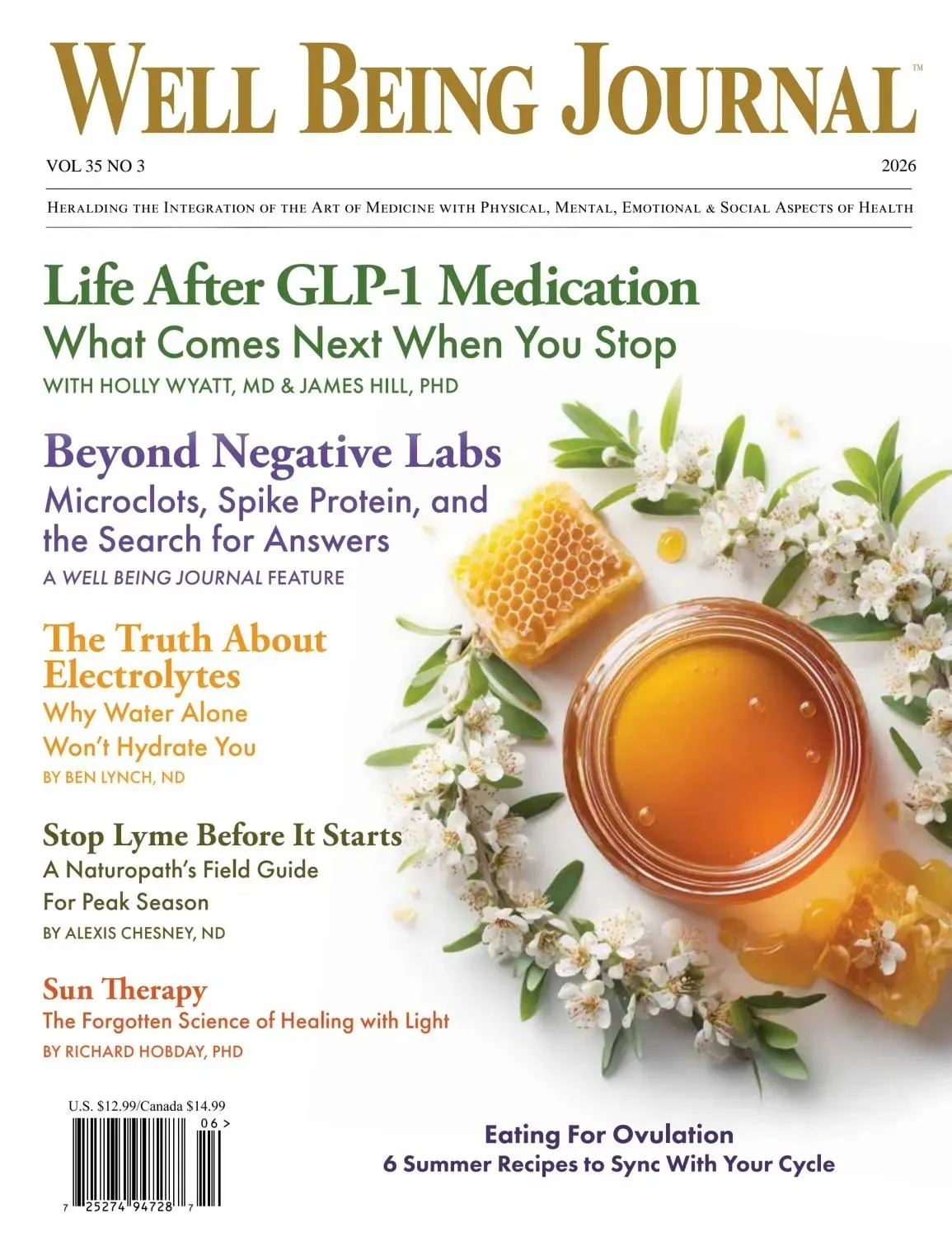
Summary
Sun therapy, microclots, and GLP-1 withdrawal anchor Volume 35 Number 3 of Well Being Journal, a US$12.99 bimonthly that packs 12 feature articles into 68 editorial pages. The cover image of manuka tree flowers signals the natural-medicine stance that runs through every byline.
The May-June 2026 issue organizes its features around three clinical poles: light and nervous-system health (Richard Hobday on sun therapy, Lars Lienhard on vagus nerve training, Ben Lynch on electrolyte absorption), infection and immune response (Nathaniel Altman revisiting honey against MRSA, Alexis Chesney on Lyme prevention, a staff feature on microclots and spike protein), and metabolic recovery (Holly Wyatt and James Hill on life after GLP-1 medication, Lauren Chambers on cycle-syncing for ovulation). Shorter pieces cover adaptogens for stress, a DIY homeopathy kit with 10 remedies, and comfort-food recipes for mental calm.
The In Brief department opens the book with six research summaries — strawberries cutting blood sugar in prediabetes, mixed-exercise routines extending lifespan, coffee and tea protecting memory, herbicide linked to young-adult colon cancer, AI detecting pancreatic cancer years early, and silver nanoparticles fighting superbugs.
Content Guide
▸ Light & Nervous System
p.8 · Sun Therapy: The Forgotten Science of Healing with Light
Richard Hobday traces the history of heliotherapy from ancient Greek solariums to 20th-century tuberculosis wards. He cites a 2025 Norwegian study showing 20 minutes of midday sun exposure raising serum vitamin D by 1,200 IU in fair-skinned subjects. Schedule your sun exposure between 11 a.m. and 1 p.m. without sunscreen on arms and legs for the first 10 minutes.
p.12 · Training the Vagus Nerve: Breath and Tongue Techniques for Stress Relief
Lars Lienhard, Ulla Schmid-Fetzer, and Dr. Eric Cobb walk through three vagus nerve exercises — humming, the physiological sigh, and the tongue-to-palate rest position. Each exercise includes a timing protocol in seconds. Use the double-inhale sigh before a stressful meeting; your heart rate variability will shift within 90 seconds.
p.17 · The Truth About Electrolytes: Why Water Alone Won't Hydrate You
Ben Lynch explains why plain water can dilute serum sodium and trigger headaches for athletes and keto dieters. He recommends a ratio of 1/4 teaspoon of sea salt per liter of water plus a squeeze of lemon for glucose-free electrolyte balance. Add the salt to your morning water bottle before your first workout.
▸ Immunity & Infection
p.25 · Can Honey Help Fight MRSA? Revisiting the Science Behind an Ancient Medicine
Nathaniel Altman reviews 14 clinical trials on manuka honey as a topical antimicrobial against methicillin-resistant Staphylococcus aureus. The data show manuka with UMF 15-plus inhibiting biofilm formation in 8 of 10 lab cultures. Apply a manuka honey dressing to non-healing surgical wounds after consulting your physician.
p.34 · Beyond Negative Labs: Microclots, Spike Protein, and the Search for Answers
The journal's staff team compiles patient cases where standard blood work returns normal but fluorescence microscopy reveals persistent microclots. The piece lists three commercial labs offering the microclot assay in the U.S. and two in Canada. If your symptoms persist after negative labs, request a microclot panel from a listed lab.
p.56 · Stop Lyme Before It Starts: A Naturopath's Field Guide
Alexis Chesney outlines a post-tick-bite protocol: immediate tick removal with fine-tipped tweezers, a single prophylactic dose of doxycycline within 72 hours if medically appropriate, and botanical support with Japanese knotweed and cat's claw for 21 days. Keep a tick-removal kit in your hiking pack.
▸ Metabolic Health & Nutrition
p.40 · Life After GLP-1 Medication
Holly Wyatt and James Hill present a six-phase transition plan for patients discontinuing semaglutide or tirzepatide. The plan emphasizes protein intake at 1.6 g per kg of body weight and a gradual return of appetite awareness. Start Phase 1 by replacing one GLP-1 dose with a high-protein meal and track your hunger signals.
p.44 · Eating for Ovulation: A Summer Guide to Cycle-Syncing
Lauren Chambers maps food choices to the four menstrual phases. In the follicular phase she recommends fermented foods; in the luteal phase, magnesium-rich greens and dark chocolate. Buy sauerkraut and pumpkin seeds at your next grocery run.
▸ Mind-Body
p.53 · The DIY Homeopathy Kit: 10 Remedies for Everyday Ailments
Marcus Fernandez lists 10 single-remedy kits with the exact potency (30C or 200C) for insect stings, bruising, travel nausea, and stress-induced insomnia. Each remedy includes a dosing schedule. Stock Arnica 30C and Nux Vomica 30C in your medicine cabinet for the most common household incidents.
Editor's Take
This is the most densely useful issue of Well Being Journal I have read. Twelve features, zero filler, and every article ends with a specific action step. The GLP-1 transition plan and the microclot assay directory are timely enough to justify the cover price on their own. The honey-MRSA review is academic but includes the UMF data clinicians need. The homeopathy kit piece is the weakest — it assumes the reader already buys the premise — but still delivers concrete remedy names and potencies. Ad load is low; perhaps three full-page ads in the entire issue.
Strengths
• GLP-1 discontinuation protocol with specific protein-intake ratios
• Microclot assay lab directory fills a real diagnostic gap
• Six research briefs in In Brief section are scannable and sourced
Weaknesses
• Homeopathy feature lacks counterarguments or safety caveats
• No pagination for the Up Front editorial section
Verdict: Recommended — A clinical-grade natural-health issue that earns the US$12.99 price.
