
What Your Cat Is Trying To Tell You – 5th Edition – 26 August 2026
Summary
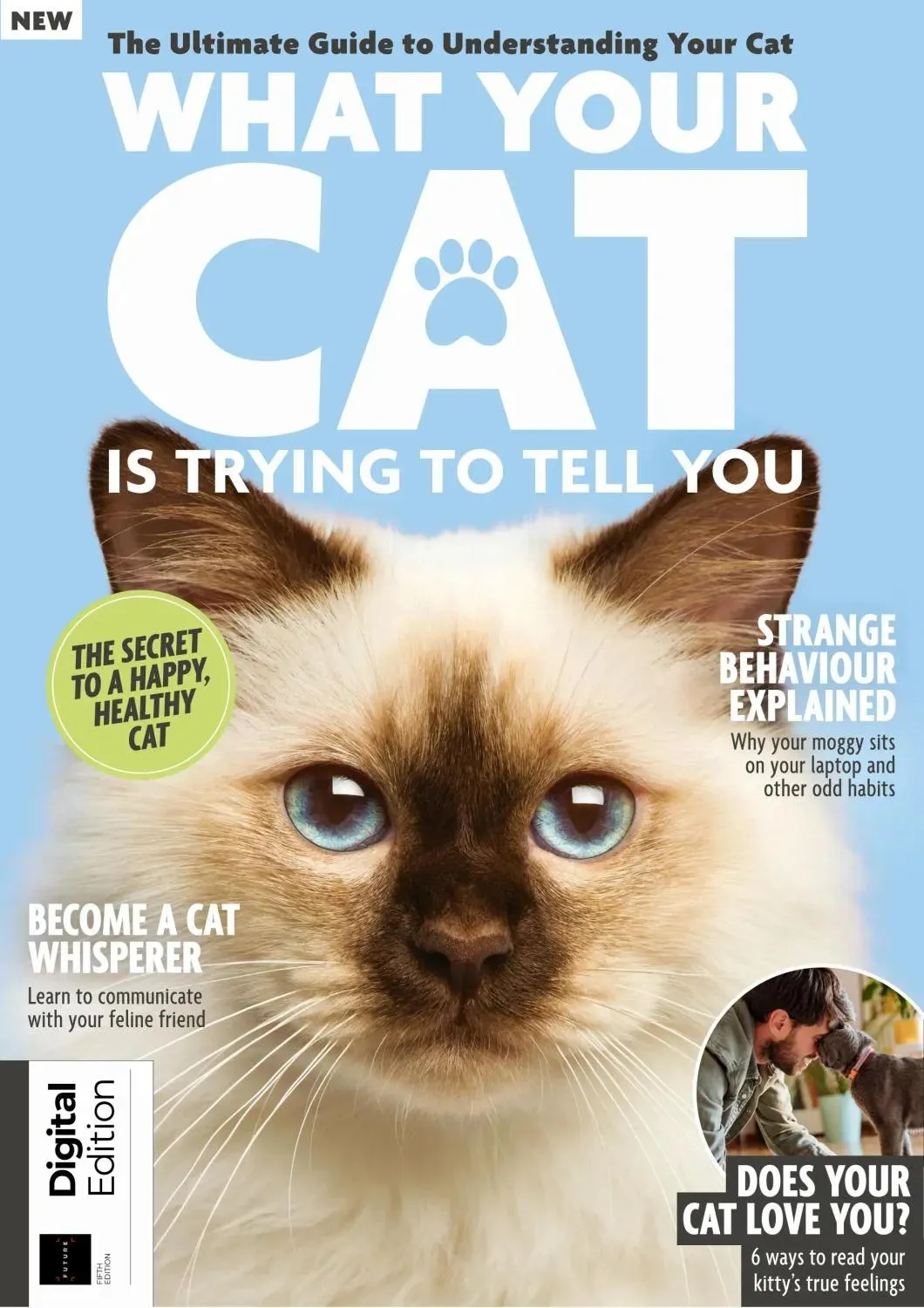
What Your Cat Is Trying To Tell You, Fifth Edition, published 26 August 2026 as a digital edition from Future PLC, promises the secret to a happy, healthy cat. The cover carries strange behaviour explained — why your moggy sits on your laptop and other odd habits — become a cat whisperer, and does your cat love you, with 6 ways to read your kitty's true feelings.
Victoria Williams's All About Domestic Cats at p8 corrects the central myth outright: cats aren't aloof, they form close and loving bonds with their owners. More than 10,000 years ago, farming and stored grain drew rodents, and rodents drew African wildcats to settlements, a partnership that suited both sides.
The body pages give the hard numbers: 32 muscles in each ear, 180 degrees of rotation, 30 adult teeth, a unique nose print like a fingerprint, and Jacobson's organ on the roof of the mouth for smelling with the mouth. Climbing, scratching and the box obsession all make sense once you look at wild ancestors.
—————
Content Guide
▸ Understanding Cats
p.8 · About Cats — Fierce predator to favourite pet
Victoria Williams sets out how the domestic cat balances fierce predator and favourite pet without fully forgetting its wild origin. Unlike pigs, birds and dogs, cats were never simply captured and kept; they have always moved in and out of human lives. More than 10,000 years ago humans began farming and storing grain, rodents came for the food, and African wildcats came for the rodents: cats got plentiful prey and farmers got crops free of pests. Read this before you call any cat aloof.
Why the odd habits make sense
Many puzzling behaviours are reasonable once you look at wild relatives. Climbing to a height gives a good vantage point over the territory. Scratching the sofa spreads scent and keeps the claws in condition. The love of a cardboard box is explained too: an enclosed space offers security and a strategic hiding place to avoid predators and ambush prey. Kittens are born with a set of hunting instincts that develop through play with mother and siblings, and those instincts are rooted in the cat brain and govern even the laziest cat. Watch your own cat do one of these and name the instinct behind it.
p.18 · Cats and Their Humans — Uncover the relationship between you and your pet
This page examines the cat-human relationship. The welcome note sets the tone: cats sometimes follow you and sometimes are not interested at all, they sit on your laptop while you work, and they drink from the tap rather than their own bowl. Every cat is different, and the way to know what they think is simply to pay attention. Sit and watch your cat for ten minutes without your phone today.
p.21 · 6 Ways You Can Tell Your Cat Loves You
The cover's six ways to read a cat's true feelings sit here. Affection signals are the reason people buy books like this. Test one of the six on your own cat this week.
▸ Language and Body Language
p.28 · Cat Chat — Decoding the hidden messages in the sounds your kitty makes
Cat Chat decodes the sounds cats make. Sound is the part of cat language owners misread most. Record one meow and compare it with the descriptions here.
p.30 · Cat Body Language — The best way to understand your cat is to watch them
Body language is named the best route to understanding. Observation beats interpretation every time. Watch your cat's tail and ears for one minute before you approach it.
p.38 · Why Does My Cat Do That? — The mystery meanings behind strange behaviours
The strange-behaviour page explains the mystery meanings, including the cover's laptop-sitting. Odd habits are the questions owners ask most. Note one habit of your cat and look it up here.
p.78 · Become a Cat Whisperer — Learn how to have better chat with your cat
The cover's cat whisperer page teaches better "chat" with a cat. Communication is a skill, not a gift. Practise one slow blink at your cat tonight.
▸ Inside the Cat
p.8 · Inside the Cat — The senses that survived domestication
Even after thousands of years of domestication and selective breeding, the domestic cat shares traits with wild relatives that make it an efficient predator and a skilled acrobat. Each ear holds 32 muscles, can rotate 180 degrees and moves independently. Their field of vision is wider than a human's and night vision far better, though they see fewer colours. Like humans, every cat has a unique nose print in the raised pattern on its nose. Adults have 30 teeth and, having evolved to eat almost only meat, lack teeth designed for grinding. Sensitive whiskers gather environmental information and let a cat judge whether it can fit through a space, and a Jacobson's organ on the roof of the mouth works as an extra scent organ. Look at your cat's nose and ears with this in mind tonight.
Coat colouration
Coats run from pure white through striped tabby to the leopard-like rosettes of the Bengal, with several genes together controlling the texture, pattern and colour of every cat's coat. Coat genetics is the reason two cats in one litter differ. Compare one litter's coats and count the patterns.
▸ Care, Training and Living
p.14 · Owner's Guide — Everything you need to know when getting a new cat
The new-cat owner's guide covers what to know before you get one. Preparation decides whether the first month goes well. Read this before you collect any cat, not after.
p.46 · How to Stroke Your Cat
Petting gets its own page as a way to build a strong bond. Most owners stroke cats in the places cats like least. Let your cat choose where and for how long today.
p.66 · How to Train Your Cat — They may not be as easy to teach as dogs
Cats are harder to teach than dogs but can master many tricks. Training a cat is possible, just different. Teach one trick with a treat this week.
p.68 · Cats and Children — Make sure your kids and kitty grow up best of friends
This page covers children and cats forming a close bond. Children and cats need managing together, not separately. Supervise one child-cat interaction properly today.
p.90 · Signs Your Cat May Be Ill — Keep an eye out for these warning signs
The illness-warning page lists signs to watch for. Cats hide illness better than any other pet. Check one sign on your own cat this week.
p.92 · How to Keep Your Cat Happy — The best way to ensure you have a carefree cat
Happiness gets a practical page. Welfare here means the cat's whole life, not just feeding. Change one thing in your cat's environment this month.
▸ Beliefs, Myths and Extras
p.60 · Cat Myths — Some of the most common cat myths debunked
Common cat myths are debunked. Myths cost cats homes. Ask one person you know to repeat a cat myth and correct it.
p.120 · Your Cat's Sixth Sense — From earthquakes to cancer, cats often know before we do
The sixth-sense page covers cats seeming to know things first, from earthquakes to cancer. This is the most speculative page in the book. Read it for interest, not for evidence.
p.126 · Benefits of Having a Cat — How having a cat can be good for you and your health
The closing page covers the health benefits of living with a cat. Companion animals lower stress, which is the claim worth testing. Note your own stress level before and after ten minutes with your cat.
p.113 · 5 Things Your Cat Wants You to Know
The closing communication page lists five things. Lists like this are the part owners photograph. Pick one of the five and act on it this week.
—————
Editor's Take
The correction on the first page is what makes What Your Cat Is Trying To Tell You worth reading: "Cats aren't aloof – they form close and loving bonds with their owners" is a myth disposed of in one line, and the 10,000-year African wildcat and stored-grain history explains why cats chose us rather than the other way round. The inside-the-cat numbers — 32 ear muscles, 180 degrees, 30 teeth, unique nose prints and Jacobson's organ — are the pages to keep. Weakest is the scale of what is promised against what is delivered: the table of contents lists 26 entries from p8 to p126, but the source gives body detail only for the About Cats and Inside the Cat pages, so the six ways, five reasons, five things never to do and the sixth-sense claims cannot be quoted. The Future PLC production credits and advertising run to several pages. Buy this for the opening section; treat the rest as a list of titles.
Strengths
• Myth that cats are aloof is corrected directly
• 10,000-year wildcat and grain history is clear
• 32 ear muscles, 180 degrees, 30 teeth
• Box, climbing and scratching explained by instincts
Weaknesses
• Most of the 26 listed pages have no body text
• Sixth-sense page is speculative
• Heavy production credits and advertising
Verdict: Selective read — the opening science is sound, the rest is titles only.
