
Parrots – December 2025
Summary
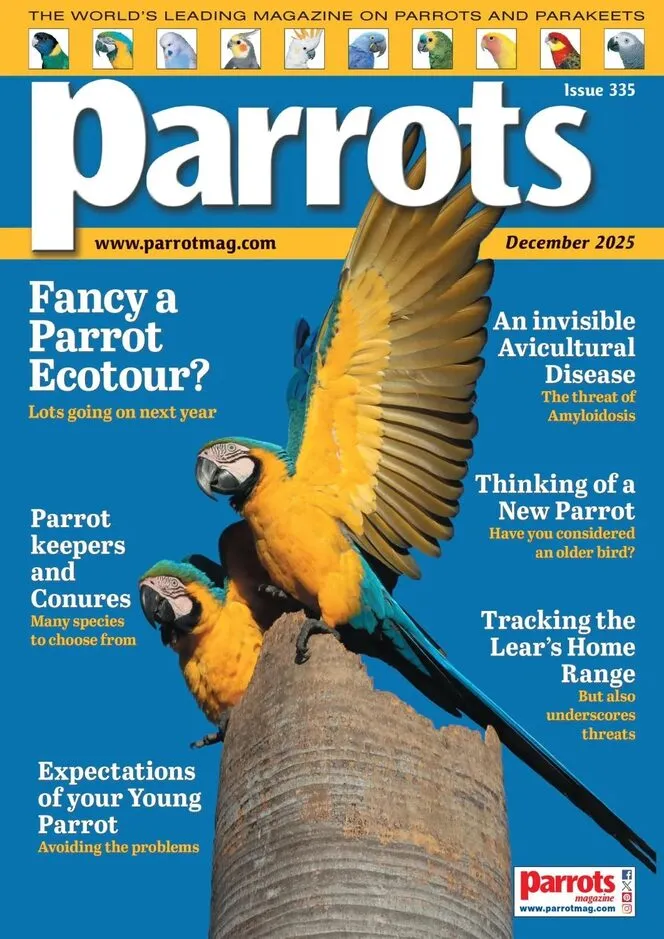
A Blue and Yellow Macaw (Ara ararauna), photographed by Steve Brookes, takes the cover of Parrots December 2025 (Issue 335). Inside, the festive welcome warns that Christmas trees, fairy lights, baubles and wires attract parrots, and that wrapping paper, ribbons and string are dangerous to a free-flying bird.
The contents run from Loro Parque's parent-raised parrots at p10 and Steve Brookes's Pantanal and Buraco das Araras travel piece at p12, through conures at p20, older birds at p24, Malabar parakeets at p28 and Lear's macaw tracking at p38.
Two features carry real weight: Leslie Moran on amyloidosis, "the invisible disease that could end aviculture," at p30, and Rosemary Low on avoiding problems with a young parrot at p34. The eMag CD offer collects 14 years, 2009 to 2022, at £9.00 instead of £19.
—————
Content Guide
▸ Welcome — A parrot-safe Christmas
Festive hazards
The editorial welcome centres on Christmas. Decorations are the risk: Christmas trees, fairy lights, baubles and wires all attract parrots, and a strong beak meeting a live wire is dangerous. With family gatherings and children running about, owners must always know where the parrot is. When a bird is free-flying, opening presents becomes hazardous, and discarded wrapping paper, ribbons and string can all harm a bird. Parrots are as active as toddlers and need constant supervision. A free-flying bird at Christmas is the hazard owners underestimate most. Check every decoration and wire in the room before you let your bird out.
▸ Features
p.10 · Raising parrots with their parents — Rafael Zamora Padrón
Loro Parque's scientific director Rafael Zamora Padrón reports on raising parrots with their parents. Parent-rearing is the alternative to hand-rearing most keepers never see. Ask any breeder how its chicks are raised before you buy.
p.12 · The Pantanal and Buraco das Araras, Brazil — Steve Brookes
Wild Parrots Up Close: Steve Brookes travels to the Pantanal and Buraco das Araras in Brazil. Field travel is the reason parrot magazines exist. Look up one Pantanal species before you read.
p.17 · Eclectus Parrot blows minds — Gabrielle LaFrank
Gabrielle LaFrank writes on the eclectus parrot. Eclectus are the parrot most owners mis-sex and mis-feed. Check your eclectus's diet against the article.
p.18 · A festival to celebrate the Great Green Macaw
A festival celebrating the great green macaw is reported. Community festivals are the conservation story that works. Look up one festival date for next year.
p.20 · Crazy for conures — Eb Cravens
Eb Cravens gives a glimpse of the "wedge-tailed" parakeets, the conures. Conures are the parrot group with the most species to choose from. Compare one conure species with your own bird.
p.24 · Don't forget the oldies! — Amanda Gregory
Amanda Gregory asks why not consider adopting an older bird. Older birds are the rehoming choice owners overlook. Ask one rescue about its older parrots.
p.28 · Spotlight on species — Malabar Parakeets
The Malabar parakeet is presented as an exotic, rare feathered gem from India. Spotlight pages are the most teachable thing in the magazine. Look up one Indian parakeet habitat this week.
p.30 · The Holistic Parrot — Amyloidosis — Leslie Moran
Leslie Moran writes on amyloidosis, the invisible disease that could end aviculture. Disease features are the reason a magazine is kept, not recycled. Ask your avian vet what amyloidosis screening exists.
p.34 · Avoiding problems with your young parrot — Rosemary Low
Rosemary Low on the expectations of a young parrot and avoiding the problems. Young parrots are where most behaviour problems begin. Set one rule for your young bird this week.
p.38 · Tracking of Lear's Macaws defines home ranges — and underscores threats
Tracking work on Lear's macaw defines home ranges and highlights the threats. Satellite tracking is the conservation tool that changes policy. Read one range map before you judge the threat.
▸ Regulars
p.44 · Calendar Dates
Parrot events and dates are listed. Event calendars are how keepers meet each other. Book one event before the year ends.
p.45 · Postbag
Reader letters run here. Letters are where a magazine's community shows. Send one letter this week.
p.46 · Paper back issues
Paper back issues are offered. Back issues are how a new keeper catches up. Order one back issue on a species you keep.
p.50 · Parrots Helpline
The helpline page answers keeper problems. Helplines are the most useful thing in a monthly. Note the number before you need it.
p.51 · Classified
Private advertising is free to place. Classifieds are where birds change hands. Read one advert before you answer it.
▸ Publishing and Offers
eMag collection CD
The Parrots eMag annual collection CD offers 14 years, 2009 to 2022, at £9.00 reduced from £19, working out at 75p an issue, or $12.00 reduced from $25 in the USA and Canada, at $1.00 an issue, with free postage anywhere in the world. A digital subscription saves £9 over 12 months. Fourteen years for £9 is the best-value item in the issue. Order one CD before the offer ends.
Publishing detail
Parrots is published 12 times a year by Imax Visual Limited, West Building, Elm Grove Lane, Steyning BN44 3SA, UK, phone 01273 464777, website www.parrotmag.com. Publisher John Catchpole, design by Victoria Wr3n. The US office is run by Margo Rose on 800-294-7951. Check the rate before you subscribe.
—————
Editor's Take
The Christmas welcome is the reason Parrots December 2025 is worth opening, because listing trees, fairy lights, baubles, wires, wrapping paper, ribbons and string as hazards to a free-flying bird, and calling parrots as active as toddlers who need constant supervision, is the only page in the issue that will prevent an emergency. Leslie Moran on amyloidosis as "the invisible disease that could end aviculture" is the most serious feature, and Rosemary Low on young parrots is the most useful. Weakest is the source: every feature is listed by title, author and page number with no body text, so the Pantanal travel, the conures, the Malabar parakeets and the Lear's macaw tracking cannot be quoted, and no species count, range figure or tracking number survives. The eMag offer — 14 years, 2009 to 2022, £9.00 down from £19, 75p an issue — is the most concrete thing in the magazine. Buy this for the Christmas warning and the offers; the features are a contents page.
Strengths
• Christmas hazards are listed in full and honestly
• Amyloidosis is framed as an industry-level threat
• Rosemary Low and Eb Cravens are named authorities
• eMag CD gives 14 years, £9.00 and 75p an issue
Weaknesses
• No feature body text available at all
• No species counts, ranges or tracking numbers
• Travel and spotlight pages are titles only
Verdict: Selective read — the Christmas warning and the CD offer.
