
BBC Wildlife – March 2026
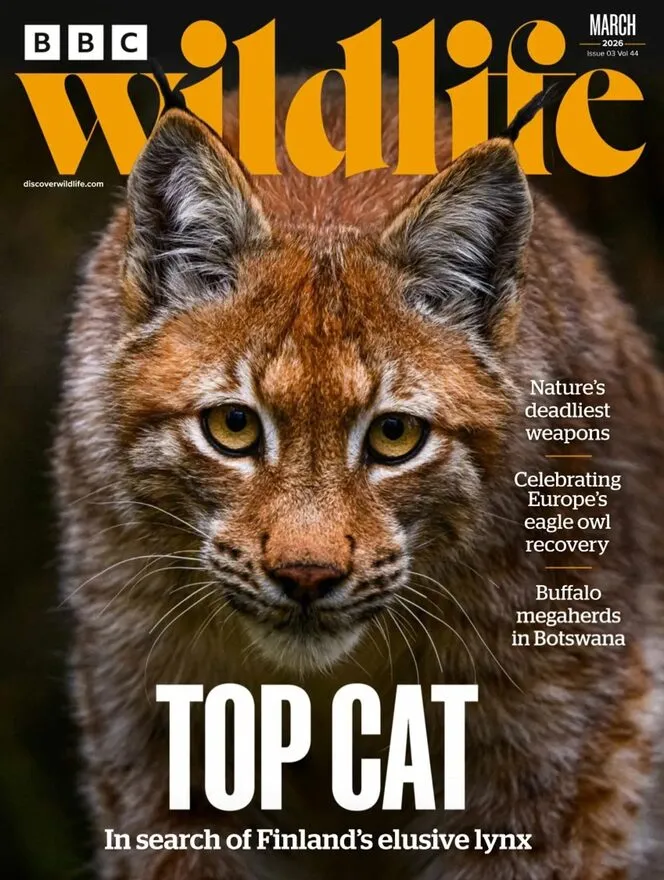
Summary
BBC Wildlife Magazine's March 2026 issue (No. 03, Vol. 44) sends filmmakers Harry Read and Edwin Towler into Finland's 23 million hectares of boreal forest after the roughly 2,250 Eurasian lynx that most Finns go a lifetime without seeing, guided by cover photographer Ossi Saarinen.
The cover story, 'Hide and seek', tracks two weeks of failed camera traps, misidentified badgers and thermal-binocular stakeouts before a mother lynx and her two kittens finally cross a clearing at midnight. Around it sit four location features: Roland Seitre's Florida portfolio of black skimmers nesting on beaches shared with 3,600-strong (and falling) colonies, Mark Hillson's report on eagle owls recolonising the Danube Delta, JV Chamary's survey of nature's weapons, and Sue Watt's visit to Botswana's 12,000-strong buffalo megaherds.
The conservation spine is James Fair's special report on Yellowstone, 30 years after wolf reintroduction, which pits George Monbiot's 'how wolves change rivers' trophic cascade against Utah State's Dan MacNulty and Colorado State's Tom Hobbs, who call the popular story oversold. David Lindo's column reports Indian rhinos walking the streets of Sauraha after Chitwan's recovery from 100 animals to 700, while Wild Times covers Seychelles giant-tortoise rewilding and four wild cat species hunting in separate vertical zones.
Regulars stay practical: Ben Hoare lists seven March encounters from boxing hares to early mining bees, Mike Dilger pinpoints five US greater sage-grouse leks with directions, Nick Baker dissects the bolas spider's moth-luring chemical mimicry, and the Q&A explains why 85 per cent of Australian mammals exist nowhere else. A piranha species guide, Photo Club and a Niger hippo-canoe mishap close the issue.
—————
Content Guide
▸ Cover Story
p.52 · Hide and seek
Filmmakers Harry Read and Edwin Towler (YouTube's Gone Feral) spend two weeks in southern Finland with lynx photographer Ossi Saarinen, whose own first two sightings came three years apart. With no snow for tracking, they work scat, hidden roe-deer kills and thermal binoculars, learning that sitting hares mimic a cat's heat signature. The payoff — a mother and two kittens feeding at a kill, then a daylight sighting flagged by a local shouting 'ilves' — makes the effort ratio plain. If you plan a lynx trip, budget at least a week and expect your sightings to come through thermal gear after dark.
▸ Features
p.42 · Beach bird
Conservation photographer Roland Seitre documents black skimmers raising chicks on Florida sandbanks metres from high-tide marks, condo harbours and boat wakes. The state population of ~3,600 has halved in 30 years, and nesting success depends on thin ropes and Audubon signs separating colonies from dogs and beachgoers. His captions decode the skimming technique — the shorter upper mandible lets the bird slice the shallows at night. Visit a roped Florida colony in spring and you can watch incubation swaps and chick-flattening anti-predator behaviour at close range.
p.60 · Eagles landing
Mark Hillson follows Rewilding Ukraine and Rewilding Romania as four young eagle owls are released near Vylkove after two weeks of acclimatisation, joining 15 birds freed since the programme's first 'pioneer owl' in 2019. The Danube Delta backdrop delivers white-tailed eagles, Dalmatian pelicans and golden jackals, plus a sober note that reintroductions must be managed because eagle owls are super-predators. Birders heading to the Romanian side around Tulcea have a realistic chance of all five delta owl and eagle species in one visit.
p.66 · Strike mode
JV Chamary grades nature's arsenal with hard numbers: a peacock mantis shrimp's dactyl club hits at 31m per second and 1,500 Newtons, a Dracula ant's mandibles close in 23 microseconds, and a great white's modelled bite reaches 18,216 Newtons while burning through 30,000 teeth a lifetime. The sharper argument is definitional — milkweed pollen sacs fight male-to-male battles, so plants carry weapons too, and Sheila Patek and Lisa Whitenack supply the biomechanics. Use the Top 10 weirdest weapons list (horned lizards squirting eye blood, bombardier beetles) as a ready-made quiz round.
p.74 · Buffalo bedlam
Sue Watt bases at Wilderness Mokete, the first camp in Botswana's Mababe Depression, a refilled ancient lake that since 2007 has become the dry-season magnet for herds drone-counted at roughly 12,000 animals. Guides Jonah Seboko and Vasco Tebalo explain horn-recognition, 'dagga boy' temperaments and why the Chobe pride hunts at midday; filmmaker Russell MacLaughlin has stayed three years filming the lion-buffalo wars. The sidebar on Balete and Hambukushu buffalo totems adds cultural weight safari coverage usually skips. Time a visit for August-November, when the basin is the region's only water source.
▸ Conservation & News
p.20 · A comeback success story?
James Fair tests the famous claim that reintroduced wolves 'changed Yellowstone's rivers', citing William Ripple's aspen data against Dan MacNulty and Tom Hobbs, who argue elk declines were driven mainly by human hunting outside the park and that aspen recovery is patchy. Luke Painter splits the difference: wolves are necessary, not sufficient. The piece lands on consequences for UK reintroduction arguments — nowhere in Britain is remote enough from livestock for a trophic cascade to run. Read this before repeating the Monbiot video in any rewilding debate; it gives you the counter-citations.
p.29 · Wild in the City
David Lindo reports Indian rhinos moving from Chitwan National Park into Nepali towns, where roughly 300,000 buffer-zone residents now share streets with two-tonne grazers. Nepal's recovery from about 100 rhinos in the early 1970s to ~700 in Chitwan is the region's standout conservation win, and celebrity rescue rhino Meghauli made BBC News with his afternoon urban strolls. The costs are real — mistaken-identity charges have killed people, and 7cm incisors do damage. Lindo's column is a useful case study for anyone studying human-wildlife coexistence at scale.
p.8 · Wild Times
The news section leads with giant tortoises flown to a Seychelles island as rewilding 'castaways', plus camera-trap research showing four wild cat species hunting in separate vertical zones to avoid competing over prey, elephant seals found to remember rivals' calls from previous years, and a puma diet study built on canopy ambushes of spider and howler monkeys. A preview of Big Cats 24/7 series two — Gordon Buchanan's team back in the Okavango with the 40-plus-strong Xudum pride — rounds it out. Skim it first; each story runs barely a page.
▸ Regulars
p.24 · Wild March
Ben Hoare picks seven UK encounters for the month: boxing hares and rabbits (whose motives are harder to read than hares'), the long-eared owls that starred on Springwatch 2025, great tit song dialects from Wytham Woods research, early and ashy mining bees nesting in dry pathside turf, siskins hitting garden feeders as birch seed runs out, lesser celandines, and freshly woken pipistrelles on mild evenings. Each entry tells you exactly where and when to look. Use it as a weekend checklist — the mining bee and bat items need nothing more than a warm evening.
p.32 · Mike Dilger's wildlife spectacles
Dilger covers greater sage-grouse leks across the American West, where males inflate yellow air sacs up to ten times a minute through three-to-four-hour dawn sessions in March and April, with record leks of nearly 400 males. He lists five viewing sites with logistics: Long Valley near Mammoth Lakes via Eastern Sierra Audubon, Wyoming's Golden Triangle (world's highest grouse density), Craters of the Moon's 11km drive, American Prairie in Montana and Valentine Refuge in Nebraska. If a lek trip is on your list, this is the planning page.
p.36 · Nick Baker's hidden world
Baker finds a southern bolas spider in Arizona by spotting a bird dropping with eyes. The female hunts with a 2.5mm silk bola flung at moths she has lured using an allomone that mimics female moth pheromone — switching between up to three chemical analogues depending on which moth species is flying. Males, too small to wield the bola, catch flies with their front legs instead. Failed hunting costs nothing: she eats the silk and recycles it. Know the mimicry trick and you can find one yourself by scanning leaves for glossy 'droppings' at dusk.
p.83 · Q&A
Reader questions get straight answers: Australia's weird fauna stems from 40 million years of isolation after Gondwana, leaving 85 per cent of its mammals, 93 per cent of reptiles and 94 per cent of frogs endemic, with platypus electroreception and venomous spurs as worked examples. A second answer confirms the Bermuda Triangle teems with life, overlapping the Sargasso Sea that Sylvia Earle called a 'golden floating rainforest', where European eels were tracked spawning in 2022. The page also fields questions on animal blood types and sunbathing species.
p.90 · Species guide: Piranha
Jo Caird's primer dismantles the Hollywood piranha: of 60-plus Serrasalmid species, most scavenge or eat plants, one (Tometes camunani) eats only river weeds, and attacks on humans are usually single defensive bites to toes. The numbers still impress — black piranhas hold the strongest bite relative to body size of any bony fish, teeth interlock in blocks, and a red-bellied piranha eats about 70g a day. Pet releases have put them in UK, Chinese and US waters. Good myth-busting reference for anyone keeping or writing about the species.
p.106 · Tales from the bush
The closing memoir recounts a teenage hippo safari on the Niger River near Niamey in a leaking plank canoe, two years after a hippo capsized a riverboat in the same waters with passengers drowned. The captain chews a twig while his son bails with a plastic bottle, and the story builds to a near-sinking. It is a short, effective reminder of why hippos stay near the top of Africa's human-fatality tables. Read it last; it pairs well with the buffalo feature's warning about animals documentaries edit into cuteness.
—————
Editor's Take
The feature well is the strongest this issue has been in a while: the lynx cover story earns its suspense honestly (eight days of nothing before a mother and kittens appear on thermal), and the Yellowstone special report is genuinely useful journalism that names the scientists on both sides of the trophic-cascade row instead of the usual rewilding cheerleading. Sue Watt's Mababe piece and the eagle-owl release story hold the standard. The weaknesses are structural: the middle of the book is thick with travel advertorials — Hays Travel, Trailfinders South Africa, Antarctic cruises — that pad the page count, and the regular columns (Dilger, Baker) run shorter and slighter than the cover price suggests. This is an issue for readers planning a wildlife trip and UK naturalists working through March; casual photo browsers get less.
Strengths
• Yellowstone wolf report cites named scientists on both sides of the debate
• Cover lynx story documents the failures, not just the sighting
• Dilger's sage-grouse piece doubles as a five-site trip planner
Weaknesses
• Mid-issue travel advertorials inflate the page count noticeably
• Regular columns are thin relative to the feature length
Verdict: Recommended — Strong features and a genuinely balanced conservation report outweigh advertorial padding.
