
Horse Hound – 12 March 2026
Summary
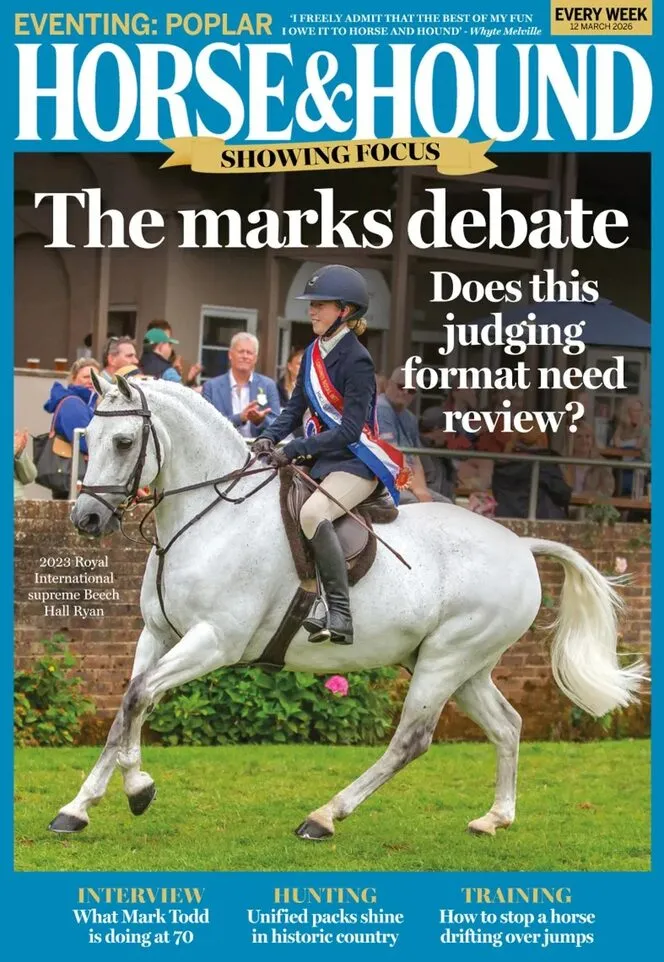
Horse & Hound's 12 March 2026 issue (Volume CXLII, No. 10) puts the 30-year-old showing marks system on its cover, asking whether HOYS judges' narrow scoring range still rewards performance over conformation in the qualifiers.
Bethan Simons leads a 5-page investigation into the marks system proposed in 1994 by pony breeder Tom Best. HOYS event director Emma Williams defends the format as 'accountability and valuable feedback', while BSPS chair Paul Cook warns narrow scoring bands let 'a beautiful but green pony' beat an outstanding performance. The new BSPS Markmaster digital app is tested alongside the Royal International's pull-in, conferring alternative.
The people features carry the issue: Sir Mark Todd, who turned 70 on 1 March, rides two lots a day for Ben Pauling at Naunton Downs and shares racehorse Rockit Tommy with New Zealand's Tayla Mason. Eventer Simon Grieve, 44, recounts his Burghley comeback on Autograf after mindset work with Charlie Unwin and Ros Canter. Octavia Pollock spends a Northumberland day with the newly amalgamated Morpeth West Percy, watching huntsman Ali Graham draw the legendary Glitters.
News from the 5 March National Equine Forum covers X-ray risk assessment replacing pass/fail vettings, plus the Royal Veterinary College's AI fracture-detection system shortlisted for a STEM award. Philip Ivens of Buckingham Equine Vets warns we stand 'on the precipice of a pre-antibiotic world'. Anna Ross and Jodie Hall McAteer write opinion columns on dressage judging pressure and the impact of the Iran conflict on Doha showjumpers.
—————
Content Guide
▸ Cover Story
p.34 · Marks of success
Bethan Simons traces the 1994 introduction of marks by BSPS's Tom Best and asks whether the format still delivers transparency at Horse of the Year Show qualifiers. HOYS's Emma Williams calls marks 'accountability and valuable feedback', while BSPS chair Paul Cook recounts a class where a co-judge's range of just five marks let a green but beautiful pony beat an outstanding performance. The new Markmaster digital app and the Royal International's pull-in alternative are compared head-to-head. Riders should track marks against the top three in their class to learn what individual judges actually reward.
p.24 · All in a day's work: Sir Mark Todd, Ben Pauling's work rider
Sir Mark Todd, who turned 70 on 1 March, explains why he rang Ben Pauling after stopping training and now rides two lots a day at Naunton Downs alongside stints at Richard Hobson's yard. He rides the bumper winner Old Clayesmorian, holds a share in Rockit Tommy with New Zealand eventer Tayla Mason, and has tickets for the Cheltenham Festival. The piece confirms he has 'no desire to be back on that treadmill again' despite John Whitaker still competing at 70. Owners looking for a post-career riding routine will find his two-lots-a-day, no-mucking-out blueprint realistic.
p.44 · A Glittering triumph: a day with the Morpeth West Percy
Octavia Pollock rides kennel-huntsman Charlie Watts' grey mare Foxy on the amalgamated Morpeth West Percy's first full season, drawing the legendary Glitters with huntsman Ali Graham, the fifth generation of his family to hunt with the West Percy. The article details the merger mechanics: chairman James Cookson's long-running push, joint-master Craig Anderson calling it 'the best thing we've ever done', and the dual collar system preserving West Percy yellow and Morpeth blue. Hunt supporters planning a season will note their hunting days run Tuesday and Saturday from a 33-couple kennel of modern English hounds.
▸ Vet & Welfare
p.4 · X-rays and risk assessing in the future of vettings
At the 2026 National Equine Forum on 5 March, vets Lucy Grieve, Sam Cuts and Mark Georgetti joined dealer Julia Martin of Kings Hill Equestrian to argue for replacing 'pass or fail' vettings with the European low-medium-high risk system. Martin revealed her yard now only 'passes' two in 10 horses, against one in 10 forty years ago, blaming buyer expectations and insurer exclusions. Buyers should ask vets for a risk-class verdict rather than a clean bill of health, and prepare for insurance exclusions on findings that do not actually raise risk.
p.5 · On the precipice of a return to a pre-antibiotics world
Philip Ivens of Buckingham Equine Vets and Professor Jane Hodgkinson of the University of Liverpool presented twin antimicrobial- and wormer-resistance warnings at the 5 March National Equine Forum. Ivens urged yards to demand culture-and-sensitivity testing, improve wound-care biosecurity and lift vaccination uptake; Hodgkinson reminded owners that resistance has been recorded to all classes of equine wormer. Owners should pick up droppings, run faecal egg counts before and after treatment, and avoid routine interval dosing on heavily grazed fields.
p.26 · Touchy-feely: all about horses' sensory hairs
Liz Richardson MRCVS explains why muzzle, eye and inner-ear whiskers are 'superpowered' tactile organs that compensate for the horse's facial blind spots and may even detect vibrational energy. The article compiles the rule patchwork: FEI banned clipped sensory hairs on 1 July 2021 and extended this to inner-ear hair on 1 January 2025, BHA followed on 1 July 2024, and Germany, France, Switzerland and Equestrian Australia enforce stricter national bans. Showing competitors must check their society's rules since UK welfare bodies strongly discourage trimming outside veterinary necessity.
▸ Sport & Opinion
p.14 · Dressage: 'Everyone's watching now'
International grand prix rider Anna Ross responds to The Times' coverage of warm-up footage at the Amsterdam World Cup qualifier and FEI penalties, arguing the sport must define where the welfare line sits. She compares the public's split on training pressure to meat-eaters versus vegetarians, and notes that pressure-and-release is taught from foal handling upwards. She proposes AI handling the mechanical counting of tempi, pirouette steps and piaffe transitions so judges can focus on harmony. Readers should email hhletters@futurenet.com with views on technology in judging.
p.16 · Showjumping: 'It's an extra level of concern'
British five-star rider Jodie Hall McAteer describes the disruption caused by the Iran conflict to riders and horses stranded in the Middle East during the Doha Tour, with cargo flights now bringing teams home. She explains why she only did one five-star at Hickstead last year while rebuilding her string of less experienced horses and how the overseas migration to Wellington, Doha and the UAE is opening spots at traditional World Cup finals. Riders rebuilding after a gap can target these late-season World Cup openings to break back into the top level.
p.40 · Catch the drift: how to stop horses drifting sideways over fences
The training article unpacks why horses drift left or right at fences, separating physical-discomfort causes from rider influence and outlining two straightness exercises to rebuild even line-homes through combinations. It details how drifting on the approach compromises take-off distance and unbalances the rider, with specific exercises for correcting both the horse's natural bend and the rider's crooked habit. Riders who repeatedly lose lines at related distances should add these straightness sessions before tackling technical courses again.
▸ People, News & Kit
p.18 · The interview: Simon Grieve
Simon Grieve, 44, talks through finishing 18th at Burghley 2025 on Autograf after a CCI4-S retirement at Thoresby that made him think he had 'lost his mojo'. He credits sports psychologist Charlie Unwin's breathing-pointing exercise, sessions with Chris Bartle and Ros Canter, and daily chats with Izzy Taylor for his Burnham Market and Burghley results. He runs an eight-horse yard at Wymeswold in Leicestershire with partner, shepherd James Horswell, and has Best Escapade and Best Trick heading to Badminton prep. Riders struggling at the top end should book a mindset coach before blaming the horse.
p.8 · How artificial intelligence can boost horse welfare
The RVC's AI fracture-detection system, shortlisted for the STEM for Britain 2026 award, can identify scan type, image angle and locate fractures using knowledge transferred from human fracture images. Vet Vision AI's EQICONNECT platform, developed by vets Jess Hulme and Robert Hyde, uses stable cameras to flag behavioural changes in eating, resting and sleep that may indicate gastric ulcers or sleep disruption. Yards concerned about early signs of ulcers or poor sleep should trial a camera-monitoring system before the next competition season.
p.30 · Wonderful Wiltshire & Tangle tamers
The property pages showcase three rural Wiltshire listings around chalk-stream country: Ladyswood House, Underhill House and Roundway Farmhouse, all marketed with stables and paddocks. The adjacent kit review tests 10 detangler sprays and mane conditioners including Equine America, NAF Silky Mane, Absorbine ShowSheen, Leovet 5Star, Carr & Day & Martin Canter, Supreme Products, Mastacare, Barrier, Cavalor Star Shine and Hy EQUESTRIAN Magic Finish, scoring each on tangle release and shine. Buyers looking at Wiltshire equestrian properties should request specific acreage and track access details before viewing.
—————
Editor's Take
The marks-debate cover is the strongest piece in the issue: Bethan Simons lets Tom Best, Emma Williams and Paul Cook argue in full, then tests the new BSPS Markmaster app against the Royal International's pull-in alternative without taking a safe middle position. That willingness to take sides is the issue's biggest asset, repeated in Anna Ross's clear stance on dressage training pressure and Sir Mark Todd's honest account of why a 70-year-old wants two lots a day, not four. The weakest material is the AI welfare feature, where technical claims from Vet Vision AI are repeated almost verbatim without independent scrutiny, and the kit pages read more like a shopping catalogue than journalism. The issue is best suited to eventing followers (Simon Grieve, Poplar Park report), hunting readers (Morpeth West Percy) and showing competitors who actually feel the points gap between HOYS qualifiers.
Strengths
• Marks-debate cover story lets Tom Best, Emma Williams and Paul Cook argue without a safe middle.
• Morpeth West Percy feature combines hunt history with real merger mechanics.
• Strong named columnist voices from Anna Ross, Jodie Hall McAteer and Sir Mark Todd.
Weaknesses
• AI welfare story repeats vendor claims without independent testing of the platforms.
• Heavy classified and feed-ad density breaks the reading flow between features.
Verdict: Recommended — Standout marks-debate cover and hunting feature justify the cover price despite ad-heavy filler between sections.
