
Your Horse – May 2026
Summary
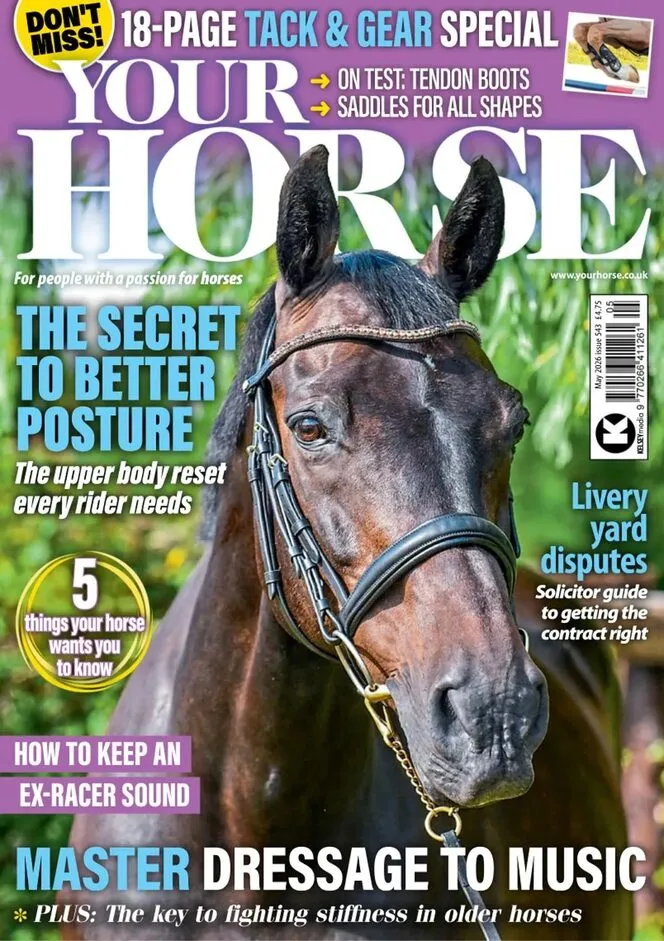
Your Horse May 2026 leads with an 18-page tack and gear special, tendon boots on test and saddles for all shapes, plus the secret to better posture. The cover also carries livery yard disputes, a solicitor's guide to the contract, keeping an ex-racer sound, master dressage to music, and the title's 45 years.
The ex-racer page at 54 argues Thoroughbreds are not as fragile as owners assume, because they cope with racing's demands; the problem is management and retraining. Livery yard disputes are rising in county courts, and senior solicitor Lara Davies says a well-drafted contract would have avoided some of them.
The news pages carry the year's real numbers: RVC AI detecting fractures at 71% to 84% accuracy with about 10% of racehorses fracturing in training, and EIDS flu data showing 75% of infected yards did not isolate new arrivals and 74% involved unvaccinated horses.
—————
Content Guide
▸ Care
p.62 · Livery yard lowdown — Solicitor Lara Davies on failing contracts
Senior solicitor Lara Davies explains why so many livery contracts are failing and how to avoid being caught out. She says livery yard disputes contested in county courts increased last year, and that many yards still operate with no formal agreement or an inadequate one. A written agreement is cheaper than any dispute. Read your own livery contract tonight and check what it says about notice and care.
p.54 · Sound as a pound — The truth about ex-racer durability
The feature reports that Thoroughbreds are not as fragile as many people assume, since they cope with the demands of racing; the issue is usually management and how they are retrained. Breed prejudice costs good horses homes. Look up one rehoming scheme before you rule out an ex-racer.
p.48 · Listen and learn — Five facts every horse wants their owner to know
Behaviourist Janne Winther Christensen reveals five things horses want owners to know at page 48. Welfare is framed as listening to signals, not just feed, shelter and exercise. Watch your horse for one signal you have been ignoring this week.
p.34 · Move it or lose it — Why daily activity matters for veterans
Resident vet Lucinda Ticehurst says "Movement is medicine," explaining stiff joints are like rusty hinges needing movement to stay lubricated, including for horses no longer ridden. Turnout is the cheapest therapy there is. Add ten minutes of in-hand walking for your veteran this week.
▸ Training
p.20 · Dressage to music toolkit — Choosing music and designing a floorplan
Expert insight on picking the best music and designing a great floorplan. Music choice is the part riders get wrong most. Time your floorplan to one piece of music before you ride it.
p.26 · Fix your showjumping warm-up — Build the round before you enter
The warm-up piece argues for building the round you want before entering the ring. Warm-ups are where most rounds are lost. Plan three fences before your next class.
p.28 · Ride better by design — The secret power of shoulder alignment
Julie Driver shares exercises including seven for releasing shoulder tension, and shoulder alignment is the cover's posture secret. Rider posture decides the horse's way of going. Do one shoulder exercise before you mount today.
p.40 · Creativity for cobs — Pole exercises your mount won't switch off from
Polework for cobs that keeps them engaged. Variety is why most school horses switch off. Add one new pole exercise this week.
▸ Experts
p.70 · Physiotherapy — Walking backwards, carrot stretches, thoracic sling, veterans, groundwork
The physio page covers walking backwards, carrot stretches, thoracic sling work, veterans and groundwork. Groundwork is the rehab most owners skip. Add one carrot stretch to your horse's routine this week.
p.72 · Bitting — Professional fitting, materials, changing bits, signs it's not working
Bitting covers fitting, materials, changing bits and the signs a bit is not working. Bit problems cause more resistance than bad riding. Get your horse's bit checked by a fitter this month.
p.74 · Pasture management — Winter damage, growing your own hay, clover and buttercups, muck removal
Pasture covers winter damage, home-grown hay, clover and buttercups, and muck removal. Pasture is the health input owners never budget for. Walk one field and count the weeds this week.
p.76 · Dressage — Counter flexion, leaning-in, warming up a young mount, resistance, test calling
The dressage experts answer counter flexion, leaning-in, warming a distractible young horse, resistance and test calling. Young horse warm-ups are the question asked most. Ride one short session rather than one long one this week.
▸ Gear Special (79–96)
p.96 · Tendon boots that deliver — Real-world test of the latest designs
The test team reports on the latest tendon boot designs. Independent testing is the only gear coverage worth reading. Check your own boots against the test before buying.
p.92 · Saddle-flap facts — How to choose between one or two
Saddle flap choice between one or two is explained. Saddle fit is the gear decision that decides soundness. Have your saddle checked before the season starts.
p.80 · What's new? — Fresh finds off the tack store shelf
New products are rounded up at page 80. New gear pages are advertising dressed as news. Try one item before you believe the copy.
▸ News
p.6 · AI detects fracture risk
Royal Veterinary College researchers, funded by the Horserace Betting Levy Board, used AI to identify subtle bone changes, with Dr Hanya Ahmed leading the work. About 10% of racehorses fracture during training, and the system detects and locates fractures with 71% to 84% accuracy. It used 100 equine fracture cases from two UK hospitals, 70 feline cases and about 4,000 human fracture images, working in three stages: scan type, image angle, then detection. The team is working with the Hong Kong Jockey Club on identifying early changes before fracture. Ask your vet what imaging your horse actually needs.
p.6 · Flu spread in unvaccinated and unisolated yards
The EIDS team at Cambridge, with lead author Fleur Whitlock, analysed 2020 to 2024 in the Equine Veterinary Journal. Of 177 UK cases, 52% occurred in the final three months of those years; where infected horses were new arrivals, 56% came from Ireland and 20% moved within the UK. 75% of infected premises did not isolate new arrivals and 74% involved unvaccinated horses. Isolate every new arrival before it meets your own horses.
p.6 · Dog attack kills horse in east London
Two dogs allegedly chased a horse at Havering Park Woods near Romford after 5pm on Friday 20 March, causing the rider to fall and the horse to hit a wall and die before the vet arrived; the rider, a woman in her thirties, was taken to hospital by London Ambulance Service. Metropolitan Police seized both dogs and no arrests had been made. Keep a record of dog incidents on your route.
—————
Editor's Take
The news pages make Your Horse May 2026 worth buying: RVC's AI at 71% to 84% accuracy with about 10% of racehorses fracturing, and EIDS's 177 cases, 75% not isolating and 74% unvaccinated, is surveillance data no other equestrian monthly prints so plainly. Lara Davies on rising county court livery disputes is the practical page, and Lucinda Ticehurst's "Movement is medicine" is a line every owner of a veteran should hear. Weakest is the gear special, which is 18 pages of advertising dressed as testing, and the ex-racer feature makes its case without naming a single horse or trainer in the available text. The editor's letter about her ex-racer Anie hiding in the stable is charming but slight. Buy this for the flu and fracture numbers; skip the 18-page gear section.
Strengths
• Fracture AI gives 10%, 71-84%, 100 equine cases
• Flu gives 177 cases, 75% no isolation, 74% unvaccinated
• Livery page names rising county court disputes
• "Movement is medicine" for veterans is usable
Weaknesses
• Gear special is 18 pages of advertising
• Ex-racer feature names no horse or trainer
• Editor's letter is charming but slight
Verdict: Recommended — the news numbers, skip the gear special.
