
Canadian Wildlife – July-August 2026
Summary
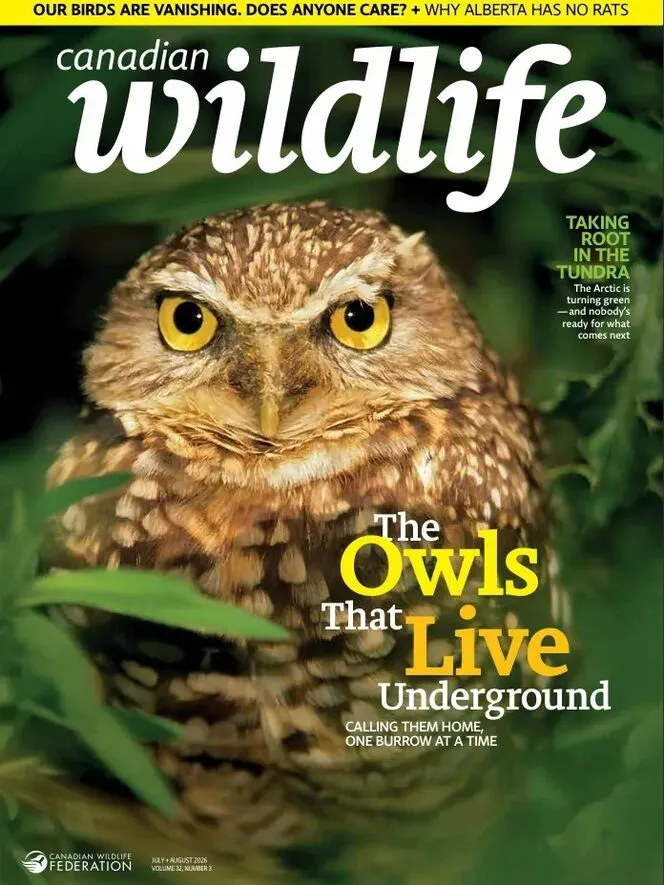
Canadian Wildlife July + August 2026 (Volume 32, Number 3) takes root in the tundra on its cover, asking whether anyone will recognise the Arctic in 50 years as shrubs creep north. Andrew Findlay's Uncanny Thaw at p28 follows beavers and bluethroats arriving with them.
Zack Metcalfe's Planting Parliaments at p18 is the issue's heart: burrowing owls head south and most do not come back, so researchers keep building homes anyway. CEO Sean Southey recalls Mike Mackintosh, who has built artificial burrows for burrowing owls in the Nicola, Thompson and Okanagan valleys since the 1990s.
Breakthrough carries the numbers: monarch butterfly overwintering numbers rose 64%, dragonflies detect deep red light at 720 nm, and jellyfish in the Gulf of St. Lawrence eat marine worms. Wild turkeys, Fogo Island caribou, Alberta's rat-free record since the 1950s and Devon Island close the issue.
—————
Content Guide
▸ Cover — Arctic
p.28 · Uncanny Thaw
Andrew Findlay reports that as the Arctic warms, shrubs are creeping north and bringing unexpected guests, asking whether the Arctic will be recognisable in 50 years. Sean Southey links it to shrubification of the tundra, with beavers and bluethroats moving in. Tundra greening changes migration routes as well as landscapes. Follow one Arctic species' range map and watch it move.
p.18 · Planting Parliaments
Zack Metcalfe reports that burrowing owls are heading south and most are not coming back, yet researchers keep building homes in hope they one day will. Sean Southey names Mike Mackintosh, who has built artificial burrows in the Nicola, Thompson and Okanagan valleys since the 1990s. Artificial burrows keep a species in a valley it has already left. Ask your provincial wildlife body whether it supports burrowing owl burrows.
▸ Breakthrough
p.8 · Breakthrough
Good news runs from new discoveries to progress against climate change and pollution. Scientists at the University of Southern Denmark found jellyfish in the Gulf of St. Lawrence prey on two marine worms, Alitta succinea and Platynereis dumerilii, giving them a nutritional boost while growing; the page shows a lion's mane jellyfish. Research in Cellular and Molecular Life Sciences found dragonflies detect deep red light at 720 nm. Eastern migratory monarch butterfly overwintering numbers rose 64% according to WWF-Mexico and partners. Enter one of these findings into your own nature notes tonight.
▸ Species and Places
p.13 · Out There — Wild Turkey
The wild turkey is the largest member of the pheasant and grouse family, and carries a bristly beard that hens use to judge a mate's fertility. Turkey recovery is one of North America's quieter wildlife successes. Watch one flock and count the beards before assuming they are all male.
p.14 · Bigger Picture — Fogo Island caribou
Researchers on Fogo Island found pregnant caribou growing antlers two months early, suggesting climate change is affecting biology down to the bone. Early antler growth in pregnancy is the kind of sign nobody budgets for. Read the study before repeating any climate claim about caribou.
p.42 · Urban Wildlife — Why Alberta has no rats
Brown rats thrive worldwide, but Alberta has stayed rat-free since the 1950s. Rat-free status is a policy achievement, not luck. Report any rat you see in a rat-free province immediately.
p.46 · Right Here — Devon Island, Nunavut
The back page visits Devon Island in Nunavut. Remote park pages give the Arctic a place rather than a statistic. Check access rules before planning any Arctic trip.
▸ Regulars
p.36 · Birding
Birding research shows nearly half of North American bird species are in steep decline. Decline on that scale is the story of the decade, not the season. Record one species list this month and send it to a national scheme.
p.38 · Field Guide — Wild Bergamot
Wild bergamot is a pollinator powerhouse and a favourite of Canadian gardeners. Pollinator plants are the cheapest conservation a gardener can do. Sow one patch of wild bergamot this season.
p.44 · Engage
CWF marine research scientist Alexandra Mayette introduces a new tool to predict whale-strike impacts. Shipping strikes are the hidden cost of whale recovery. Ask what speed limits apply where you travel by boat.
In Focus — Red Fox
Mike Douthwright photographed a red fox at Elliston, Newfoundland, coming out of shrubs by the sea on the way to a puffin viewing spot. Front-of-book images work when the caption tells you something. Give any fox the distance it chooses when you photograph it.
—————
Editor's Take
Planting Parliaments is the strongest page in Canadian Wildlife July + August 2026, because burrowing owls that mostly do not return, and Mike Mackintosh building burrows since the 1990s anyway, is conservation reported with its cost included. The monarch 64% rise and the dragonflies detecting 720 nm red light give Breakthrough real numbers, and Alberta rat-free since the 1950s is the best short item. Weakest is the cover, where Uncanny Thaw promises a changed Arctic and then shares space with a park page and a gear list, and the Fogo Island caribou item is truncated before it lands. The magazine also corrects itself on the MERS founders, which is to its credit. Buy this for the owl and monarch pages.
Strengths
• Burrowing owl piece includes a 1990s burrow builder
• Monarch rise of 64% and 720 nm red light
• Alberta rat-free since the 1950s is reported
• Correction on MERS founders shows honesty
Weaknesses
• Cover Arctic story shares space with filler
• Fogo Island caribou item is cut short
Verdict: Recommended — the owl, monarch and rat pages earn the issue.
