
Architectural Design – Issue 3 2026
Summary
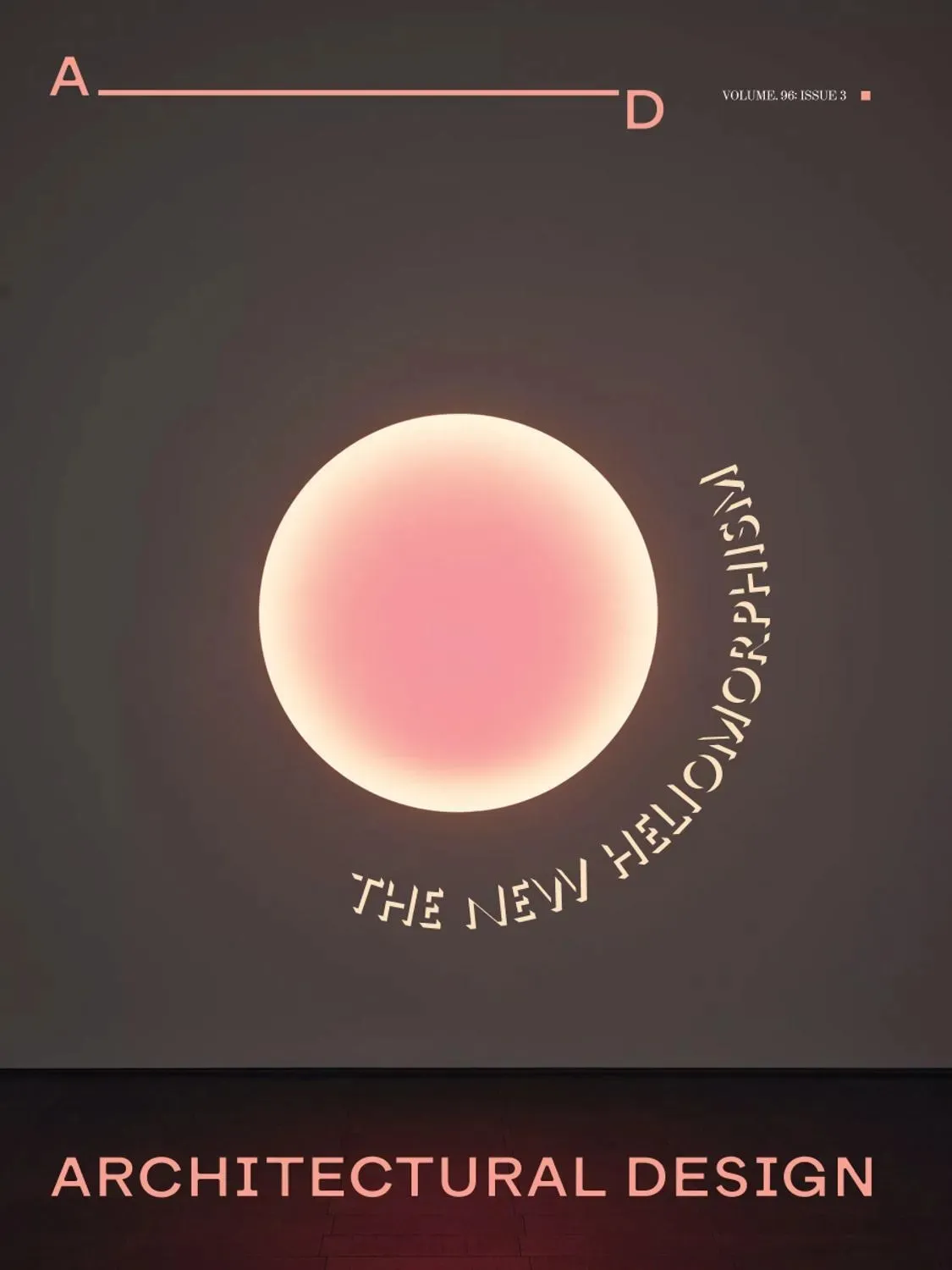
James Turrell's Beneath the Surface, Circular Glass, 2021 — LED light, etched glass and shallow space, 52 inches in diameter, runtime 2 hours 30 minutes — provides the visual anchor for Volume 96 Issue 3 of Architectural Design, titled The New Heliomorphism: A General Theory of Solar Architecture, with guest editors Salmaan Craig, Charles Waldheim and Seok Min Yeo assembling 19 papers that argue architecture must stop outsourcing thermodynamic work to mechanical servants and instead let buildings perform heat exchange through form, gradient and material.
The editorial framework by Craig, Waldheim and Yeo (page 6: Thermal Gradients and the Avant-Garde) sets the thesis: 20th-century solar design was marginalised by high-carbon photovoltaics and sealed glass envelopes, but climate collapse now demands that buildings reclaim thermal work. Paul Bouet (page 14) revisits the 1970s passive-versus-active solar conflict and traces the rise of photovoltaic hybrids. Fatma Al-Alawi, Daniel A. Barber and Michelle Addington (page 24) revisit late-20th-century hot-climate architecture in Kuwait. Thomas Schroepfer (page 32) uses Singapore's one-north district as a heliomorphic laboratory for dense, green urbanism. Jenny E. Sabin's team (page 42) presents HelioSkin, a kirigami-based building-applied photovoltaic canopy that tracks the sun. Emmett Zeifman (page 50) traces the history of camping inside modernism, from Mies's ambiguous shells to contemporary thermal避难所s. Javier Garcia-German (page 56) argues heliomorphism must engage inhabitation as daily atmosphere. John May (page 64) traces poché from solid wall to hollow cavity to computational deposition. Carl D'Apolito-Dworkin (page 70) uses convection, turbulence and stratification as design media. Dorit Aviv (page 78) proposes membrane-assisted cooling and solar wind catchers. Renata Sentkiewicz (page 86) presents the Zhuhai Huafa Art Museum as an experimental thermodynamic instrument. Kiel Moe (page 96) redefines modulation as a heliomorphic practice, calling for forest-first building ecologies. Aleksandra Jaeschke (page 104) asks how much land a building takes, proposing bio-centric metrics linking material yield to soil health. Lola Ben-Alon (page 112) uses prairie grass, kelp and earth as solar-developed matter. Daniel Ibanez (page 120) traces metabolic timber chains from forest to facade. Kelly Alvarez Doran (page 128) contrasts high-tech, fossil-fuel-driven construction with low-temperature material recipes. LTL Architects (page 136) proposes thick plant-based enclosures in single-material straw assemblies.
Editor's Take
This is Architectural Design at its most useful: a tightly edited theme issue with a coherent thesis rather than a loose collection of unrelated papers. The strongest contributions are Jenny Sabin's HelioSkin, which bridges material science and architectural application with actual prototyping data, and Kiel Moe's modulation essay, which reframes forestry as a design problem rather than a supply-chain problem. The weakest is Paul Bouet's historical survey — it covers familiar territory without adding new archival evidence. The James Turrell cover is well-chosen but under-discussed in the text. This is for architecture academics and advanced practitioners who want the theoretical case for post-carbon building form, not for students seeking a general introduction to solar design.
Strengths
• Jenny Sabin's HelioSkin feature includes prototyping data and kirigami geometry research
• Kiel Moe's forest-first building ecology reframes timber construction beyond carbon accounting
• Coherent editorial thesis holds across all 19 papers without conceptual drift
Weaknesses
• Paul Bouet's historical survey covers known territory without new archival material
• James Turrell cover image is not substantively discussed in the editorial content
Verdict: Essential — The most coherent solar-architecture thesis published this decade; essential reading for anyone teaching or practicing climate-responsive design.
