
New Scientist International Edition – 29 August 2026
Summary
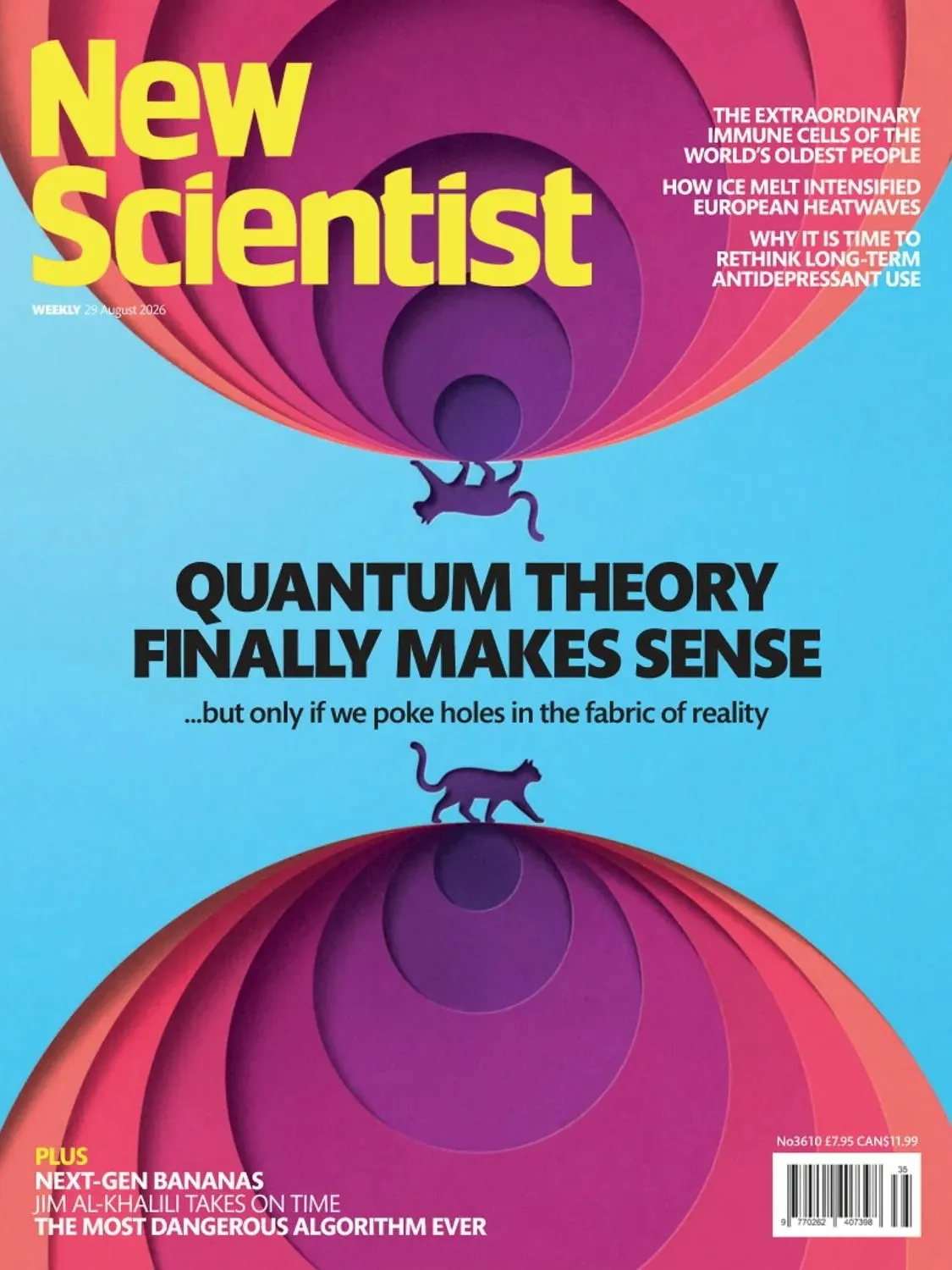
Vol 271 No 3610 (29 August 2026) proposes that quantum theory finally makes sense—but only if we poke holes in the fabric of reality, removing irrational numbers from quantum mechanics to resolve its conceptual paradoxes. The cover, designed by Eiko Ojala, signals an issue that also tackles the antidepressant trap (p.36), the world's most dangerous algorithm (p.40), and a gamma-ray signal that may unlock dark matter's secrets (p.4).
Three features dominate: the quantum-reality cover (p.30), a hard look at SSRI withdrawal severity (p.36), and the man trying to prove quantum computers can work (p.40). News reports that the world may warm 25 percent more than we thought (p.6), scientists finally found what creates the drive for shuteye (p.9), and healthy female clones were created from a male mouse (p.13). Graham Lawton asks how long we could possibly live (p.19).
The back pages include a deep dive into music-making on the future quantum internet in Feedback. The leader tackles when to stop—why healthcare isn't built for coming off medication.
—————
Content Guide
▸ Cover Story / Physics
p.30 · Poking holes in reality — What would happen if we removed irrational numbers from quantum mechanics?
The feature explores a fringe but mathematically rigorous proposal: strip out the irrational numbers (pi, e, square roots) that underpin quantum amplitudes, replacing them with rational approximations. The result preserves experimental predictions but eliminates the measurement problem. It walks through the implications for free will, locality, and the nature of reality itself. Readers come away with a lucid explanation of why Hilbert spaces are not as solid as they seem.
p.4 · Fresh light on dark matter — Peculiar gamma-ray signal may unlock dark matter's secrets
The LUX-ZEPLIN experiment has detected a 248 keV gamma-ray excess at 2.6 sigma significance that could come from dark matter annihilation. The news article explains why 2.6 sigma is not a discovery but why the signal's spectral shape lines up with a leading dark-matter candidate. A graph plots signal vs background across energy bands.
▸ Health / Medicine
p.36 · The antidepressant trap — Withdrawal symptoms following long-term SSRI use appear far more serious than we thought
A meta-analysis of 47 studies reveals that 56 percent of long-term SSRI users experience moderate to severe withdrawal symptoms when stopping, far higher than the 20 percent previously quoted by some guidelines. The piece profiles two patients who endured months of "brain zaps" and emotional instability. It gives readers a tapering protocol: reduce dose by 10 percent every two weeks, not the 50-percent cuts still recommended by some GPs.
p.5 · The extraordinary immune cells of the world's oldest people
Supercentenarians carry a uniquely activated set of cytotoxic CD4 T-cells that may clear senescent cells more aggressively. The finding opens a drug-repurposing avenue: existing compounds that boost CD4 activation could be tested for age-related disease. A biopsy comparison shows immune cell profiles of a 112-year-old and a 70-year-old.
▸ Technology
p.40 · Most dangerous algorithm — The man trying to prove that quantum computers can work
Profile of a mathematician who claims a proof that quantum error-correction thresholds are fundamentally unattainable. If he is right, fault-tolerant quantum computing is impossible. The article gives equal space to his critics and reproduces the key equation. Readers get a clear summary of the surface-code vs. cat-code debate.
▸ Environment
p.7 · How ice melt intensified European heatwaves
A climate model study shows that the loss of summer sea ice in the Arctic has shifted the jet stream in a way that makes European heat domes more likely to stall. The ice-loss mechanism accounts for roughly 30 percent of the increased heatwave duration observed since 2018. A schematic shows the altered pressure pattern.
▸ Regulars
p.45 · Puzzles — Try our crossword, puzzle and quick quiz
The quick quiz includes a question about the gamma-ray energy quoted in the dark matter piece (248 keV), testing whether readers actually absorbed the news section.
p.46 · Almost the last word — Why do humans so readily adopt fiction into our lives?
Evolutionary psychologists weigh in: fiction allows low-cost social simulation, improving our ability to navigate real-world alliances and threats. One respondent calls it "the mind's flight simulator."
—————
Editor's Take
The quantum-reality cover is intellectually ambitious and genuinely provocative—the kind of feature that makes New Scientist essential for physics readers. The antidepressant-trap feature (p.36) is even more valuable: it fills a real information gap for millions of patients, with practical tapering advice that most clinical guidance still lacks. Weakest item: "Our upper limit" (p.19) recirculates longevity statistics without fresh reporting. The "next-gen bananas" item (p.26) is too short to justify its cover billing. The heavy ad spread for a luxury watch brand in the first signature feels out of place next to the dark matter news. Best for quantum-curious readers and anyone currently on SSRIs; skip if you follow longevity news closely.
Strengths
• Quantum-emptied-reality thesis: rigorous yet accessible
• Antidepressant-withdrawal meta-analysis with practical taper protocol
• Dark-matter gamma-ray signal coverage is appropriately cautious
Weaknesses
• "Our upper limit" recycles longevity stats without new data
• "Next-gen bananas" too brief to warrant cover mention
Verdict: Recommended — Two standout features (quantum and antidepressants) in one issue; the best antidepressant reporting New Scientist has run this year.
