
Airline Business – June 2026
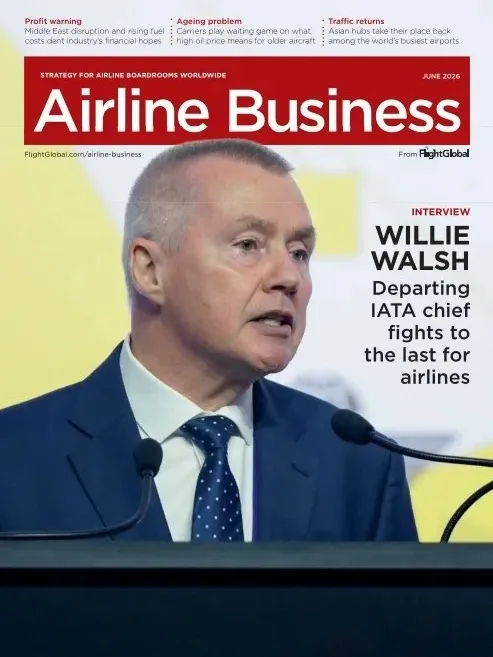
Summary
Willie Walsh, departing IATA chief, fights to the last for airlines in the June 2026 issue of Airline Business as the Middle East conflict and rising fuel costs shred industry profit forecasts. IATA cut its global net profit expectation to USD 23 billion — halved year-on-year — with Middle East carriers alone swinging from a projected USD 7 billion profit to more than USD 4 billion in the red. Fuel costs jumped 39% to USD 350 billion on flat usage.
The cover story at P14 profiles Walsh's IATA tenure from pandemic start to present crisis. The International Briefing (P6) reports from IATA's 82nd annual general meeting in Rio de Janeiro in early June. Air New Zealand CEO Nikhil Ravishankar (P18) discusses adapting to higher fuel costs after seeing light at the end of the tunnel on aircraft availability. Air Astana's new CEO Ibrahim Canliel (P20) seizes the opportunity to build East-West connectivity through Kazakhstan. The "Age Concern" focus (P22) examines why high fuel prices have not yet pushed airlines to shed older, less efficient aircraft. Traffic data shows Asian hubs rebounding strongly while US passenger levels dropped.
—————
Content Guide
▸ Cover Story / Features
P14 · Leading Out of Crisis
Willie Walsh began his IATA tenure during the pandemic and has kept fighting as challenges continued. The profile covers his stance on the Iran war — which he insists is not a "crisis" for the industry unlike Covid — and his parting assessment of the airline industry's resilience.
P18 · Poised to Unleash Growth
Air New Zealand CEO Nikhil Ravishankar saw light at the end of the tunnel on aircraft availability, then the fuel-cost shock hit. The interview captures how a network carrier adjusts growth plans when the single biggest input cost doubles.
P20 · Seizing the Opportunity
New Air Astana CEO Ibrahim Canliel has taken the helm as the carrier capitalises on the chance to build East-West connectivity through Kazakhstan. The crisis has accelerated Air Astana's growth plans.
P22 · Age Concern
Strong demand, capacity constraints and uncertainty over the Middle East crisis mean higher fuel costs have yet to force airlines to retire older, less efficient aircraft. Fleet planners should model the scenarios this piece outlines against their own retirement schedules.
P26 · Traffic Returns as Asia Rebounds
While US passenger levels dropped, leading Asian hubs enjoyed strong growth during 2025. The data section breaks down which airports gained and which lost.
▸ Briefing
P04 · Comment: Maintaining Resilience
The Iran war doubled fuel prices and closed Middle East airspace, yet IATA AGM mood was upbeat. Spirit Airlines shut down in early May. IATA expects global traffic growth of just 2.1% in 2026 — less than half of 2025's 5.3%.
P06 · Fuel Costs Bite Into Profit Hopes
IATA cut profit expectations: global airline net profits forecast to halve year-on-year to USD 23 billion. Total fuel costs jump 39% to USD 350 billion. Middle East carriers swing to more than USD 4 billion in the red.
P08 · US Merger Talk Runs Out of Spirit
Spirit Airlines' demise reshapes the US low-cost carrier landscape.
P10 · Turkish Airlines Plays Long Game
The flag carrier's strategic positioning amid Middle East conflict.
P11 · Qantas Offers Glimpse of Sunrise
Project Sunrise — Qantas's ultra-long-haul plans — takes shape.
▸ Analysis
P30 · Market Outlook: Heathrow Third Runway Funding
Heathrow's owners face airline fire over how a third runway should be funded.
P31 · Viewpoint: AI and Passenger Experience
Why airline leaders should not fear AI's power to improve passenger experience.
P32 · Quarterly Data Review
Industry performance indicators, traffic data and financial metrics by region.
—————
Editor's Take
This is the most consequential Airline Business issue of 2026 — the Walsh interview, the IATA profit downgrade and the Spirit Airlines collapse are all genuinely newsworthy events with specific numbers. The fuel-cost briefing (P6) is the most useful piece: IATA's USD 23 billion profit forecast versus USD 41 million six months earlier, the 39% fuel-cost jump to USD 350 billion, and the Middle East swing from USD 7 billion profit to USD 4 billion loss are concrete figures every airline analyst will cite. The Asian traffic rebound data is useful for network planners. The weakest element is the AI Viewpoint, which is too brief to offer real insight. Best for airline executives, aviation investors and anyone tracking the industry's post-Iran-war financial trajectory.
Strengths
• IATA profit downgrade with specific numbers (USD 23B, 39% fuel jump, USD 350B total)
• Walsh cover interview provides genuine access and perspective
• Spirit Airlines collapse coverage marks a structural industry shift
Weaknesses
• AI Viewpoint piece is too short to be useful
• Asian traffic data could use more granular route-level analysis
Verdict: Essential — The IATA profit data and Walsh interview make this a reference issue for aviation finance professionals.
