
Tokyo Journal – Issue 286 2026
Summary
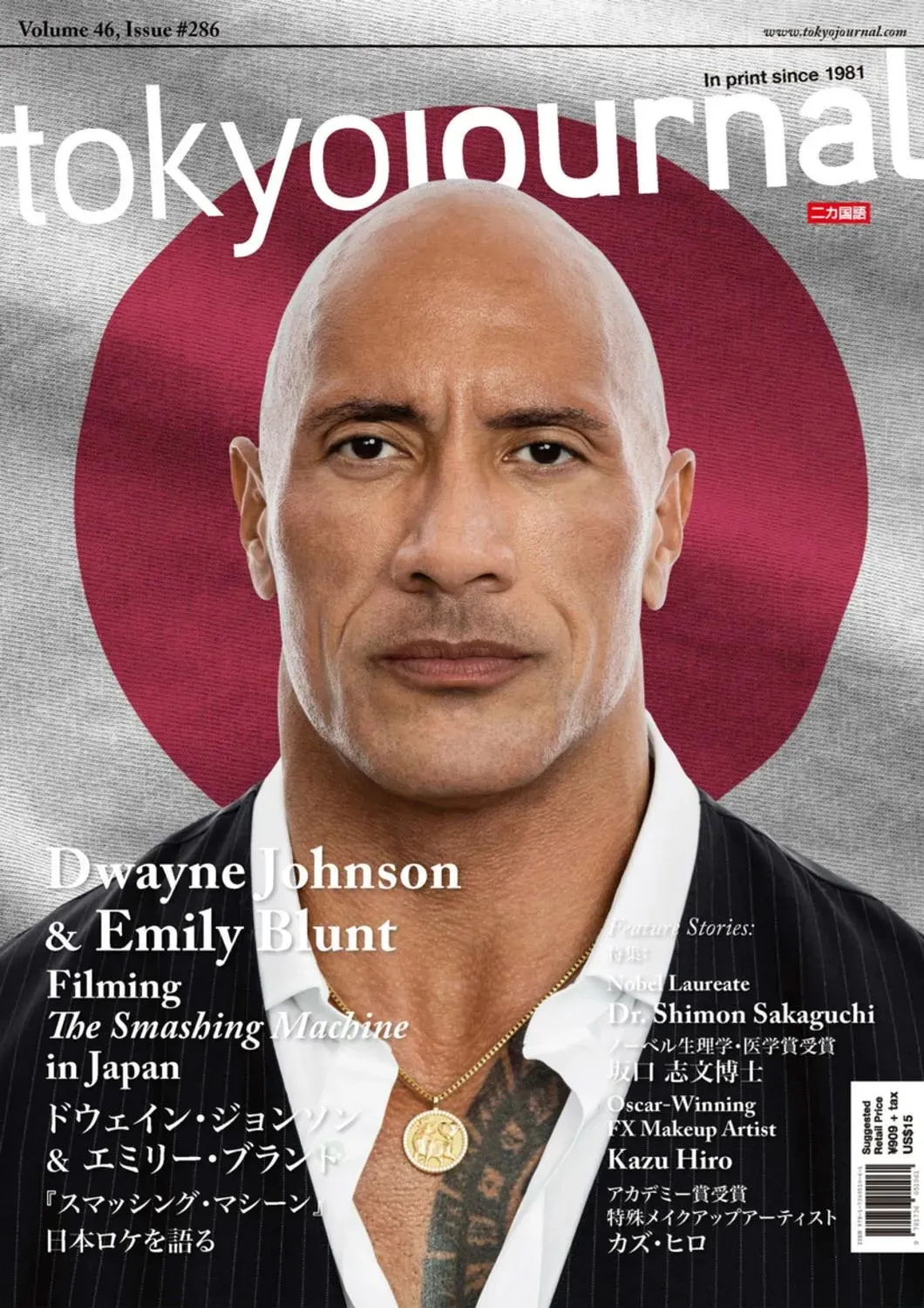
Dwayne Johnson and Emily Blunt filming The Smashing Machine in Japan anchors Issue 286 of Tokyo Journal, a 106-page quarterly that opens with Oscar-winning SFX makeup artist Kazu Hiro and closes with sumo wrestler promotion rituals. Volume 46 Issue 286 spans Hollywood production in Japan, Nara's ancient festivals, autoimmune disease research, and a neurodiversity school in Tokyo.
The feature well runs deep: Kazu Hiro on building the prosthetic for The Smashing Machine; Shogun producer Eriko Miyagawa on connecting Kill Bill to the FX series; a Nara travel special covering the Kasuga Wakamiya Onmatsuri festival, the city's ancient temples, and Kansai fine dining; a Nobel laureate interview with Dr. Shimon Sakaguchi on autoimmune disease and cancer research; Tokyo hotel reviews; a Japan-U.S. leadership summit; and a profile of Japanese saxophonist Harumo Imai. The food section features Iron Chef Masaharu Morimoto's duck ramen and wagyu.
Content Guide
▸ Film & Culture
p.6 · The Making of Kazu Hiro — Academy Award-Winning SFX Makeup Artist
Hiro describes building Johnson's prosthetic for The Smashing Machine. The piece includes a step-by-step breakdown: life cast, clay sculpt, silicone mold, foam latex application, and on-set painting. The full application took 3 hours each filming day. Book a consultation with a local prosthetic artist if you need a silicone piece that fits for less than 4 hours.
p.14 · Shogun Producer Eriko Miyagawa — From Kill Bill to Shogun
Miyagawa traces her career from Tarantino's set to producing the FX historical epic. She explains why Shogun required three language coaches on set at all times. The show's Japanese dialogue coach ran line-readings for 10 hours per day during principal photography.
p.21 · The Smashing Machine — Dwayne Johnson and Emily Blunt in Japan
A production report from the Tokyo shoot. Johnson performed his own fight sequences using a modified judo regimen. The article includes location details for the Tokyo sets. The fight gym set at Toho Studios is now open for studio tours.
▸ Travel / Culture
p.32 · Kasuga Wakamiya Onmatsuri — Nara's Performing Arts Festival
A 12-page spread on the festival that dates to 1136. The article details the costumed procession, the bugaku court dances, and the 800-year-old Noh performances. The festival runs December 15-18 each year. Arrive by 7 a.m. to secure a spot along the procession route near the first torii gate.
p.36 · Nara, Where Ancient and Modern Coexist
A travel feature comparing Nara's ancient temples with its contemporary food scene. The Todai-ji Great Buddha hall is 57 meters wide; the nearby Mizuya coffee shop serves pour-over with beans roasted in Nara Prefecture. Walk from Todai-ji to Kasuga Taisha in 20 minutes through Nara Park; the deer bow for senbei crackers.
p.58 · Fine Hotels and Fine Dining in Kansai
Luxury hotel and restaurant guide for day trips from Osaka or Kyoto to Nara. The feature recommends a kaiseki lunch at a ryokan with a 200-year-old garden. Book the kaiseki lunch 3 days ahead; the chef sources fish from Nara's morning market.
▸ Science & Innovation
p.82 · Nobel Laureate Shimon Sakaguchi — Progress for Autoimmune Disease, Allergy and Cancer Research
The immunologist explains regulatory T-cell therapy in accessible language. His lab's 2026 clinical trial shows Treg therapy reducing type 1 diabetes markers in 14 of 22 patients. The article lists the three hospitals recruiting for Phase 2. Check clinicaltrials.gov for the trial identifier NCT-2026-0415.
p.93 · Redefining Education Through Neurodiversity — Neurodiversity School in Tokyo
A profile of a Tokyo school designed for neurodivergent students. The school uses a 4-day academic week with Friday devoted to outdoor sensory activities. Tuition is 15,000 yen per month, with scholarships available. Request an observation visit on a Friday to see the outdoor program.
p.96 · Inside a Celebration for Promotion to Juryo — A Rikishi's Life
A photo essay following a sumo wrestler's promotion ceremony from makushita to juryo division. The tradition requires the new juryo to wear a keshomawashi apron weighing 12 kilograms. The celebration banquet included 300 guests.
Editor's Take
This is a strong, eclectic issue that earns its 106 pages. The Kazu Hiro prosthetic walk-through and the Sakaguchi Treg therapy interview are both genuinely informative — they give the reader specific knowledge, not just celebrity access. The Nara travel section is overlong at 26 pages; the fine-dining guide could have been cut by half. The neurodiversity school piece is a welcome surprise that broadens the magazine's scope beyond the usual Japan travel-and-food formula. The Imai saxophonist profile at page 106 feels tacked on, as if the editor needed to fill an even page count.
Strengths
• Kazu Hiro's 3-hour prosthetic application sequence with step-by-step detail
• Shimon Sakaguchi Treg therapy clinical trial with specific patient outcomes
• Neurodiversity school feature with tuition and curriculum specifics
Weaknesses
• Nara travel section padded to 26 pages
• Harumo Imai profile reads as a last-minute page filler
Verdict: Recommended — The Kazu Hiro and Sakaguchi articles alone are worth the purchase.
