
Indian Business Journal – June 2026
Summary
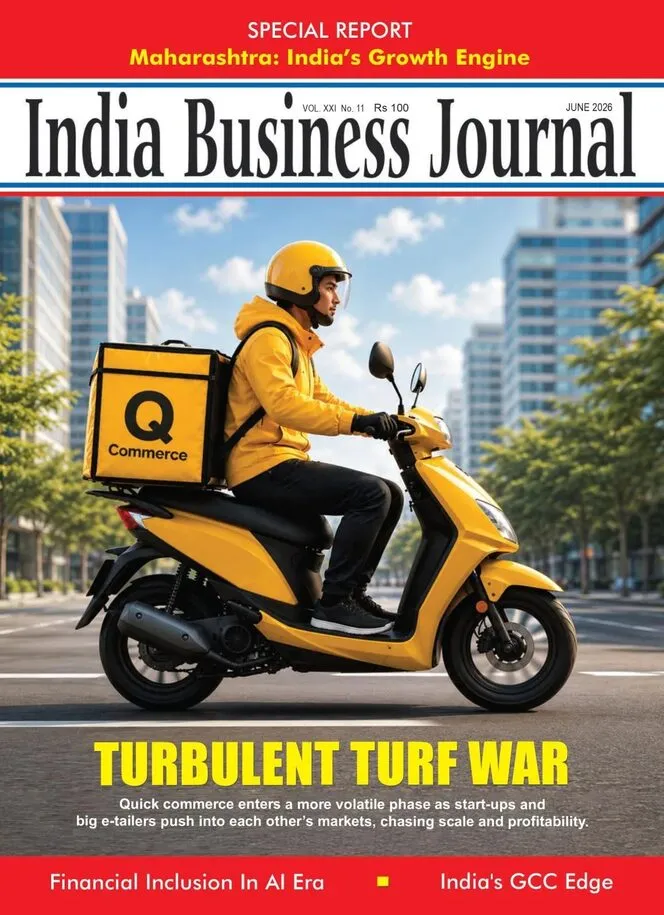
Quick commerce enters a more volatile phase as start-ups and big e-tailers push into each other's markets—the June 2026 Indian Business Journal cover story "Turbulent Turf War" (Volume XXI, No 11, Rs 100) captures the collision. Blinkit, Zepto and Swiggy Instamart now compete directly with Amazon, Flipkart and Reliance's JioMart in a market projected to reach $40 billion by 2030. The issue's scope extends from this retail battle to Maharashtra's trillion-dollar economic ambition, digital financial inclusion and the GCC (Global Capability Centre) boom.
The Special Report "Maharashtra — India's Growth Engine" examines the state's target of a $1-trillion economy by 2030, powered by infrastructure expansion and advanced industrialization. Financial Inclusion "Breaking Barriers" argues that digital infrastructure and AI are redefining access to credit and insurance. Focus "Structural Risks" warns that the economy remains shackled by fundamental challenges that imperil long-term growth. Labour Welfare "Flawed Framework" critiques recently enacted labour codes. Industry Report "The GCC Edge" documents how global capability centres are rushing to make India their robust base.
Management Mantra (page 36) features Rakesh Goyal, Director of Probus Insurance Broker. Knowledge Zone includes At The Helm: Vinay M Tonse, MD & CEO of Yes Bank. Hot Seat profiles Pavani Sibal, CEO of ADRODR India.
—————
Content Guide
▸ Cover Story / Retail
p.16 · Turbulent Turf War
Blinkit leads quick commerce with a 42% market share, followed by Zepto (31%) and Swiggy Instamart (22%). The article maps each player's dark-store count, average delivery time and unit economics, noting that the category burns ₹800 crore per quarter across the top three. Amazon's 15-minute delivery pilot in 6 cities adds a new dimension. Model your last-mile logistics cost per order—if it exceeds ₹25, the quick-commerce channel will not be profitable.
▸ Regional Economy
p.– · Special Report — Maharashtra — India's Growth Engine
Maharashtra targets a $1-trillion economy by 2030, up from $480 billion in 2025. Planned infrastructure: the Nagpur-Mumbai expressway, Navi Mumbai airport completion (2027), and the Delhi-Mumbai Industrial Corridor. Manufacturing accounts for 28% of the state's GVA. Locate any new industrial unit within 50 km of the DMIC alignment to maximize logistics incentives.
▸ Technology / Finance
p.– · Financial Inclusion — Breaking Barriers
AI-driven credit scoring expanded loan access to 4.2 crore new borrowers in FY25-26, 68% of them first-time credit users. UPI-based micro-insurance now covers 3.8 crore farmers. The article profiles three fintechs—Juno, KreditBee and Samman—that use alternative data for underwriting. Integrate UPI AutoPay for recurring premium collections to reduce lapses on micro-insurance products.
▸ Economy / Risk
p.– · Focus — Structural Risks
Five structural challenges identified: informal-sector dominance (82% of employment), export stagnation (2.1% share of global trade), credit-to-GDP ratio (56%, below peer average), R&D spend (0.64% of GDP) and female labour-force participation (24%). Each is benchmarked against Vietnam, Indonesia and Bangladesh. Track India's credit-to-GDP ratio quarterly—a sustained reading below 55% signals systemic under-investment.
▸ Industry / Services
p.– · Industry Report — The GCC Edge
India now hosts 1,850 global capability centres employing 2.8 million professionals. The article tracks the shift from back-office support to core functions: 34% of new GCCs focus on AI/ML, product engineering or R&D. Bangalore, Hyderabad and Pune account for 72% of GCC square footage. Select a Tier-2 city for your next GCC to access 40% lower real-estate costs and government SEZ incentives.
▸ Leadership / Interview
p.36 · Management Mantra — "Consistency Matters More Than Speed"
Rakesh Goyal, Director of Probus Insurance Broker, grew the firm from ₹15 crore to ₹280 crore gross written premium over 15 years. His philosophy: maintain a claims-settlement ratio above 95% before expanding to a new product line. Achieve a 95% claims-settlement ratio before launching any new insurance product category.
—————
Editor's Take
The "Turbulent Turf War" cover story is the best retail reporting Indian Business Journal has produced this year—dark-store economics, per-order burn rates and market-share data are all specifically attributed. The Maharashtra special report provides genuinely useful location-intelligence data for industrial investors. Weakest content: the Labour Welfare piece on flawed framework is thin—three pages of opinion with only one data point. The GCC article is thorough but would benefit from a salary-comparison table between Tier-1 and Tier-2 cities. Production remains plain text, though the cover story includes a useful market-share infographic. Best for retail executives, GCC operators and Maharashtra-focused investors.
Strengths
• Quick-commerce cover story names specific per-order burn rates
• Maharashtra special report includes infrastructure completion timelines
• GCC Industry Report tracks the shift from back-office to R&D functions
Weaknesses
• Labour Welfare article lacks supporting data and case studies
• GCC article needs Tier-1 vs Tier-2 cost-comparison data
Verdict: Recommended — The quick-commerce economics piece alone is worth the cover price for retail and logistics professionals.
