
Business Today – 16 August 2026
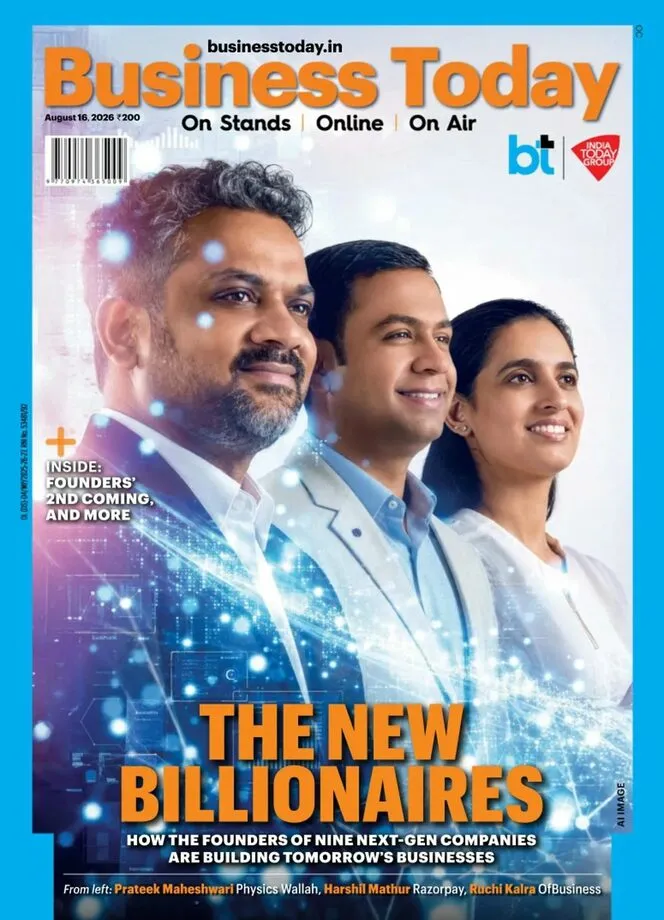
Summary
Nine founders of next-generation Indian companies are building tomorrow's businesses, and the Hurun Global Rich List 2026 shows that India added 28 new billionaires last year — Business Today's August 16, 2026 issue (Vol 35 No 17) tracks the money in "The New Billionaires." Harshil Mathur, co-founder of Razorpay, tells BT that failing is acceptable but being second is not, and the Wealthmakers section examines how India's first-generation consumer internet founders are building again after exits.
The cover story profiles 9 founders from sectors including fintech, space tech, SaaS, and direct-to-consumer brands. Each profile includes the founder's age, company valuation, equity stake, and the key decision that accelerated growth. The Point column analyses the Hurun list fine print: India now has 212 billionaires, with a combined wealth of 950 billion dollars. The Wealthmakers feature tracks 4 founders who sold their first companies and are now building second ventures.
Regular sections include The Point, BT Interview, Cover Story, Wealthmakers, and market analysis.
—————
Content Guide
▸ Cover Story / Entrepreneurship
p.24 · The New Billionaires
Nine next-gen founders are profiled with age, valuation, and equity data. The youngest is 28; the oldest is 41. Combined company valuations exceed 25 billion dollars. The article identifies a common pattern: 7 of the 9 founders built their businesses by serving India's Tier 2 and 3 markets first, then expanding to metros. Venture capitalists can use the profile set to build a pattern-matching framework for early-stage investments.
▸ Interview / Fintech
p.16 · It's Okay to Fail, Never Okay to Be Second
Razorpay co-founder Harshil Mathur discusses the company's transition from payments gateway to full-stack financial services, now processing 5 billion dollars in monthly total payment volume. He explains why Razorpay chose to stay private despite multiple IPO-ready quarters and reveals that the company's SaaS side-product for invoices generates 150 crore rupees in annual revenue. Fintech founders can use Mathur's "second-mover penalty" framework in their competitive strategy documents.
▸ Wealth / Markets
p.10 · Billion-Dollar Club 2026
The Hurun Global Rich List 2026 data shows India added 28 new billionaires, taking the total to 212. Combined wealth of Indian billionaires stands at 950 billion dollars. The article notes that 64 percent of new wealth came from technology and fintech, while traditional manufacturing accounted for only 12 percent. Wealth managers can use the sector breakdown to advise ultra-high-net-worth clients on sector concentration risk.
▸ Entrepreneurship / Second Acts
p.34 · The Second Coming
Four Indian founders who sold their first companies are now building again. The article names the founders, their first exits (totalling 1.8 billion dollars in aggregate), and their new ventures in SaaS, climate tech, and D2C brands. The shortest gap between exit and new venture was 8 months; the longest was 3 years. Angels and incubators can track these repeat founders as high-probability investment targets.
—————
Editor's Take
The New Billionaires cover story fills a genuine gap in Indian business journalism — a systematic, data-backed profile of the next generation of company builders rather than the usual breathless "young entrepreneur" fluff. The Razorpay interview with Harshil Mathur is candid and covers strategy details (5-billion-dollar monthly TPV, 150-crore SaaS revenue) that most founders would not share on record. The Second Coming article on repeat founders is a smart addition. The Hurun list analysis is competent but offers little beyond what the list itself publishes. The issue's weakness is its narrow focus — 80 percent of editorial content is entrepreneurship-oriented, leaving little for readers who want macro or sector coverage.
Strengths
• Nine-founder profile set is a VC's pattern-recognition tool
• Razorpay interview with specific revenue data
• Second-coming founder tracking is a genuinely novel angle
Weaknesses
• Over-indexes on entrepreneurship at the expense of macro content
• Hurun list piece adds limited value beyond the published data
Verdict: Recommended — Essential for early-stage investors and startup founders; general business readers may find the single-topic focus too narrow.
