
The Healthy Mens Handbook – 2nd Edition – 25 June 2026
Summary
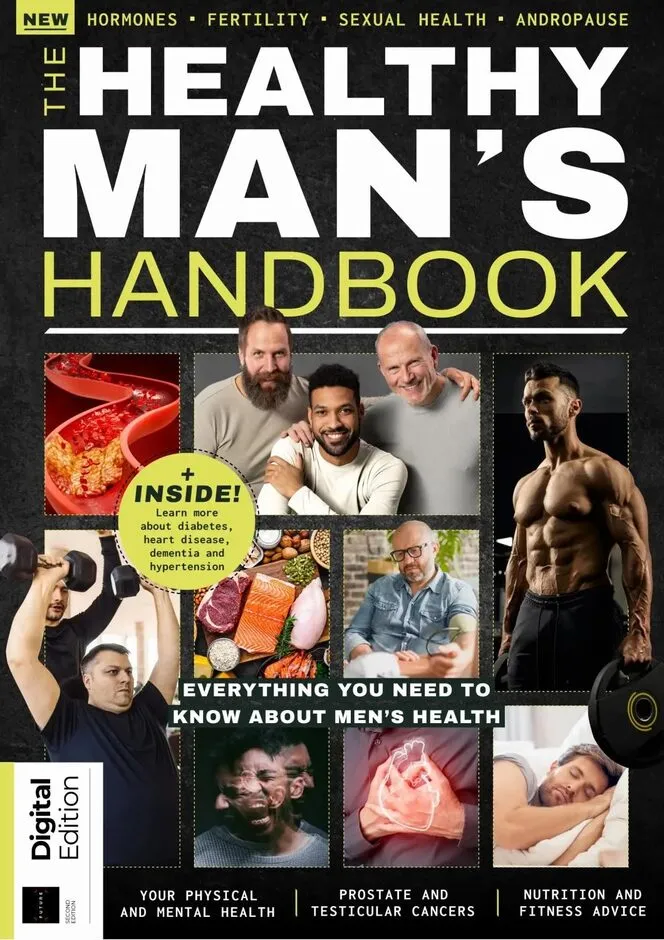
The Healthy Men's Handbook 2nd Edition (25 June 2026, 130+ pages) covers the male body from adolescence through andropause, with chapters on heart health, diabetes, prostate care, sexual health, mental health, fertility, and cancer screening. Taglined "New Hormones · Fertility · Sexual Health · Andropause," it is the publisher's most comprehensive men's health reference and updates the 1st Edition with expanded coverage of testosterone therapy, obesity pharmacology, and inclusive healthcare.
The handbook opens with the male anatomy (p.8) and adolescence and puberty (p.10), covering growth spurts, voice changes, and testicular development. "Key Hormones" (p.16) focuses on testosterone, DHT, and oestrogen's overlooked role in men's bone health. "Understanding Good Health" (p.20) distinguishes between risk-factor management and health optimisation. Heart health (p.26) covers the fact that cardiovascular disease is the leading cause of death for men globally, with specific guidance on blood pressure targets.
The middle section covers obesity (p.36), diabetes (p.40), cardiovascular fitness (p.44), building strength (p.48), and nutrition (p.52). Mental health (p.58) addresses male suicide statistics and barriers to help-seeking. The reproductive section covers reproduction (p.62), sperm health (p.66), erectile problems (p.68), contraception (p.72), fertility (p.74), sexual health (p.78), and libido (p.82). Cancer chapters cover male cancers (p.86), prostate care (p.92), and other cancers (p.108). The later chapters address urinary health (p.96), pancreatic health (p.100), bowel health (p.104), and screenings (p.112). The handbook closes with andropause (p.116), arthritis (p.122), bone health (p.124), Parkinson's (p.126), and dementia (p.128).
—————
Content Guide
p.36 · Living with Obesity
Explains BMI and waist-circumference thresholds, the physiological basis of weight regain, and the role of GLP-1 receptor agonists. A medication table lists semaglutide, tirzepatide, and orforglipron with cardiovascular-outcome data. The chapter normalises obesity as a chronic disease rather than a willpower failure.
p.68 · Erectile Problems
Distinguishes between vascular, neurological, and psychological causes with a self-assessment flowchart. The chapter reviews PDE5 inhibitors (sildenafil, tadalafil) by onset time and duration. Readers learn that erectile dysfunction is often an early marker for cardiovascular disease — a fact many men discover too late.
p.86 · Male Cancers
Covers prostate, testicular, and penile cancers with screening timelines and symptom checklists. The testicular self-exam instructions include diagrams and a recommended monthly schedule. The chapter emphasises that 95% of testicular cancer cases are curable when caught early.
p.112 · Health Screenings and Tests
A by-age table listing blood pressure measurement from age 18, cholesterol from 20, blood glucose from 35, colonoscopy from 45, and prostate-specific antigen discussion from 50. The chapter includes preparation instructions for each test. Men who avoid annual checkups gain a minimum schedule.
p.116 · Andropause
Covers testosterone decline of about 1% per year after age 30, symptom checklists, and the controversy around testosterone replacement therapy. The chapter cites the T Trials showing benefits for sexual function and mood but flags the unresolved cardiovascular-safety question. Balanced guidance on a topic that is often hyped by clinics.
—————
Editor's Take
This is the strongest of the publisher's men's handbooks — the 2nd Edition adds genuine updates on GLP-1 drugs, obesity pharmacology, and inclusive care that the 1st Edition lacks. The andropause chapter is notably balanced, neither dismissing symptoms nor over-promising testosterone as a panacea. The weakness is that the obesity chapter is effectively a GLP-1 advertisement — oral medications are promoted with more enthusiasm than evidence for long-term outcomes. The cancer chapter could use more specific nutrition guidance. Also, the handbook is nearly identical to the other "2nd Edition – June 2026" version (pdf_11); the only difference appears to be the exact publication date (25 June 2026 vs June 2026). For home reference, this is the men's health book to buy. For depth on any single topic, it falls short of a condition-specific resource.
Strengths
• GLP-1 and obesity pharmacology coverage is genuinely updated
• Andropause chapter is balanced, not hype-driven
• Screening schedule is a practical minimum standard for men
Weaknesses
• Obesity chapter reads as promotional for GLP-1 drugs
• Nearly identical to the other 2nd Edition — minor date variation only
Verdict: Selective read — The most current men's health handbook from this publisher, but buyers should verify they are not duplicating content between the two dated 2nd Edition versions.
