
Todays Dietitian – January-February 2026
Summary
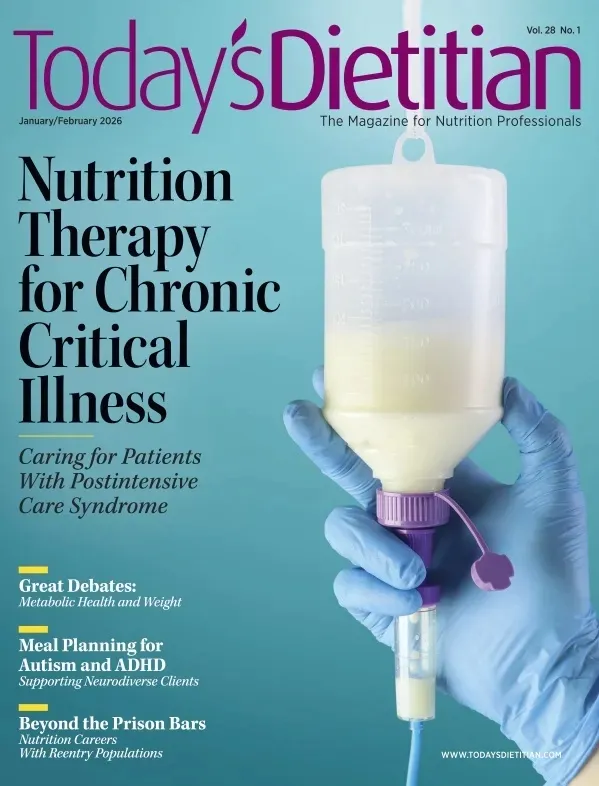
Today's Dietitian Vol. 28 No. 1 opens 2026 with a challenging clinical frontier: "Nutrition Therapy for Chronic Critical Illness — Caring for Patients With Postintensive Care Syndrome" (p.20), addressing the estimated 4 million ICU survivors annually who face muscle wasting, dysphagia, and metabolic dysregulation long after discharge. The January/February 2026 issue also debates metabolic health versus weight-centric care, offers flexible meal-planning frameworks for autism and ADHD, and examines nutrition care for individuals re-entering society after incarceration.
The chronic critical illness feature provides a nutrition assessment algorithm tailored to post-ICU patients who present with fat malabsorption, refeeding risk, and sarcopenia that standard MNT protocols miss. "Great Debates: Metabolic Health and Weight" (p.24) brings together five RDs who argue for and against weight-inclusive care, producing a nuanced framework that neither side wholly wins. "Flexible Meal Planning for Autism and ADHD" (p.28) addresses sensory sensitivities, executive-function barriers, and food selectivity through a low-pressure structure that respects neurodivergent clients' autonomy. "Beyond the Prison Bars: Nutrition Care for Reentry" (p.34) is the issue's most distinctive feature — an investigation into what happens when incarcerated individuals with chronic conditions return to communities with no nutrition safety net.
The CPE Monthly on oncology eating schedules (p.38) explores chrono-nutrition for patients undergoing chemotherapy, complete with a sample meal-timing protocol. "Cultural Foodways" (p.18) examines traditional African diets and their alignment with diabetes guidelines. "Food Service Forum" (p.14) covers menu engineering for post-acute care settings. For RDs working in hospital, outpatient, or public-health roles, this issue asks uncomfortable questions about who gets nutrition care and why.
—————
Content Guide
▸ Cover Story / Critical Care
p.20 · Nutrition Therapy for Chronic Critical Illness
A detailed protocol for assessing the post-ICU patient: indirect calorimetry timing, protein targets above 2.0 g/kg, and strategies for refeeding syndrome prevention in this population. The authors provide a three-phase intervention timeline covering the first 90 days post-discharge. RDs gain a framework for a patient population that lacks standard clinical pathways.
▸ Clinical Debates
p.24 · Great Debates: Metabolic Health and Weight
Five RDs argue the Health at Every Size approach against a structured weight-loss model, with the middle-ground conclusion that metabolic health markers — not scale weight — should drive clinical decisions. The article includes a decision tree for choosing between weight-inclusive and weight-management approaches based on patient comorbidities and readiness. A balanced resource for any RD tired of the either-or debate.
▸ Neurodivergent Nutrition
p.28 · Flexible Meal Planning for Autism and ADHD
An occupational therapist and a dietitian co-author a framework that separates true food selectivity from pathological avoidance. The meal-planning grid uses a "green-yellow-red" food list rather than rigid exchanges, honouring sensory needs while maintaining nutritional adequacy. Practitioners finish with a template they can adapt for any neurodivergent client.
▸ Social Justice / Public Health
p.34 · Beyond the Prison Bars: Nutrition Care for Reentry
A 6-page exploration of the nutrition challenges facing formerly incarcerated individuals, many of whom enter the community with diabetes, hypertension, or HIV managed inside prison but without continuity of care. The authors interview RDs working in reentry programs and list three policy changes that could improve outcomes. Essential reading for any dietitian who thinks social determinants of health stop at the cell door.
p.38 · CPE Monthly: Trends in Oncology Nutrition — Eating on a Schedule
A review of chrono-nutrition research showing that timing carbohydrate intake around chemotherapy cycles may reduce nausea and maintain lean mass. The CE course includes a sample patient diary and a meal-timing algorithm for 5-FU and platinum-based regimens. Practitioners earn 2 CE credits and a novel clinical tool simultaneously.
▸ Regulars
p.18 · Cultural Foodways — West African Nutrition Traditions
A column that connects traditional Nigerian and Ghanaian ingredients — egusi, garden eggs, moringa — to current diabetes and hypertension guidelines. The author includes a sample one-day West African meal plan that meets AHA sodium targets. Perfect for RDs working with West African diaspora communities.
—————
Editor's Take
This is the most intellectually ambitious issue of Today's Dietitian in recent memory. The chronic critical illness protocol fills a gap that most critical-care RDs know exists but lack the training to address. The prison-reentry feature is the kind of article that changes how a reader thinks about their profession — it's uncomfortable, evidence-based, and actionable. The neurodivergent meal-planning piece is equally strong, giving RDs who feel out of their depth with ASD/ADHD clients a concrete framework. The weakness is "Food Service Forum," which offers generic menu-engineering advice that feels decades old compared to the rest of the issue. And the metabolic health debate, while well-structured, reaches a middle ground that neither side will cite. Still, an issue that takes on post-ICU care, carceral nutrition, and neurodiversity in one package is rare.
Strengths
• Post-ICU nutrition protocol fills a real clinical void
• Prison-reentry feature is bold, necessary, and actionable
• Neurodivergent meal-planning framework is genuinely novel
Weaknesses
• Food Service Forum column feels dated and out of place
• Metabolic health debate lands on a predictable middle ground
Verdict: Essential — The most socially and clinically ambitious issue of 2026, with three features that expand what RDs should be expected to know.
