
Scientific American – October 2026
Summary
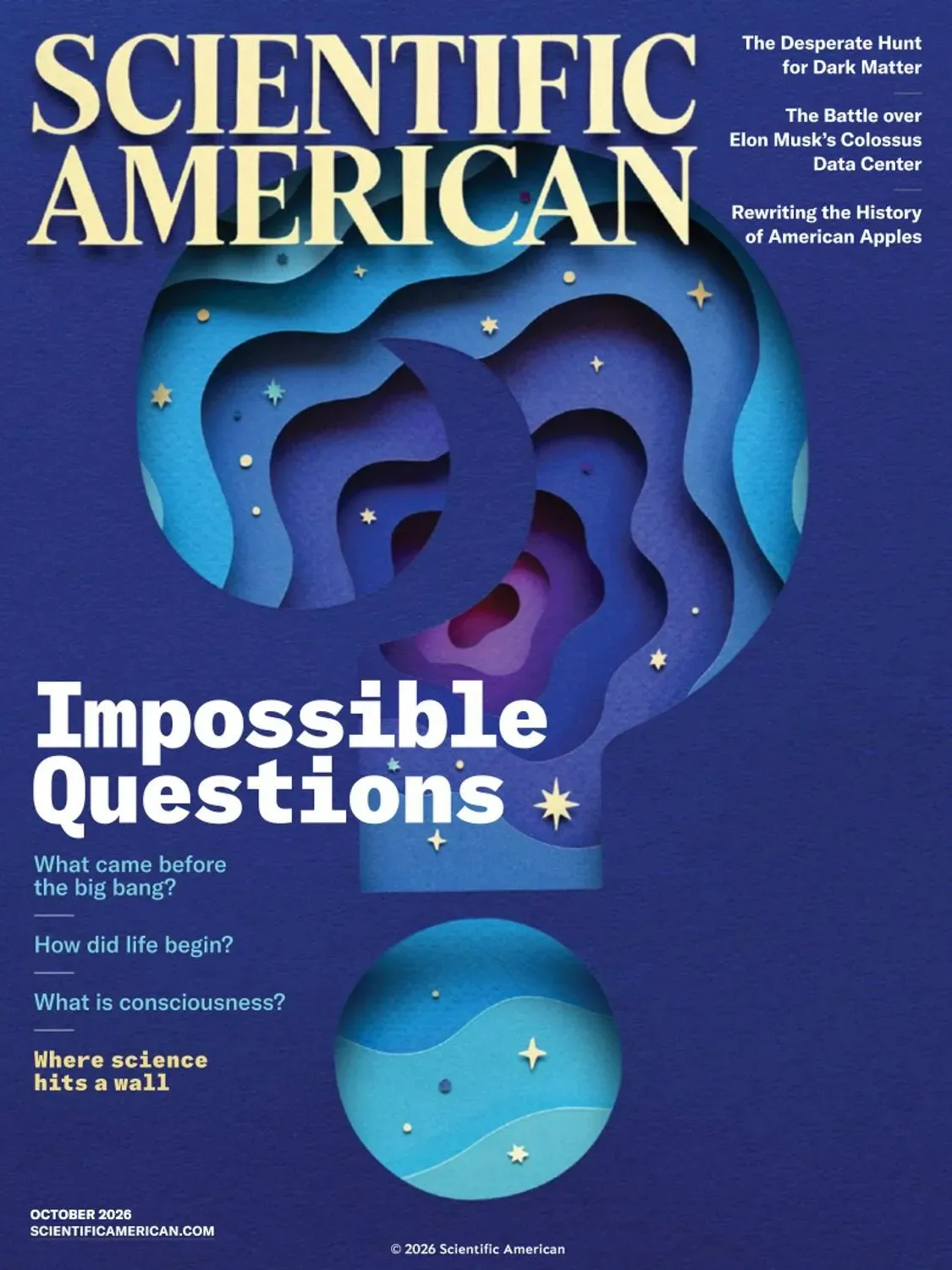
Scientific American's October 2026 issue (Vol. 335 No. 3) tackles seven questions that may be unanswerable — from the origin of life to what came before the Big Bang — in a special report spanning pages 28 to 58 with cover art by Owen Gildersleeve. Sarah Scoles leads the package, writing both the introduction and the cosmology finale. Philosopher Tim Bayne asks whether consciousness is even real, given that studying it requires the faculty it is trying to explain.
The "Impossible Questions" package covers biology (how did life begin?), health (how long could humans live?), particle physics (what is dark matter?), physics (what are the smallest pieces of the universe?), mind (what is consciousness, really?), and cosmology (what came before the Big Bang?). Venki Ramakrishnan on longevity limits and Joseph Howlett on dark matter are standouts. Maryn McKenna's "The Mystery Tree" on page 62 follows amateur apple-hunters who rewrote the history of American apples. Austyn Gaffney's "Feeding Colossus" on page 72 documents SpaceXAI's private power system built across two states to fuel its data centres.
The editor's column notes that GLP-1 obesity drugs emerged from research on Gila monster starvation survival, and that alchemists' failed quest for gold gave us modern chemistry. The industry column covers the battle over Elon Musk's Colossus data centre.
—————
Content Guide
▸ Special Report: Impossible Questions / Agriculture / Energy / Departments
p.28 · Impossible Questions (Introduction)
Sarah Scoles frames the special report: some scientific questions persist because they may be beyond the capacity of the human brain to solve, not because we lack technical tools. The goal is not answers but better questions.
p.32 · How Did Life Begin?
Sarah Scoles examines RNA-world theory, soda-pond chemistry, and the question of ultimate origin. The Miller-Urey experiment demonstrated amino-acid formation in 1953, but nobody has yet assembled a self-replicating protocell from scratch under plausible early-Earth conditions.
p.38 · How Long Could Humans Live?
Venki Ramakrishnan argues that longevity has a hard ceiling near 120 years based on telomere biology and cellular senescence data. The current record stands at 122 years, set by Jeanne Calment in 1997.
p.44 · What Is Dark Matter?
Joseph Howlett reports that more physicists than ever think we may never identify dark matter's constituent particle. The failure of LUX-ZEPLIN and XENONnT to detect WIMPs has pushed the field toward alternative theories like Modified Newtonian Dynamics.
p.54 · What Is Consciousness, Really?
Tim Bayne asks whether our concept of consciousness itself is fundamentally flawed. He points to anaesthesia research: the same drugs that keep patients safely unconscious have refined our understanding of what consciousness requires.
p.62 · The Mystery Tree
Maryn McKenna tracks amateur apple hunters who identified a forgotten 19th-century orchard variety and, in doing so, rewrote the history of American apple cultivation. DNA analysis proved the tree predated known commercial nurseries by 40 years.
p.72 · Feeding Colossus
Austyn Gaffney reports that SpaceXAI assembled its own private power system across two states to fuel AI data centres, building ahead of permits and next to residents who live with the noise and exhaust. The system draws 150 megawatts at peak demand.
p.90 · Q&A: Why Nuclear War May Keep Humanity From a "Theory of Everything"
Lee Billings interviews physicists who argue that a full-scale nuclear exchange would destroy the large-scale experimental infrastructure — particle colliders, neutrino observatories — needed to probe fundamental physics.
—————
Editor's Take
The "Impossible Questions" framing is a clever editorial device because it relieves each writer of the burden to produce a tidy conclusion. Venki Ramakrishnan's longevity piece and Joseph Howlett's dark-matter feature are the strongest entries — both commit to a position (the ceiling is real; the WIMP is dead) rather than hedge. The real-world discoveries that emerged from impossible-seeming questions (GLP-1 drugs, transcendental numbers) are threaded through the editor's note with genuine surprise. Weakness: the two non-package features — McKenna's apple tree and Gaffney's data centre — are excellent pieces but feel orphaned outside the special report. Best for readers who enjoy meta-science over disciplinary deep dives.
Strengths
• Ramakrishnan makes a controversial longevity-claim with telomere data
• Howlett's dark-matter agnosticism is honest about the field's crisis
• Anaesthesia-consciousness link in Bayne's piece is genuinely novel
Weaknesses
• Apple-tree feature belongs in a separate food-science issue
• Data-centre piece is too short for the complexity of its subject
Verdict: Essential — The special report alone is worth the price; a rare issue that rewards reading cover to cover.
