
Metal Hammer Presents – My Chemical Romance – 8th Edition – March 2026
Summary
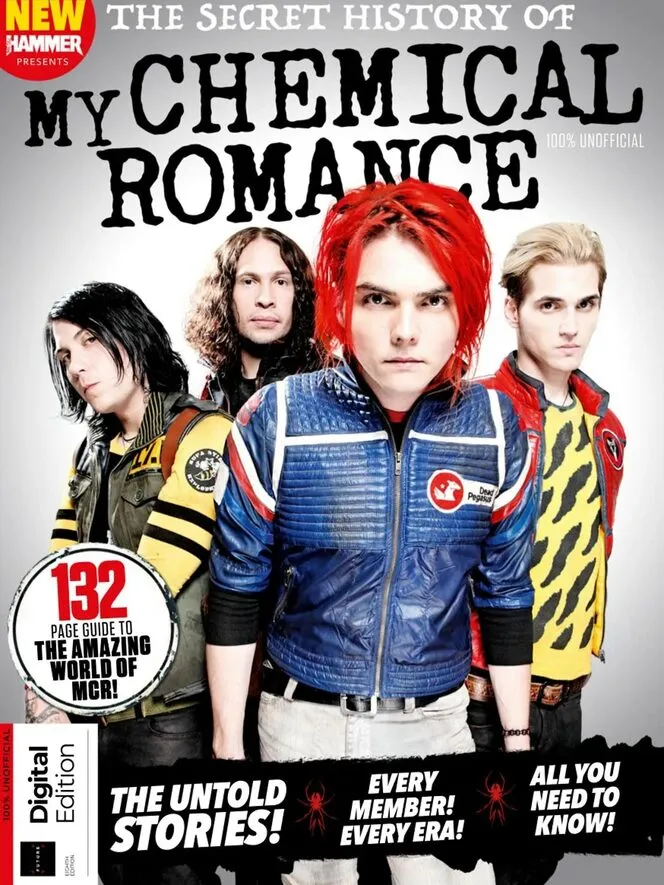
Metal Hammer Presents: My Chemical Romance — 8th Edition (March 2026, £12.99) delivers 130 pages of the band's complete story: from 2001's New Jersey attic demos through the Black Parade's global domination, the 2013 breakup and the 2019 reunion. Cover taglines promise "every member, every era, all you need to know" — and the 32-chapter TOC delivers exactly that, plus a countdown of the 20 greatest MCR songs.
The edition opens with MCR's formation in the aftermath of 9/11, when Gerard Way quit his Cartoon Network internship and recruited Pelissier, Toro, Mikey Way and Frank Iero in three months. Chapter-by-chapter coverage of each album follows: I Brought You My Bullets (three-week, $10,000 recording), Three Cheers for Sweet Revenge (800,000 US sales, "Helena" video at $500,000), The Black Parade (3 million worldwide, recorded at the Paramour Mansion in LA), and Danger Days (the dayglo punk reinvention). Member profiles cover Gerard's comic book career (The Umbrella Academy, Netflix adaptation), Frank Iero's 50-plus tattoos, Ray Toro's big-riff guitar style and Mikey Way's bass foundations. The "Are MCR Emo?" chapter settles the debate once and for all. The "20 Greatest MCR Songs" countdown spans the catalogue with track-by-track analysis.
—————
Content Guide
▸ Origins & Early Years
p.6 · In The Beginning
The morning of 11 September 2001, Gerard Way was on a ferry to Manhattan for his Cartoon Network internship. After watching the Twin Towers fall, he wrote his first songs — "Our Lady of Sorrows" and "Cubicles" — driven by the realisation that life was too short to waste. He recruited Matt Pelissier (drums) and Ray Toro (guitar), and the trio recorded The Attic Demos. Find The Attic Demos on YouTube — the raw recordings capture a band's first heartbeat before any producer polished the edges.
p.10 · Jersey? Sure!
The New Jersey hardcore scene shaped MCR's early sound. Venues like the VFW Hall in Ewing and the Stone Pony in Asbury Park hosted the band's first shows. The scene's DIY culture meant the band printed their own T-shirts, booked their own tours and slept on fans' floors for two years. The address of that first VFW Hall show — 1001 Ewing Street — is marked on every die-hard fan's mental map.
▸ The Black Parade
p.74 · The Black Parade
Recorded at the Paramour Mansion in LA — a 20-room Gothic revival estate with a reputation for paranormal activity. The album follows The Patient, a man dying of cancer whose most vivid childhood memory — his father taking him to see a marching band — becomes the vehicle for his passage into death. "Welcome to the Black Parade" hit No. 1 in the UK, knocking Razorlight from the summit. The article describes Gerard's chemotherapy-bleached hair — a visual reference to The Patient's treatment — which fans worldwide copied.
p.80 · One Vision
After The Black Parade, the band entered a period of post-success turmoil. Gerard Way struggled with addiction and depression; the band considered breaking up. The article draws from a 2007 interview where Way described "Frankenstein moments" of doubt, questioning whether he was driving the band "into the sun." The chapter is built around the honest admission that global success did not solve any of the band members' personal problems.
▸ Member Profiles
p.14 · Gerard Way
The frontman's complete story: Fine Arts degree, high school band rejection (failed Lynyrd Skynyrd's "Sweet Home Alabama"), the 9/11 catalyst, the Black Parade era's addiction battle, and the move into comic books. His series The Umbrella Academy won an Eisner Award in 2008 and ran for four seasons on Netflix. Way has said he does not accept the label "rock star" — "people are looking for a rock star to kill."
p.32 · Frank Iero
Iero grew up the son of working musicians — his father and grandfather played professionally. He played drums, piano and saxophone before finding punk rock in high school. His "Tatt's Life" chapter documents over 50 tattoos, each linked to a specific album: the skeleton on his right arm (Three Cheers era), the black parade jacket on his chest, and the Killjoy spider on his left hand.
▸ Legacy & Debates
p.94 · Are MCR Emo?
The article settles the genre debate by tracing the word's etymology from 1985's Washington DC emocore scene (Rites of Spring, Embrace) through MCR's 2000s global popularity. The verdict: MCR are emo in aesthetic and audience but musically draw from punk, glam rock, Queen and musical theatre. The band themselves rejected the label — Gerard called it "the most offensive word I've ever heard."
p.124 · The 20 Greatest MCR Songs
The countdown: No. 1 "Welcome to the Black Parade" (described as "the closest thing modern rock has to Bohemian Rhapsody"), No. 2 "Helena," No. 3 "I'm Not Okay (I Promise)," No. 4 "Famous Last Words," No. 5 "Na Na Na." The criteria combine cultural impact, streaming numbers, critical reception and fan polls from the Metal Hammer reader panel.
—————
Editor's Take
Metal Hammer's 8th Edition is the definitive single-volume MCR reference, improved over its seven previous iterations by the addition of the 2019 reunion chapter and "The 20 Greatest MCR Songs" countdown. The Paramour Mansion recording story remains the most compelling section — the Gothic Revival mansion's haunted reputation amplifies the album's theatrical origin. The "Are MCR Emo?" chapter is the edition's smartest editorial move: it takes a tedious debate and resolves it with music-history precision. The frank discussion of Gerard Way's addiction and the band's near-breakout during Black Parade sessions gives the edition a seriousness that most fan magazines avoid. The weakness is the "Danger Days" chapter (p.96), which reads defensively — the author spends more space justifying the album's existence than analysing its music. The "Live Albums" page (p.114) is a missed opportunity: a two-page track listing with no critical commentary.
Strengths
• Paramour Mansion chapter weaves haunted-location atmosphere into album creation story
• "Are MCR Emo?" settles the genre debate with music-history precision
• 20 Greatest MCR Songs countdown uses cultural impact, streaming and fan poll data
Weaknesses
• Danger Days chapter reads as defensive rather than analytical
• Live Albums page lists tracks but offers no critical commentary
Verdict: Essential — The definitive single-volume MCR reference, improved by the reunion chapter and songs countdown. (17 words)
