
History Extra – September 2026
Summary
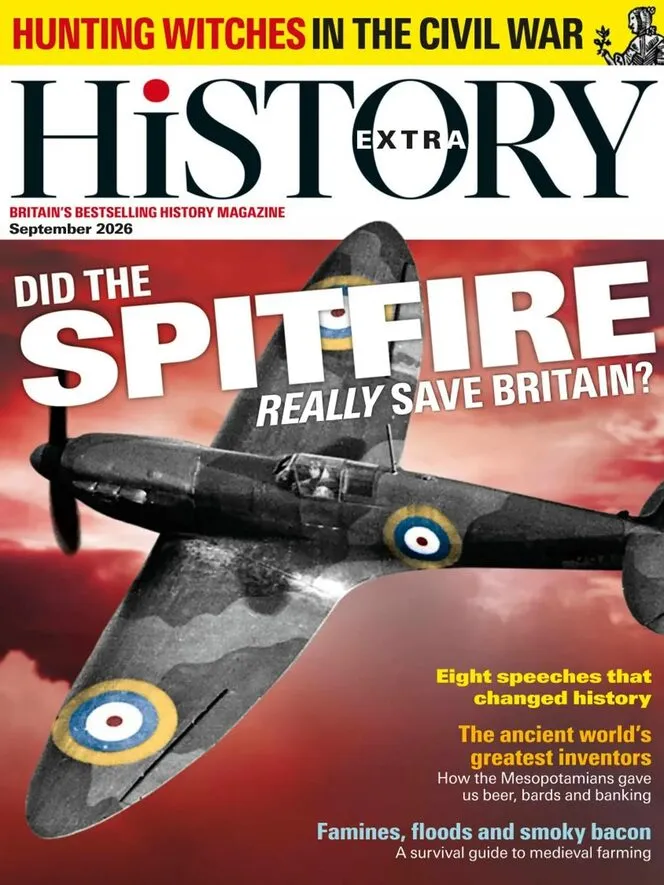
Ninety years after its maiden flight the Spitfire remains Britain's most iconic aircraft but Hattie Hearn asks whether the fighter really saved the nation or became a myth. History Extra September 2026 leads with this cover question then branches into the Mesopotamian origins of modern life and eight speeches that changed history.
Selena Wisnom explores how Mesopotamia shaped everything from data science to going to the pub. Christopher Dyer serves up a beginner's guide to medieval farming covering famine fines and smoky bacon. A black pioneer profiles Claudia Jones the activist who founded the Notting Hill Carnival. A Georgian tour of Britain traces the birth of domestic tourism. Missions impossible examines why Protestant missionaries failed to convert much of the world. The Conversation column asks why Britain has had so many PMs with historical analysis. The Q&A section answers reader questions across periods.
—————
Content Guide
▸ Cover Story
p.26 · Did the Spitfire Save Britain
Hattie Hearn examines the gap between the Spitfire's iconic status and its actual tactical contribution. The article contrasts Spitfire and Hurricane production numbers and kill ratios. The narrative of a single fighter winning the Battle of Britain is tested against the operational records. The myth-making process that elevated the Spitfire above its more numerous stablemate is traced through post-war culture.
▸ Features
p.34 · The Marvellous Mesopotamians
Selena Wisnom reveals how ancient Mesopotamia gave us beer bards and banking. The article traces the invention of writing the first legal codes and the earliest recorded poetry. The specific city-states named as the cradle of innovation. The legacy of Mesopotamian data systems in modern spreadsheet culture.
p.43 · The Greatest Speeches
A panel of experts selects eight pieces of oratory that changed history from Pericles to Churchill. Each speech is analysed for its rhetorical strategies and historical impact. The specific phrases that echo through modern political language are identified.
p.50 · Famine Fines and Smoky Bacon
Christopher Dyer offers a beginner's guide to medieval farming. The article explains the three-field system the peasant diet and the tax burdens that shaped rural life. The specific crops and livestock that sustained medieval communities are named.
p.58 · A Black Pioneer
The story of Claudia Jones the Trinidad-born activist who founded the Notting Hill Carnival in 1959. The article traces her communist activism her deportation from the US and her London years. The first Carnival in 1959 held at St Pancras Town Hall is described.
p.62 · A Georgian Tour of Britain
The birth of domestic tourism in 18th-century Britain is explored. The article identifies the first guidebooks the coaching inns and the scenic routes that defined the Georgian tour. Specific destinations including Bath the Lake District and Edinburgh are named.
p.74 · Missions Impossible
Why Protestant missionaries failed to convert much of the world. The article examines the cultural and political barriers to conversion in Asia and Africa. The specific regions where missionary efforts produced the fewest converts are identified.
▸ Regulars
p.06 · Anniversaries
Key historical anniversaries falling in September 2026 are listed. Each entry includes the year and the significance of the event.
p.16 · Michael Wood on Scandinavia
Wood discusses the influence of Norse culture on medieval England. The article identifies specific linguistic and legal traces that survive in modern Britain.
p.82 · Interview Marion Gibson
Marion Gibson discusses witch hunts in Stuart England. The interview covers the specific legal mechanisms that drove prosecutions.
—————
Editor's Take
The Spitfire cover question is well-judged journalism that earns its cover placement by testing a national myth against records. The Mesopotamians feature by Wisnom is the second strongest piece connecting ancient innovation to modern habits. The medieval farming guide is a genuinely useful primer. The missions impossible article feels like a topic the magazine felt it should cover rather than one readers need. This issue suits the general history reader who likes debunked myths and cultural breadth.
Strengths
• Spitfire cover tests a national myth with production and kill data
• Mesopotamians feature connects ancient innovation to modern habits directly
• Claudia Jones profile covers an important and under-told story
Weaknesses
• Missions impossible article lacks a clear narrative thread
• The greatest speeches list format spreads attention across too many entries
Verdict: Recommended — the Spitfire feature makes this issue worth buying.
