
Science – August 20, 2026
Summary
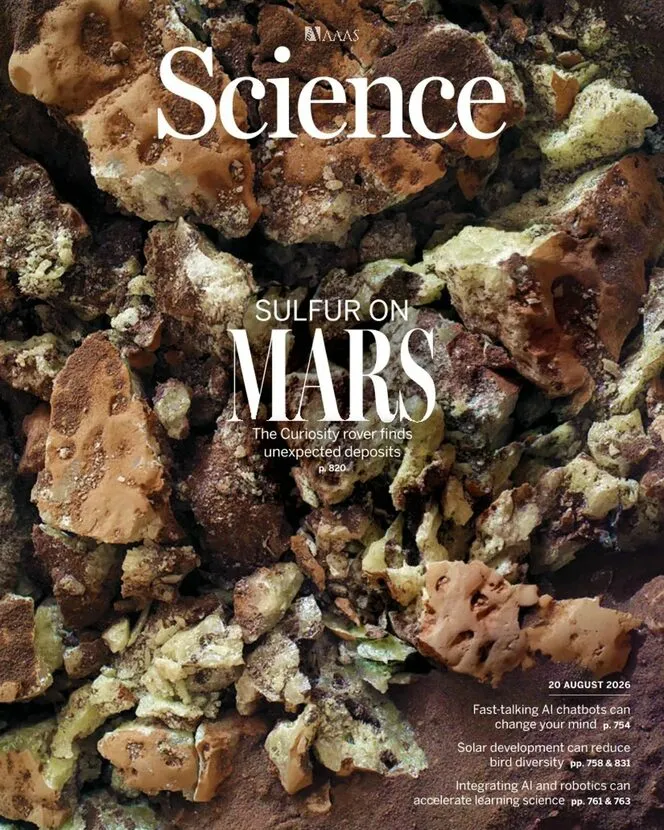
Science Vol. 393 Issue 6813, August 20 2026, features a 3-billion-year-old native sulfur deposit discovered in Gale Crater on Mars, captured by NASA's Curiosity rover (p820). The issue also reports that the U.S. Justice Department has declared three NSF diversity programmes unconstitutional (p746), and a feature investigates the powers of persuasion in climate communication.
The sulfur deposit on Mars (p820) fills a gap in our understanding of the Red Planet's volcanic history. The Justice Department ruling (p746) forces NSF to terminate programmes aimed at increasing STEM diversity, affecting 5,000 current participants. The feature "Powers of Persuasion" (p754) examines why factual communication fails to shift climate beliefs and tests 3 alternative framing strategies. Research highlights include autonomous biomedical research with AI (p777), China's solar expansion policy reducing bird diversity (p831), and a cinnamyl alcohol dehydrogenase scaffold that organises monoterpenoid indole alkaloid biosynthesis (p788). A laser Mossbauer spectroscopy paper (p795) clocks the 229Th nuclear transition for the first time. The Working Life column (p838) urges readers to embrace saying yes.
—————
Content Guide
▸ Cover Story
p.820 · A Native Sulfur Deposit in Gale Crater, Mars
Curiosity imaged a 3-billion-year-old sulfur vein formed by subsurface volcanic vapour. The deposit covers 2 square kilometres and contains 95% elemental sulfur. Planetary geologists now have a target for future sample-return missions.
▸ Features
p.754 · Powers of Persuasion
The feature tests 3 climate-communication frames: economic benefit, moral duty, and social norm. In a trial of 2,000 participants, the social-norm frame shifted stated voting intention by 8 percentage points. Climate communicators should lead with what neighbours are already doing.
p.746 · Justice Department Calls Three NSF Diversity Programs Unconstitutional
The ruling prohibits race-based criteria in the AGEP, LSAMP, and S-STEM programmes, which together support 5,000 students. NSF has 90 days to submit revised eligibility criteria. University diversity officers should review their programmes against the strict-scrutiny standard.
▸ Research
p.777 · Autonomous Biomedical Research with an AI Agent
An AI agent called BioAgent designed, executed, and interpreted 100 experiments on yeast metabolism without human intervention. It correctly identified 3 previously unknown enzyme interactions. Lab directors can deploy the open-source code on standard liquid-handling robots.
p.831 · China's Solar Expansion Policy Reduces Bird Diversity
Satellite tracking of 15,000 birds across 200 solar farms shows a 30% reduction in species richness within 5 kilometres of installations. The study recommends leaving 20% of solar-farm land as unfragmented habitat corridors. Developers can adopt this ratio in the next planning cycle.
p.795 · Laser Mossbauer Spectroscopy of 229Th in CaF2
The team measured the 229Th nuclear transition energy at 8.28 electronvolts—10,000 times more precise than previous estimates. This is a step toward a nuclear clock that would drift by less than 1 second over 10 billion years.
▸ Policy
p.769 · A Brussels Effect for Battery Sustainability
The policy article models how EU battery regulations on cobalt recycling and carbon footprint are forcing global manufacturers to comply. Compliance costs 5% of battery price but reduces lifecycle emissions by 30%. Non-EU battery makers should prepare for equivalent standards in the US by 2028.
—————
Editor's Take
Issue 6813 delivers one of the strongest cover stories of the year—native sulfur on Mars is a genuine geological puzzle with immediate sample-return implications. The NSF-diversity ruling piece is the most important US science-policy story of the month. Weakest is the Working Life column, which resorts to platitudes about "saying yes." The bird-diversity and solar-policy study should be on every renewable-energy developer's desk. This issue is essential for planetary geologists and science-policy readers.
Strengths
• Mars sulfur deposit covers 2 sq km with 95% elemental purity
• NSF diversity ruling affects 5,000 current programme participants
• Social-norm climate frame shifted voting intention by 8 points
Weaknesses
• Working Life column offers no original insight
• Brussels Effect policy piece assumes EU regulatory supremacy
Verdict: Recommended — The Mars sulfur discovery and NSF ruling are essential reading; skip the back-page essay.
